Sony PSPgo vs Valve Steam Deck OLED
Better figure, where one is clearly better
| SonyPSPgo | ValveSteam Deck OLED | |
|---|---|---|
| Overview | ||
| Released | October 2009 | November 2023 |
| Performance | ||
| Type | Handheld | Handheld |
| CPU | Sony PSP CPU, 1–333 MHz | AMD Zen 2, 4 cores / 8 threads |
| GPU | – | AMD RDNA 2, 8 CUs |
| GPU compute | – | 1.6 TFLOPS |
| Memory | 64 MB | 16 GB (better) |
| Storage | 16 GB | 512 GB, 1 TB (better) |
| Disc drive | No | No |
| CPU | – | 6 nm AMD APU; Zen 2, 4 cores / 8 threads, 2.4–3.5 GHz (up to 448 GFlops FP32); APU power 4–15 W |
| GPU | – | 8 RDNA 2 compute units at 1.6 GHz (1.6 TFlops FP32) |
| Memory detail | 64 MB (Sony's PSP-N1000 specification) | 16 GB LPDDR5 on-board, 6400 MT/s, quad 32-bit channels |
| Storage detail | 16 GB of built-in flash memory; games are downloaded, with no UMD drive | NVMe SSD |
| Storage expansion | Memory Stick Micro (M2) slot | High-speed microSD slot (UHS-I; SD, SDHC and SDXC) |
| Display and video | ||
| Maximum output | – | 8K up to 120 fps |
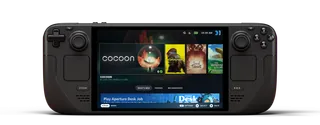
| Built-in screen | 3.8″ LCD, 480 × 272 | 7.4″ OLED, 1280 × 800, 90 Hz |
| Built-in screen | 3.8-inch TFT LCD, 16:9, approximately 16.77 million colours; sliding screen | 1280 × 800 HDR OLED touchscreen; 1,000 nits peak (HDR), 600 nits (SDR); contrast over 1,000,000:1; 110% P3; under 0.1 ms response; dual ambient light sensors. 1 TB model has premium anti-glare etched glass |
| Video output | Analogue video output through the multi-use connector with a separately sold PSPgo cable or cradle; PSP-2000/3000 video cables and older cradles are incompatible | DisplayPort over USB-C; up to 8K at 60 Hz or 4K at 120 Hz |
| HDR | – | HDR on the built-in OLED screen |
| Audio | Built-in stereo speakers and microphone; headset and microphone connector | Stereo speakers with embedded DSP; dual microphone array; 3.5 mm headset jack; multichannel audio over DisplayPort, USB-C or Bluetooth |
| Design and power | ||
| Battery life (maker's claim) | – | Up to 12 hours |
| Weight | 158 g (better) | 640 g |
| Battery life detail | Built-in lithium-ion battery; Sony's launch specification does not publish capacity or runtime | 50 Wh; 3–12 hours of gameplay depending on content |
| Power use | AC adapter or USB charging | 45 W USB PD 3.0 power supply with 2.5 m cable |
| Size | Approximately 128 × 16.5 × 69 mm, excluding the largest projection (Sony labels these width × height × depth) | – |
| Colours | Piano Black and Pearl White | – |
| In the box | AC adapter, USB cable and CD-ROM with Media Go software (launch package) | Steam Deck OLED, 45 W power supply, carrying case (with removable liner on the 1 TB model) |
| Connections | ||
| Ports | Hi-speed USB 2.0 through the proprietary multi-use connector, which also carries DC power, analogue video and sound input/output; headset and microphone connector; Memory Stick Micro slot | 1 × USB-C (DisplayPort over USB-C, USB 3 Gen 2, charging), 3.5 mm headset jack, microSD slot |
| Wi-Fi and Bluetooth | Wi-Fi IEEE 802.11b, infrastructure and ad hoc modes (up to 16 consoles); Bluetooth 2.0 + EDR with A2DP, HSP and AVRCP profiles | Tri-band Wi-Fi 6E (2.4, 5 and 6 GHz, 2 × 2 MIMO), Bluetooth 5.3 |
| Controller | Built-in D-pad, analogue nub, four face buttons, L/R, Start, Select and PS buttons; compatible DUALSHOCK 3 and SIXAXIS controllers require a PS3 for pairing, with some buttons and vibration unsupported | Built-in controls with A/B/X/Y, D-pad, analogue triggers, bumpers, 4 assignable grip buttons, 2 full-size analogue sticks with capacitive touch, 2 × 32.5 mm square haptic trackpads, HD haptics and a 6-axis gyro |
| Backward compatibility | Supported downloadable PSP games and PS one Classics; no UMD games or films. Sony ended remaining PSP purchases on 6 July 2021, but previously purchased PSP content can still be downloaded from the device's Download List (PlayStation UK support) | Runs Steam games natively on SteamOS 3 or through Proton; KDE Plasma desktop mode |
More comparisons
- MSI Claw 8 EX AI+ vs Valve Steam Deck OLED
- ASUS ROG Xbox Ally X vs Valve Steam Deck OLED
- MSI Claw A8 vs Valve Steam Deck OLED
- Nintendo Switch 2 vs Valve Steam Deck OLED
- Lenovo Legion Go S (8″, 1) vs Valve Steam Deck OLED
- MSI Claw 7 AI+ vs Valve Steam Deck OLED
- Sony PlayStation 5 Pro vs Sony PSPgo
- ASUS ROG Ally X (2024) vs Valve Steam Deck OLED
- MSI Claw A1M vs Valve Steam Deck OLED
- ASUS ROG Ally (2023) vs Valve Steam Deck OLED
- Lenovo Legion Go (2023) vs Valve Steam Deck OLED
- Sony PlayStation Portal vs Valve Steam Deck OLED
- Valve Steam Deck LCD vs Valve Steam Deck OLED
- Sony PlayStation Portal vs Sony PSPgo
- Sony PlayStation 5 Slim vs Sony PSPgo
- Sony PlayStation 5 vs Sony PSPgo