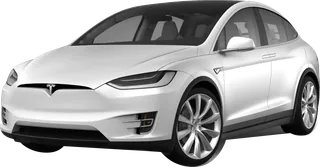
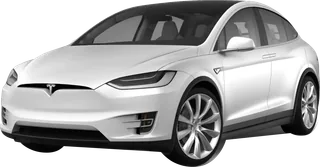
Tesla Model X (2015) vs Tesla Model X (2019)
Better figure, where one is clearly better
| TeslaModel X (2015) | TeslaModel X (2019) | |
|---|---|---|
| Overview | ||
| Released | September 2015 | 2019 |
| Performance | ||
| Powertrain | Electric | Electric |
| Power | 329–532 bhp | – |
| 0–62 mph | 3.1–6.2 s | 2.9–4.8 s (better) |
| Top speed | 130–155 mph | 155 mph |
| Engine or motors | Liquid-cooled AC induction motors at the front and rear, as specified in Tesla’s original European owner guide. The guide’s separate motor maximum ratings are not added together as combined output. Exact EV Database European listings give 245 kW (60D/75D), 311 kW (90D/100D), 345 kW (P90D) and 397 kW (P90D Ludicrous), converted to bhp. P100D power is omitted because that database marks 500 kW as estimated. | Tesla’s Q1 2019 update confirms the revised powertrain; the historical Model X manual specifies a permanent-magnet front motor and induction rear motor. EV Database marks configuration motor power and usable battery capacity as estimates, so these are omitted. |
| Gearbox | Single-speed fixed gear. Tesla’s guide gives final-drive ratios of 9.325:1 for the smaller motor and 9.734:1 for the larger Performance rear motor. | Single-speed fixed gear |
| Drive | All-wheel drive, with a motor at each axle. | Dual-motor all-wheel drive |
| Range and charging | ||
| Zero-emission range (WLTP) | – | 233–349 miles |
| Fastest charging | 120–145 kW | 100–200 kW (better) |
| Range detail | These pre-Raven versions have NEDC or EPA ratings, rather than WLTP. EV Database’s European NEDC figures include 259 miles (75D), 304 miles (90D), 351 miles (100D) and 337 miles (P100D). They are not entered in the WLTP fields. The 2019 Standard Range, Long Range and later Performance versions belong to the separate Raven generation. | WLTP configuration ranges and 0–62 mph figures are from EV Database. WhichEV reported 314 miles for its 2020 Long Range test car and 301 miles for Performance, rather than the database’s 315 and 303 miles for those periods. Tesla’s original 325-mile US claim is EPA. Later Performance 3.1-second acceleration is an estimated rollout correction, not a directly published comparable test figure, and is omitted. |
| Charging | Exact EV Database European listings: up to 120 kW DC for 60D/75D/90D/P90D and P90D Ludicrous, or 145 kW for 100D/P100D. AC ratings are 11 kW for 60D/90D/P90D/P90D Ludicrous, and 16.5 kW for the listed 75D/100D/P100D versions. These equipment-dependent ratings are not one universal original specification. The 60D used a software-limited 75 kWh pack (EV Database). Battery badge capacities are nominal, and estimated usable values are omitted. | Tesla’s original announcement reproduced by Electrek specifies up to 200 kW on V3 and 145 kW on V2. EV Database lists Standard Range at 100 kW and 2019–20 Long Range/Performance at 200 kW. Later 250 kW entries are explicitly estimates and omitted. WhichEV’s UK review gives 16.5 kW AC and a supplied CCS adaptor; Edmunds gives 11.5 kW AC for its US car. |
| Practicality | ||
| Body | SUV | SUV |
| Seats | 5–7 | 5–7 |
| Length | 5,036 mm | 5,052 mm |
| Width | 1,999 mm | 1,999 mm |
| Weight | From 2,352 kg | – |
| Boot | Tesla’s European guide specifies maximum rear cargo space behind the front seats: 2,299.5 litres (five seats), 2,002 litres (six seats) or 2,166 litres (seven seats), with the second row forward and/or folded as applicable. A separate 187-litre front boot is listed. The 357-litre area behind the third row is included in those rear totals. Maximum folded/forward figures are not entered as all-seats-up boot capacity. Early six-seat individual middle-row chairs slide and tilt but do not fold flat, as tested by Car and Driver. | The Tesla historical US manual lists 187 litres in the front boot and maximum rear volume of 2,299.5 litres with five seats, 2,002 litres with six and 2,166 litres with seven. These maxima require second-row seats forward and/or folded and are not all-seats-up boot capacity. Five seats are standard; six and seven were optional layouts (WhichEV). Its six-seat test car has fixed middle-row chairs. |
| Towing | Up to 2,250 kg when equipped with the towing package and within gross-weight limits, per the European guide. Its specified 19-inch winter tyres are required if towing on that wheel size; passenger and luggage loads can reduce available capacity. | – |
| Size | Original European owner guide: 5,036 mm long, 1,999 mm wide without mirrors, 2,072 mm with mirrors folded or 2,271 mm with mirrors extended; 1,684 mm high and 2,965 mm wheelbase. Main 2,352 kg kerb weight is the guide’s lightest 60D/75D rating with fluids, without occupants or cargo; 90D is 2,389 kg, P90D 2,439 kg, 100D 2,459 kg and P100D 2,487 kg, varying with equipment. | Tesla’s historical US manual: 5,052 mm long, 1,999 mm wide excluding mirrors, 2,271 mm with mirrors, 1,684 mm high and 2,965 mm wheelbase. EV Database’s UK Long Range table gives 5,036 mm length; the differing published regional/source figures are retained rather than combined. |
| Release and generation details | Tesla’s October 2015 delivery report confirms the first customer handovers in Q3 2015; contemporaneous Fortune coverage places those handovers on 29 September. Main date retains September precision. European battery/motor versions followed later; EV Database’s October 2016 or January 2017 order dates are not treated as this family’s first delivery. Six- and seven-seat layouts are options alongside the five-seat version. The 2019 Raven generation changes the front motor and damping and is documented separately. | The drivetrain and suspension update was announced and made available to order in April 2019. Tesla’s dated Q2 and Q3 accounts confirm that it reached customers in 2019; no exact first-delivery month is established here. Long Range Plus and later Performance are subsequent configurations of this portrait-screen hardware generation. |
| Tech and safety | ||
| Infotainment | 17-inch portrait centre touchscreen and separate driver instrument display. Driver-assistance hardware and software options changed during this generation. | 17-inch portrait touchscreen and separate driver display. Fully adaptive air-suspension damping is distinct from the earlier height-adjustable air suspension. Equipment and driver-assistance features vary by build date and purchased package. |
More comparisons
- Tesla Model X (2015) vs Tesla Model X (2025)
- Tesla Model X (2019) vs Tesla Model X (2025)
- Mercedes-Benz EQS SUV vs Tesla Model X (2019)
- BMW iX vs Tesla Model X (2019)
- BMW iX vs Tesla Model X (2015)
- Tesla Model X (2019) vs Tesla Model X (2021)
- Tesla Model X (2015) vs Tesla Model X (2021)
- Tesla Model S (2016) vs Tesla Model X (2015)
- Tesla Model S (2012) vs Tesla Model X (2015)