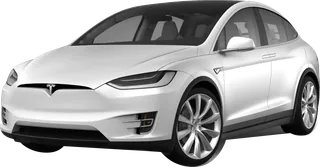
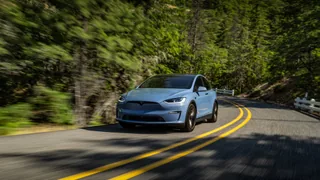
Tesla Model X (2015) vs Tesla Model X (2025)
Better figure, where one is clearly better
| TeslaModel X (2015) | TeslaModel X (2025) | |
|---|---|---|
| Overview | ||
| Released | September 2015 | 2025 |
| Performance | ||
| Powertrain | Electric | Electric |
| Power | 329–532 bhp | 670–1,020 bhp (better) |
| 0–62 mph | 3.1–6.2 s | 2.6–3.9 s (better) |
| Top speed | 130–155 mph | 149–163 mph (better) |
| Engine or motors | Liquid-cooled AC induction motors at the front and rear, as specified in Tesla’s original European owner guide. The guide’s separate motor maximum ratings are not added together as combined output. Exact EV Database European listings give 245 kW (60D/75D), 311 kW (90D/100D), 345 kW (P90D) and 397 kW (P90D Ludicrous), converted to bhp. P100D power is omitted because that database marks 500 kW as estimated. | Dual-motor all-wheel drive or Plaid with three motors and carbon-sleeved rotors. Current UK maker peak claims are 670 hp and 1,020 hp, based on acceleration testing, simulation and battery limits. |
| Gearbox | Single-speed fixed gear. Tesla’s guide gives final-drive ratios of 9.325:1 for the smaller motor and 9.734:1 for the larger Performance rear motor. | – |
| Drive | All-wheel drive, with a motor at each axle. | The 2025 physical refresh adds revised and retuned air suspension, new comfort components, greater noise isolation and sound-absorbing interior materials. New 20- and 22-inch wheel designs and low-resistance tyres improve efficiency. |
| Range and charging | ||
| Fastest charging | 120–145 kW | 250 kW (better) |
| Range detail | These pre-Raven versions have NEDC or EPA ratings, rather than WLTP. EV Database’s European NEDC figures include 259 miles (75D), 304 miles (90D), 351 miles (100D) and 337 miles (P100D). They are not entered in the WLTP fields. The 2019 Standard Range, Long Range and later Performance versions belong to the separate Raven generation. | UK maker page estimates 403 miles for Dual Motor and 378 miles for Plaid without explicitly labelling these configuration figures WLTP. Main WLTP range is therefore omitted; US EPA estimates and review highway tests use different conditions. Current US maker EPA estimates: 352 miles Dual Motor and 335 miles Plaid; these are separate regional ratings, not WLTP. |
| Charging | Exact EV Database European listings: up to 120 kW DC for 60D/75D/90D/P90D and P90D Ludicrous, or 145 kW for 100D/P100D. AC ratings are 11 kW for 60D/90D/P90D/P90D Ludicrous, and 16.5 kW for the listed 75D/100D/P100D versions. These equipment-dependent ratings are not one universal original specification. The 60D used a software-limited 75 kWh pack (EV Database). Battery badge capacities are nominal, and estimated usable values are omitted. | Maximum 250 kW Supercharging; actual charging rate depends on battery temperature, state of charge and charger. |
| Efficiency | – | Current UK product page: 18.3 kWh/100 km Dual Motor; 19.3 kWh/100 km Plaid. German maker labels distinguish these current values from the older 2022–2025 versions at 19.1/20.8. |
| CO2 emissions | – | 0 g/km tailpipe CO₂; UK maker page lists CO₂ efficiency class A. |
| Practicality | ||
| Body | SUV | SUV |
| Seats | 5–7 | 5–7 |
| Boot | – | 420–1,111 litres |
| Length | 5,036 mm | 5,057 mm |
| Width | 1,999 mm | 1,999 mm |
| Weight | From 2,352 kg | From 2,348 kg |
| Boot | Tesla’s European guide specifies maximum rear cargo space behind the front seats: 2,299.5 litres (five seats), 2,002 litres (six seats) or 2,166 litres (seven seats), with the second row forward and/or folded as applicable. A separate 187-litre front boot is listed. The 357-litre area behind the third row is included in those rear totals. Maximum folded/forward figures are not entered as all-seats-up boot capacity. Early six-seat individual middle-row chairs slide and tilt but do not fold flat, as tested by Car and Driver. | Current US manual: five-seat rear boot 1,111 litres; six- and seven-seat layouts 420 litres behind the occupied third row. All have an additional 183-litre front trunk. With third row folded: six-seat 996 litres; seven-seat 1,018 litres. Six-seat second row moves to maximum cargo position rather than folding flat. Its 2,675-litre maximum includes the front trunk, third row folded and second row moved forward, with only driver and front passenger; it is not Plaid boot space with six occupants. |
| Towing | Up to 2,250 kg when equipped with the towing package and within gross-weight limits, per the European guide. Its specified 19-inch winter tyres are required if towing on that wheel size; passenger and luggage loads can reduce available capacity. | UK maker claims 2,300 kg Dual Motor and 2,250 kg Plaid. |
| Size | Original European owner guide: 5,036 mm long, 1,999 mm wide without mirrors, 2,072 mm with mirrors folded or 2,271 mm with mirrors extended; 1,684 mm high and 2,965 mm wheelbase. Main 2,352 kg kerb weight is the guide’s lightest 60D/75D rating with fluids, without occupants or cargo; 90D is 2,389 kg, P90D 2,439 kg, 100D 2,459 kg and P100D 2,487 kg, varying with equipment. | Current US manual: 2,271 mm wide with mirrors, 2,965 mm wheelbase; height 1,680 mm at medium suspension or 1,720 mm at highest setting. Current UK curb mass: 2,348 kg Dual Motor and 2,470 kg Plaid. Main acceleration uses German maker 0–100 km/h figures; Plaid’s 2.6 seconds subtracts rollout. The refresh also increases third-row shoulder room. The current US maker dual-motor top speed is 155 mph, differing from the UK 149 mph specification. |
| Release and generation details | Tesla’s October 2015 delivery report confirms the first customer handovers in Q3 2015; contemporaneous Fortune coverage places those handovers on 29 September. Main date retains September precision. European battery/motor versions followed later; EV Database’s October 2016 or January 2017 order dates are not treated as this family’s first delivery. Six- and seven-seat layouts are options alongside the five-seat version. The 2019 Raven generation changes the front motor and damping and is documented separately. | The physical refresh was announced in Tesla’s US article on 12 June 2025 and described in a regional article dated 27 October 2025. Neither publication establishes an exact first customer-delivery date, so year precision is retained. This entry covers the refreshed hardware and current regional configurations; its 2026 model-year naming does not mean a separate generation. Tesla’s Q2 2026 investor report states the Model S and Model X production lines were decommissioned; remaining stock is distinct from ongoing manufacture. The current US maker page also states Model X is no longer in production; remaining pre-owned inventory may still be available. |
| Tech and safety | ||
| Infotainment | 17-inch portrait centre touchscreen and separate driver instrument display. Driver-assistance hardware and software options changed during this generation. | Current UK page lists 17.4-inch front and 9.4-inch rear touchscreens plus driver instrument display; 22-speaker/960 W audio, dynamic ambient lighting, heated seats, front-seat ventilation, three-zone climate control and HEPA filtration. Display sizes describe current specifications, not asserted initial June equipment. |
| Driver assistance | – | The refresh adds a front fascia camera, blind-spot indicator and adaptive headlights. Tesla Vision provides camera-based driving and parking assistance. Full Self-Driving (Supervised) requires active supervision and depends on regional availability; it is not autonomous driving. |
| Warranty | – | UK: basic vehicle 4 years/50,000 miles; battery and drive unit 8 years/150,000 miles, whichever comes first. |
More comparisons
- Tesla Model X (2025) vs Tesla Model Y L
- Audi Q6 Sportback e-tron vs Tesla Model X (2025)
- Tesla Model X (2019) vs Tesla Model X (2025)
- Tesla Model X (2021) vs Tesla Model X (2025)
- Porsche Macan Electric vs Tesla Model X (2025)
- BMW iX vs Tesla Model X (2015)
- Tesla Model X (2015) vs Tesla Model X (2021)
- Tesla Model X (2015) vs Tesla Model X (2019)
- Tesla Model S (2016) vs Tesla Model X (2015)
- Tesla Model S (2012) vs Tesla Model X (2015)