Xiaomi POCO F4 vs Xiaomi POCO F6
Better figure, where one is clearly better
| XiaomiPOCO F4 | XiaomiPOCO F6 | |
|---|---|---|
| Overview | ||
| Released | June 2022 | May 2024 |
| Display | ||
| Screen size | 6.67″ | 6.67″ |
| Resolution | 2400 × 1080 | 2712 × 1220 (better) |
| Sharpness | 395 pixels per inch | 446 pixels per inch (better) |
| Panel | OLED | OLED |
| Refresh rate | 120 Hz | 120 Hz |
| Peak brightness | 1,300 nits | 2,400 nits (better) |
| Display type | E4 AMOLED DotDisplay, 20:9 aspect ratio, 2.76 mm camera cut-out and 5,000,000:1 contrast | AMOLED with 68 billion colours |
| Pixel density | – | 446 ppi |
| Brightness detail | 900 nits HBM and 1,300 nits peak | 500 nits typical, 1,000–1,200 nits high-brightness mode and up to 2,400 nits peak |
| Screen protection | Corning Gorilla Glass 5 | Corning Gorilla Glass Victus |
| Display features | 100% DCI-P3 typical, TrueColor, Dolby Vision, HDR10+, 360 Hz touch sampling, MEMC, sunlight display 3.0, 360° ambient light sensing and SGS Eye Care Display; maker DynamicSwitch offers 60/90/120 Hz | DCI-P3, 5,000,000:1 contrast, 1,920 Hz PWM dimming, 480 Hz touch sampling and up to 2,160 Hz instantaneous touch sampling in gaming mode; Dolby Vision, HDR10+, Original Color Pro, reading, cycle, Sunlight and Pro HDR modes; TÜV eye-care certifications |
| Performance | ||
| Chip | Qualcomm Snapdragon 870 | Qualcomm Snapdragon 8s Gen 3 |
| Memory | 6 GB – 8 GB | 8 GB – 12 GB (better) |
| Storage | 128 GB, 256 GB | 256 GB, 512 GB (better) |
| CPU | 7 nm Kryo 585; one A77-based Prime core at 3.2 GHz, three A77-based Gold cores at 2.42 GHz and four A55-based Silver cores at 1.8 GHz | TSMC 4 nm; one Cortex-X4 at 3.0 GHz, four Cortex-A720 at 2.8 GHz and three Cortex-A520 at 2.0 GHz |
| GPU | Adreno 650 | Qualcomm Adreno; GSMArena and Notebookcheck identify Adreno 735 |
| AI engine | Maker overview cites 15 TOPS from Qualcomm | – |
| Storage type | LPDDR5 RAM and UFS 3.1 storage; UK 6 GB/128 GB and 8 GB/256 GB; India review's 12 GB configuration is not a UK option; no microSD slot, as confirmed by Android Authority | LPDDR5X and UFS 4.0; no microSD slot, confirmed by Notebookcheck |
| Cooling | LiquidCool Technology 2.0, seven-layer graphite heat dissipation structure and 3,112 mm² vapour chamber | LiquidCool technology 4.0 IceLoop with a 4,800 mm² stainless-steel pump |
| Cameras | ||
| Main camera | 64 MP (better) | 50 MP |
| Ultra wide camera | 8 MP | 8 MP |
| Telephoto camera | None | None |
| Optical zoom | None | None |
| Front camera | 20 MP | 20 MP |
| Main camera | 64 MP, f/1.79, six-element lens, 4-in-1 binning to 1.4 µm and optical image stabilisation | Sony IMX882, 50 MP, f/1.59, 6-element lens, OIS and 4-in-1 binning to 1.6 µm pixels |
| Ultra wide camera | 8 MP, f/2.2 and 119° field of view | Sony IMX355, 8 MP; f/2.2 and fixed focus confirmed by GSMArena |
| Front camera | 20 MP, f/2.45 | OV20B, 20 MP, f/2.2, 1/4-inch sensor and 4-element lens; fixed focus confirmed by GSMArena |
| Video recording | 4K and Full HD at 30/60 fps; HD at 30 fps | 4K at 30/60 fps, 1080p at 30/60 fps and 720p at 30 fps; slow motion 1080p or 720p at 120/240 fps |
| Front video | – | 1080p at 30/60 fps and 720p at 30 fps |
| Camera features | Additional 2 MP f/2.4 macro camera with 1.75 µm pixels | Motion tracking focus 2.0, P3 colour imaging, Lightning snap, slow motion and time-lapse |
| Battery and charging | ||
| Battery | 4,500 mAh | 5,000 mAh (better) |
| Wired charging | Up to 67 W | Up to 90 W (better) |
| Wireless charging | None | None |
| Battery life detail | 4,500 mAh typical | 5,000 mAh typical |
| Wired charging | 67 W turbo charging and included 67 W adaptor; Middle Middle Tab technology; maker laboratory claim of full charge in 38 minutes | Up to 90 W turbo charging; UK 90 W adaptor included |
| Design | ||
| Type | Standard | Standard |
| Weight | 195 g | 179 g (better) |
| Thickness | 7.7 mm (better) | 7.8 mm |
| Height × width | 163.2 × 75.95 mm | 160.5 × 74.4 mm |
| Water and dust resistance | – | IP64 |
| Materials | Glass back and plastic frame, as described by The Indian Express | Plastic frame and rear, confirmed by GSMArena, Trusted Reviews and Notebookcheck |
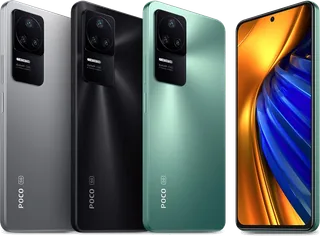
| Colours | Moonlight Silver, Night Black and Nebula Green | Black, Green and Titanium |
| Water resistance detail | – | IP64 splash and dust resistance; not rated for immersion |
| Biometrics | Side fingerprint reader and AI Face Unlock | In-screen fingerprint sensor and AI face unlock |
| Sensors | Proximity, ambient light, accelerometer, gyroscope, electronic compass and IR blaster; X-axis linear motor | Proximity, ambient light, accelerometer, electronic compass, IR blaster and gyroscope; x-axis linear vibration motor |
| Speakers | Stereo 1216 super-linear and 1012 speakers, Dolby Atmos and Hi-Res Audio; HDR10+ and Dolby Vision video playback | Dual speakers with Dolby Atmos and Hi-Res Audio wired/wireless certification |
| Software | ||
| Operating system | Android | Android |
| Software at launch | MIUI 13 for POCO based on Android 12, as reported by both reviews | Xiaomi HyperOS based on Android 14, confirmed by all three full reviews |
| Software updates | – | Three Android version upgrades and four years of security patches, reported by GSMArena and Notebookcheck |
| AI features | – | AI Subtitles, Album Search, Expansion and Magic Erase Pro; software rollout and beta availability vary by region |
| In the box | Phone, 67 W adaptor, USB-C cable, SIM tool, protective case, quick-start guide, warranty card, safety information and USB-C to 3.5 mm adaptor | UK phone, 90 W adaptor, USB-C cable, SIM tool, protective case, guides and warranty card |
| Connectivity | ||
| Mobile network | Sub-6 GHz NSA/SA 5G n1/n3/n5/n7/n8/n20/n28/n38/n40/n41/n77/n78; LTE FDD B1/B2/B3/B4/B5/B7/B8/B12/B17/B18/B19/B20/B26/B28 and TDD B38/B40/B41; WCDMA B1/B2/B4/B5/B6/B8/B19 and GSM 850/900/1800/1900 MHz; 4×4 MIMO | Dual-SIM 5G+5G or 4G; LTE, WCDMA and GSM also supported |
| SIM | Dual nano-SIM | Dual SIM dual standby; no eSIM, confirmed by Notebookcheck |
| Wi-Fi | Wi-Fi 6 | 802.11 a/b/g/n/ac/ax; Notebookcheck's review unit also connected to its 6 GHz Wi-Fi 6E network |
| Bluetooth | Bluetooth 5.2 | Bluetooth 5.4 |
| NFC | NFC with Google Pay; availability varies by market | NFC, availability varies by region |
| USB | USB-C | USB-C; USB 2.0 confirmed by Notebookcheck |
| Positioning | GPS L1/L5, Galileo E1/E5a, QZSS L1/L5, BeiDou B1I/B2a and NavIC; maker labels GLONASS as L1 | GPS L1, GLONASS G1, BeiDou B1, Galileo E1 and QZSS L1 |

More comparisons
- Xiaomi POCO F4 vs Xiaomi POCO F8 Pro
- Xiaomi POCO F6 vs Xiaomi POCO F8 Pro
- Xiaomi POCO F6 vs Xiaomi POCO F8 Ultra
- Xiaomi POCO F4 vs Xiaomi POCO F8 Ultra
- Xiaomi POCO F6 vs Xiaomi POCO F7
- Xiaomi POCO F4 vs Xiaomi POCO F7
- Xiaomi POCO F6 vs Xiaomi POCO F7 Pro
- Xiaomi POCO F6 vs Xiaomi POCO F7 Ultra
- Xiaomi POCO F4 vs Xiaomi POCO F7 Pro
- Xiaomi POCO F4 vs Xiaomi POCO F7 Ultra
- Xiaomi POCO F6 vs Xiaomi POCO X7 Pro
- Google Pixel 9 vs Xiaomi POCO F6
- Nothing Phone (2a) Plus vs Xiaomi POCO F6
- Motorola moto g85 5G vs Xiaomi POCO F6
- Xiaomi POCO F6 vs Xiaomi POCO F6 Pro
- OnePlus OnePlus Nord 4 vs Xiaomi POCO F6