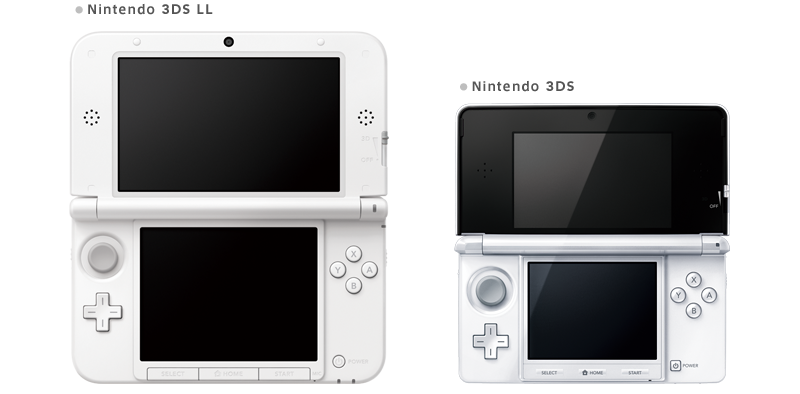
3DS
Nintendo's original 2011 3DS, a dual-screen handheld whose upper screen shows 3D without glasses, for collectors and anyone comparing it with the DS, New 3DS XL or PS Vita.
- Type
- Handheld
- Output
- –
- Memory
- 134 MB
- Storage
- –
- Weight
- 235 g
What reviewers say
Reviewers found the glasses-free 3D impressive when it works, but noted it depends on a narrow viewing angle and can cause discomfort, and that it cuts battery life to roughly three to five hours. IGN found the launch line-up lacking landmark games; CNET found the cameras' photos grainy but felt later releases and a price cut made it compelling.
Specifications
Report a wrong or missing specPerformance
- Type
- Handheld
- CPU
- ARM11 MPCore, 2 cores, 268 MHz
- GPU
- DMP PICA200, 268 MHz
- Memory
- 134 MB
- Disc drive
- No
- CPU
- Dual-core ARM11 MPCore at 268 MHz plus an ARM946 processor (original 3DS security research)
- GPU
- DMP PICA200 at 268 MHz (DMP and Copetti)
- Memory detail
- 128 MB FCRAM plus 6 MB VRAM (original 3DS security research)
- Storage detail
- Games on Nintendo 3DS game cards; 2 GB SD card included
- Storage expansion
- SD and SDHC cards
Display and video
- Built-in screen
- 3.53″ LCD, 800 × 240
- Built-in screen
- Upper 3.53-inch 3D LCD, 800 × 240 (400 pixels per eye in 3D), 16.7 million colours; lower 3.02-inch LCD touch screen, 320 × 240
- Audio
- Stereo speakers (pseudo-surround); headphone jack
Design and power
- Battery life (maker's claim)
- Up to 5 hours
- Weight
- 235 g
- Battery life detail
- 5 Wh lithium-ion battery (CTR-003); about 3–5 hours with 3DS software and 5–8 hours with DS software; charges in about 3 hours 30 minutes
- Power use
- About 4.1 W maximum while charging (Nintendo UK manual)
- In the box
- Console, charging cradle, AC adapter, stylus, 2 GB SD card, 6 AR Games cards
Connections
- Ports
- Game card slot, SD card slot, AC adapter connector, audio jack (stereo out); charging cradle contacts
- Wi-Fi and Bluetooth
- Wi-Fi IEEE 802.11b/g (2.4 GHz); infrared (Nintendo UK manual)
- Controller
- Built-in Circle Pad, D-pad, A/B/X/Y, L/R buttons; motion sensor and gyro sensor; stylus
- Backward compatibility
- Nintendo DS and DSi games
Pros and cons
Pros
- Glasses-free 3D on the 3.53-inch upper screen
- Plays Nintendo 3DS and Nintendo DS games
- Circle Pad analogue control, motion and gyro sensors, and three 0.3-megapixel cameras
Cons
- About 3 to 5 hours of battery life in 3DS games
- Low-resolution screens (400 × 240 per eye on the upper screen)
- Only one analogue control; the Circle Pad Pro add-on adds a second
Closest rivals
Model | Type | Output | Memory | Storage | Weight | Released |
|---|---|---|---|---|---|---|
| Handheld | – | – | – | 336 g | Jul 2012 | |
| Handheld | – | 640 MB | – | 260 g | Dec 2011 | |
| Handheld | – | – | – | 260 g | Oct 2013 |
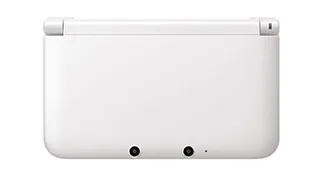
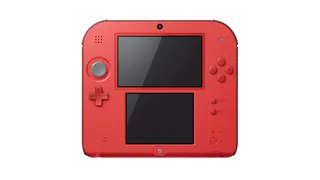
Newer model: New 3DS.
Sources
- nintendo.com/eu/media/downloads/support_1/nintendo_3ds_14/Nintendo3DS_Operation…
- nintendo.co.jp/corporate/en/history/index.html
- nintendo.co.jp/corporate/release/en/2012/120622.html
- smealum.github.io/3ds/32c3
- dmprof.com/en/news/dmp-gpu-ip-core-adopted-for-nintendos-portable-game-console-…
- copetti.org/writings/consoles/nintendo-3ds