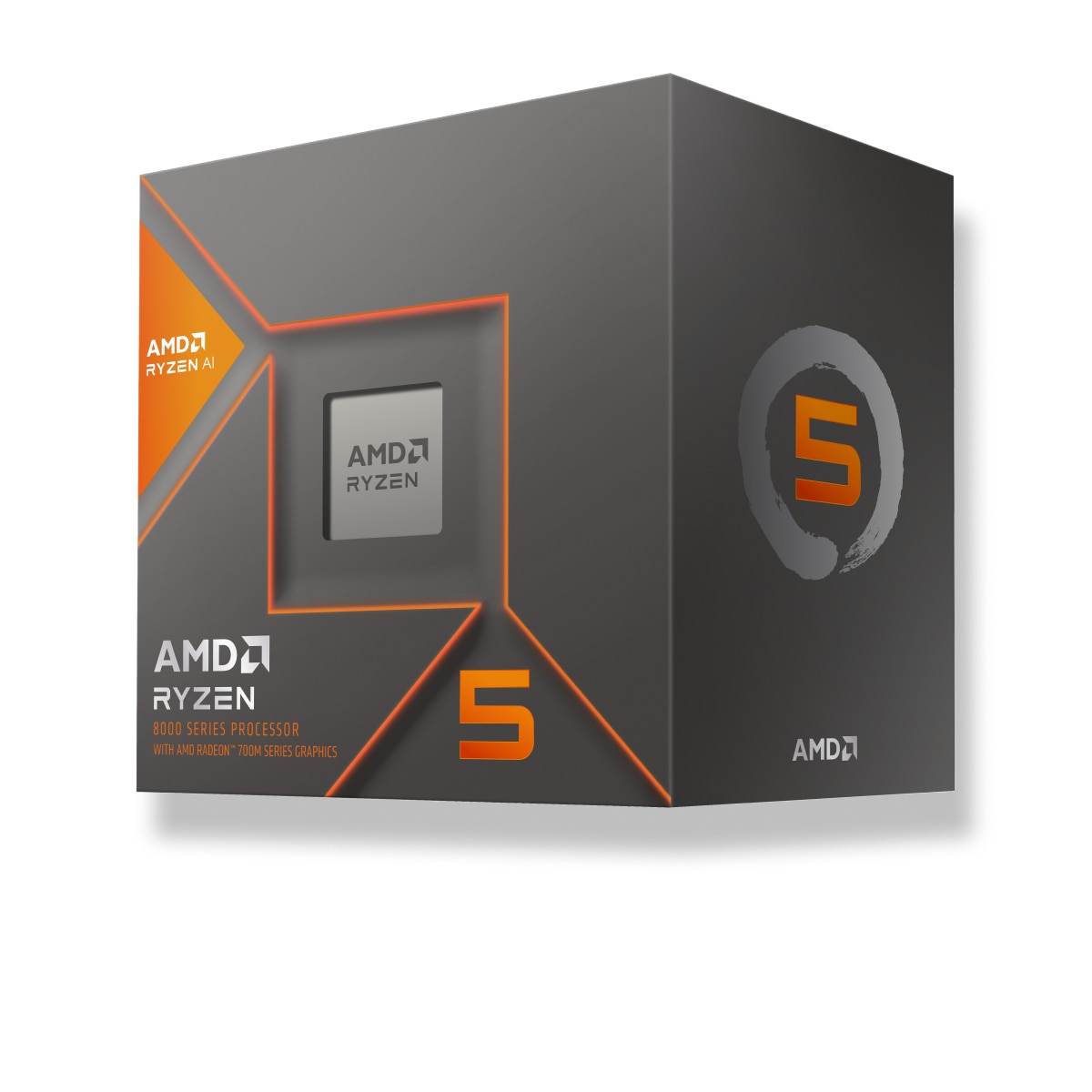
Reviews favour the 8600G for compact or inexpensive PCs that use its integrated graphics, finding playable 1080p performance at reduced settings and good efficiency. It is generally better value than the 8700G for this purpose, though frame rates depend on memory speed and some games need upscaling or a lower resolution. Ryzen 7000 alternatives perform better with a separate graphics card, and a CPU-plus-GPU build can offer better gaming performance if the budget allows.
Zen 4; Phoenix; simultaneous multithreading; one monolithic package die.
Clocks
Precision Boost 2; Precision Boost Overdrive and Curve Optimizer supported; configurable TDP 45–65 W.
Cache
6 MB L2; 16 MB L3.
Graphics and AI
Built-in graphics
Yes
Graphics
Radeon 760M; RDNA 3; eight graphics cores at 2800 MHz; up to four displays; DisplayPort 2.1 and HDMI 2.1; hardware AV1 encode and decode.
AI engine
AMD Ryzen AI; XDNA neural processing unit; up to 16 TOPS.
Platform
Socket
AM5
Base power
65 W
Unlocked
Yes
Memory support
DDR5 UDIMM; two channels; up to 256 GB on the current AMD specification page. Two single- or dual-rank DIMMs: DDR5-5200; four single- or dual-rank DIMMs: DDR5-3600.
PCIe
PCIe 4.0; 20 native lanes, 16 usable, as published by AMD; discrete graphics slot up to ×8 (PC Gamer). Two native USB4 40 Gbps, two USB 3.2 Gen 2 10 Gbps and one USB 2.0 port.
Chipsets
AMD lists A620, X670E, X670, B650E, B650, X870E, X870, B840 and B850; motherboard firmware support required.
Process
TSMC 4nm FinFET; 178 mm² CPU compute die.
Cooler
95°C maximum operating temperature. Retail review boxes included a Wraith Stealth air cooler (PC Gamer and PCGamesN); tray products do not establish the same bundle.
Pros and cons
Pros
+Radeon 760M integrated graphics
+Dedicated Ryzen AI engine
+Unlocked CPU multiplier
Cons
−DDR5 memory required
−PCIe 4.0 rather than PCIe 5.0
−Discrete graphics connection limited to eight PCIe lanes