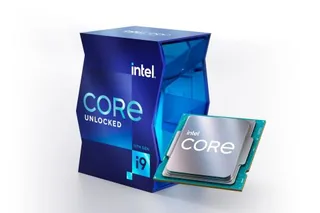
Reviews find capable gaming performance, but gains over the Core i7-10700K are often small and vary by game. The Ryzen 7 5800X offers better efficiency, while cheaper processors can provide similar gaming results. Its eight cores help in productivity work, but cooling requirements and overall platform costs reduce its appeal.
Hyper-Threading, Turbo Boost Max 3.0, AVX-512 and Deep Learning Boost supported. Thermal Velocity Boost is not supported. General retail sale began 30 March 2021, according to Intel's sales-embargo statement reported by Windows Central; the 16 March maker press release was the announcement.
Clocks
Up to 5 GHz with Turbo Boost Max 3.0, or 4.9 GHz with Turbo Boost 2.0. Configurable TDP-down to 95 W with a 3.1 GHz base clock. Tom's Hardware reports 251 W PL2; the current Intel specification page publishes TDP only.
Graphics and AI
Built-in graphics
Yes
Graphics
Intel UHD Graphics 750; 32 execution units; 350 MHz base, up to 1.3 GHz; up to 64 GB shared graphics memory; three displays. HDMI up to 4096×2160 at 60 Hz; DisplayPort up to 5120×3200 at 60 Hz; Quick Sync Video supported.
AI engine
Intel Gaussian & Neural Accelerator 2.0; Deep Learning Boost on the CPU.
Platform
Socket
LGA1200
Base power
125 W
Unlocked
Yes
Cooler in the box
No
Memory support
Up to 128 GB; two channels; DDR4-3200; 50 GB/s maximum bandwidth; ECC not supported. Tom's Hardware reports official Gear 1 support to DDR4-2933, with DDR4-3200 using Gear 2; its review tests faster Gear 1 settings as memory overclocking.
PCIe
PCIe 4.0; 20 CPU lanes, configured as 1×16+1×4, 2×8+1×4 or 1×8+3×4.
Process
14 nm; Rocket Lake; 37.5 × 37.5 mm package; 100°C maximum junction temperature. Cypress Cove CPU architecture (Intel launch announcement).
Cooler
No cooler included with the boxed processor (Tom's Hardware exact-model review). The photograph shows its labelled preproduction review sample installed in a motherboard.