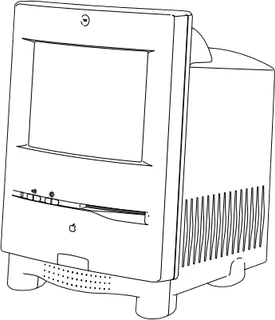
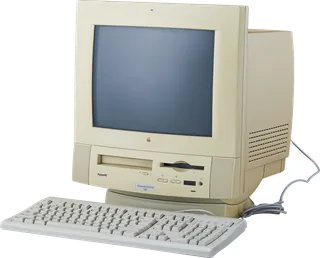
An education-market all-in-one Macintosh with a 33 MHz 68LC040 processor, colour CRT, IDE hard disk and slots for optional networking and video capture.
Original Motorola 68LC040 at 33 MHz, without an integrated floating-point unit. Apple catalogue gives 66/33 MHz internal/bus clock; optional PowerPC upgrade is excluded from this configuration. Shared Service Source describes it as an updated LC 575
GPU
Built-in video uses 1 MB DRAM soldered to the logic board, displaying 32,768 colours at 640 × 480
Memory type
8 MB standard in the maker catalogue: 4 MB soldered plus one 4 MB SIMM, with a second socket free. Two 72-pin 80 ns SIMM sockets, expandable to 52 MB; the single-bank socket accepts only 1, 4 or 16 MB modules. 1 MB ROM in original service specifications
Storage type
500 MB internal IDE hard disk in the catalogue configuration, plus manual-inject Apple SuperDrive floppy. Double-speed tray-loading internal CD-ROM is optional or included in some regional configurations; the separately marketed Performa 580CD has its own software and hardware bundle
Expansion slots
One 114-pin LC processor-direct slot, one communications slot for optional Ethernet or fax modem, one video-input slot for optional capture hardware and an internal connector for optional external video
Display
Screen size
14″
Resolution
640 × 480
Panel
CRT
Refresh rate
66.67 Hz
Display type
Built-in 14-inch diagonal shadow-mask colour CRT, 0.28 mm dot pitch. The exact service manual calls the viewable image 11.5 inches and gives a nominal 240 × 180 mm active raster; these maker descriptions are retained separately
Display features
640 × 480 at 66.67 Hz in the exact timing table (66.7 Hz rounded elsewhere in the same manual); 16-bit colour
Connections
Ports
Headphone jack
Front ports
Stereo headphone socket; front brightness and contrast controls
Back ports
One ADB port; one DB-25 SCSI port supporting six external devices; two RS-232/RS-422 serial ports, with 9-pin mini-DIN modem and 8-pin mini-DIN printer connectors; mono sound input and stereo sound output
External displays
Optional external video connector supports mirroring on compatible 640 × 480 and 800 × 600 monitors, as listed in the shared service manual; no external video socket as standard
Speakers
Two integrated speakers; 8-bit stereo playback and mono recording at 11 or 22 kHz. Optional CD-ROM supports audio-CD playback
Microphones
Integrated microphone for monaural sound input
Keyboard and mouse
Supports Apple Desktop Bus keyboards and the ADB Mouse II. Maker photograph shows a keyboard and mouse; regional education bundles vary
Design and power
Type
All-in-one
Weight
18.3 kg
Width × depth × height
343 × 419 × 455 mm
Operating system
macOS
Size and weight detail
Apple catalogue: 455 × 343 × 419 mm (height × width × depth), 18.3 kg, varying with installed devices. Service Source rounds the same 17.9 × 13.5 × 16.5 inch case to 455 × 344 × 420 mm and 18.4 kg; headline follows the catalogue’s published metric values
Power supply
Automatically configured 100–240 V AC mains; service supply operating range 90–264 V rms, 50–60 Hz ±3 Hz
Power use
Service Source: 120 W maximum for all line and load conditions. Current support article describes a PowerPC-upgraded configuration and lists 60 W, so that figure is not transferred to the original model
In the box
Original 68LC040 model is offered in Apple’s April and October 1995 catalogues; the latter identifies US education-only sales and varying worldwide configurations. Current Apple support article describes an installed PowerPC 601 upgrade card. It records introduction on 3 April 1995, while contemporary Macworld says education shipping was planned for that day; exact actual first retail delivery is unconfirmed, so release retains supported year precision
Configurations
Processor
Memory
Storage
Storage type
Motorola 68LC040 33 MHz (Macintosh LC 575)
8 MB
500 MB
Hard drive
Pros and cons
Pros
+Integrated colour screen, stereo speakers and microphone
+Two RAM expansion sockets, supporting up to 52 MB
+Optional networking, video capture and external display hardware
Cons
−No integrated floating-point unit
−Ethernet and external video connector require optional hardware