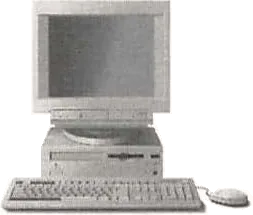
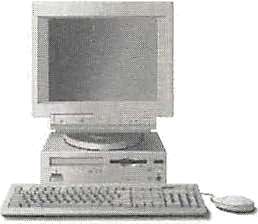
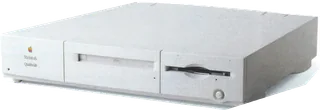
Apple Power Macintosh 7100/66

Apple · Power Mac

Power Macintosh 7100/66

Released 1994

A 66 MHz PowerPC 601 desktop with three NuBus slots, built-in Ethernet through AAUI and separate video outputs.

Type
Compact
Processor
PowerPC 601 66 MHz (Power Macintosh 7100/66)
Memory
8 MB
Storage
250 MB – 500 MB
Screen
–
Weight
11.34 kg

Performance

Processor
PowerPC 601 66 MHz (Power Macintosh 7100/66)
CPU cores
1
Memory
8 MB
Storage
250 MB to 500 MB
CPU
66 MHz PowerPC 601 with integrated memory management and floating-point unit, 32 KB L1 cache and 64-bit data path at 33 MHz
GPU
Built-in HDI-45 video uses system DRAM; separate DB-15 video has 1 MB VRAM standard and supports 2 MB for up to 24-bit colour at 832 × 624
Memory type
8 MB on the logic board plus four 72-pin SIMM slots installed in pairs; Apple supports 8–136 MB total
Storage type
Internal 1.44 MB floppy drive, 250 or 500 MB SCSI hard drive and optional 2× CD-ROM drive
Expansion slots
Three NuBus slots; processor-direct slot filled by the video card

Display

Screen
None built in

Connections

Ports
Ethernet
Back ports
Apple Desktop Bus, DB-15 and HDI-45 video, DB-25 SCSI, two GeoPort serial connections, AAUI-15 Ethernet, microphone input and speaker output
External displays
DB-15 video supports up to 1152 × 870 pixels; available colour depth depends on VRAM

Design and power

Type
Compact
Weight
11.34 kg
Width × depth × height
330 × 419 × 152 mm
Operating system
macOS
Size and weight detail
Apple's 6 × 13 × 16.5 inch and 25 lb reference dimensions; metric fields are rounded conversions
Power supply
Maximum 230 W; 100–240 V AC, 50–60 Hz; 3.6 V lithium clock battery
In the box
Original System Software 7.1.2 with PowerPC Enabler. Apple lists 14 March 1994 as introduction; a separate maker first-sale date was not established.

Configurations

ProcessorMemoryStorageStorage type
PowerPC 601 66 MHz (Power Macintosh 7100/66)8 MB250 MBHard drive
PowerPC 601 66 MHz (Power Macintosh 7100/66)8 MB500 MBHard drive

Pros and cons

Pros

  • Three NuBus expansion slots
  • Built-in Ethernet through AAUI
  • Optional VRAM expansion for higher colour depth

Cons

  • Ethernet requires an AAUI transceiver
  • Standard onboard video shares system memory
  • No USB ports

Closest rivals

Model
TypeProcessorMemoryStorageScreenWeightReleased
CompactMotorola 68LC040 33 MHz (Macintosh LC 575)4 MB – 8 MB250 MB–7.7 kg1994
CompactMotorola 68LC040 33 MHz (Macintosh LC 630 DOS Compatible)8 MB500 MB–8.6 kg–
CompactMotorola 68LC040 25 MHz (Macintosh Quadra 610 DOS Compatible)8 MB160 MB––Mar 1994

Sources

  1. support.apple.com/en-la/112087
  2. commons.wikimedia.org/wiki/File:Power_Macintosh_7100_66.jpg

Photo: Apple-authored UK Power Macintosh 7100/66 and 7100/66AV brochure, page 1, archived by 1000bit. Shared front/right housing photograph covering both named models; AV connectors are not visible. Native monochrome scan with paper backdrop removed; no generated hardware.

Spot a mistake? Tell us