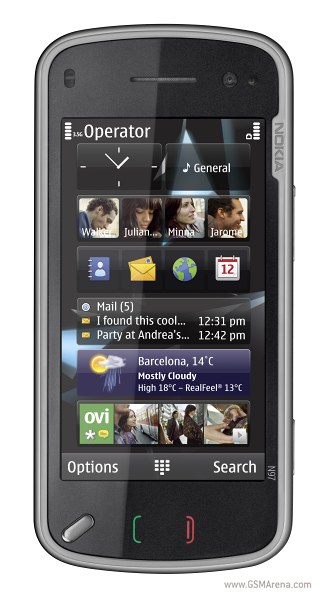
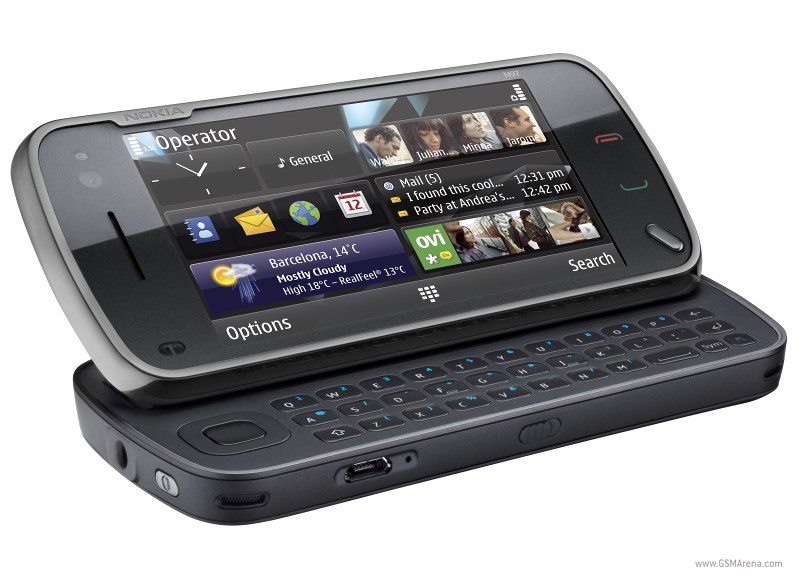
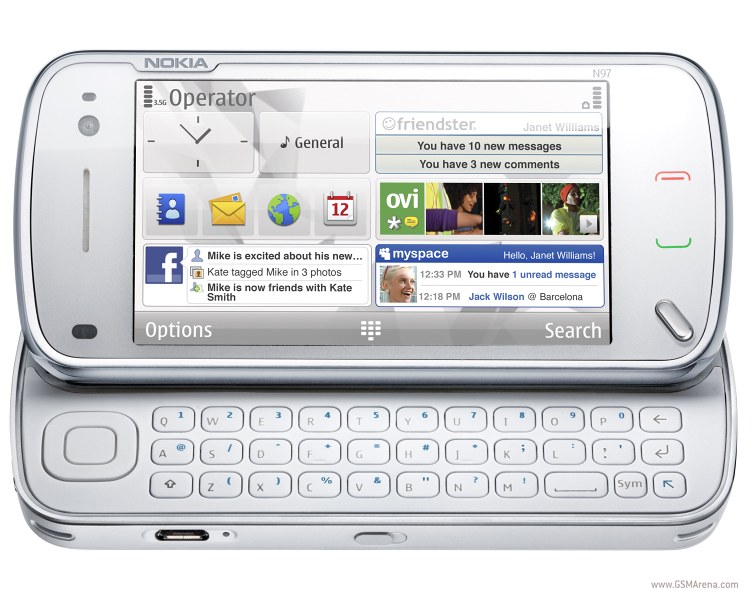
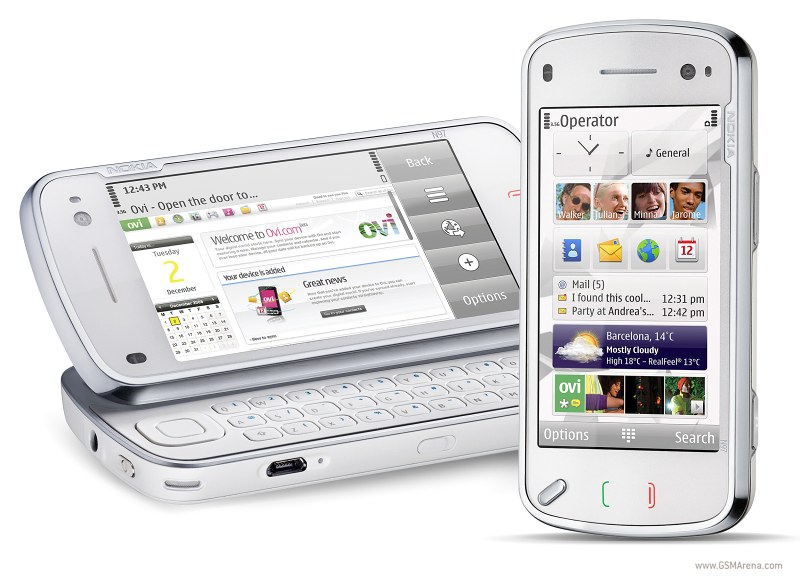
GSMArena and All About Symbian liked the tilting keyboard/screen design, large built-in storage and broad multimedia features, but both criticised the keyboard layout, inconsistent touch interface and limited supplied office software. Their sunlight judgements differed: GSMArena found excellent outdoor legibility, while AAS found the touch layer made viewing difficult. GSMArena’s launch test reported generally responsive operation and decent still photos, with warm colour and clipped highlights; its VGA footage showed compression artefacts. AAS’s month-long2010 test on firmware21 still found RAM/system-partition limits and instability, despite improved software, and praised outdoor photographs. The findings describe different software versions and test dates.
3.5-inch TFT LCD, 640 × 360, up to 16 million colours; resistive touch input with optional stylus. No maker refresh-rate or peak-brightness figure published.
Performance
Chip
ARM11 434 MHz (GSMArena)
Memory
128 MB
Storage
32 GB
Memory
32 GB built-in mass storage from maker sheet. 128 MB installed RAM and 434 MHz ARM11 CPU from GSMArena’s full production review. All About Symbian’s later v 21 test reports only 10–15 MB free on the separate C: system partition after use; this is not total RAM or the 32 GB mass-storage capacity.
Storage type
microSD expansion up to 16 GB from original maker sheet. Original up-to 48 GB marketing total includes the removable card, not 48 GB built-in storage.
Cameras
Main camera
5 MP
Ultra wide camera
None
Telephoto camera
None
Optical zoom
None
Main camera
5 MP autofocus Carl Zeiss Tessar, F2.8,5.4 mm physical focal length, dual LED flash/video light and sliding lens cover. Launch sheet 2584 ×1938 still matrix conflicts with 2592 ×1944 in exact issue 5 owner guide and production review; guide matrix identified as later exact-model evidence.
Front camera
Secondary front camera for video calling, confirmed in owner guide; no headline megapixel figure inferred. AAS reports 176 ×122 in its v 21 review, without treating that as a maker sensor specification.
Video recording
Maker sheet specifies VGA 640 ×480 MPEG-4 at up to 30 fps. AAS later test records 640 ×360 at 29 fps; recording modes/settings differ. No HD or optical zoom claimed.
Camera features
Two-stage shutter key, sliding lens cover, geotagging, scene settings, white balance, ISO and exposure compensation. No transferred N86 variable aperture or mechanical-shutter claim.
Battery and charging
Battery
1,500 mAh
Video playback (maker's claim)
Up to 4.5 hours
Wireless charging
None
Battery life detail
Removable BP-4L 1500 mAh. Original maker sheet maxima:320 minutes 3G or 400 minutesGSM talk,400 hours 3G or 430 hoursGSM standby,4.5 hours offline video or 37 hours offline music. GSMArena cites later 6/9.5-hour talk and 408/432-hour standby figures; differing launch claims are qualified rather than combined.
Wired charging
Micro-USB charging with simultaneous data transfer confirmed by exact owner guide; no maker charging wattage published.
Design
Type
Standard
Weight
150 g
Thickness
15.9 mm
Height × width
117.2 × 55.3 mm
Weight detail
Maker body dimensions 117.2 ×55.3 ×15.9 mm; camera area reaches 18.25 mm. Headline retains the main body thickness.
Buttons
Slide-and-tilt three-row QWERTY keyboard with directional pad on the left and space key on the right. Numeric/symbol input uses modifiers. Physical menu, volume and capture controls, touch call/end keys and screen-lock slider.
Speakers
Built-in stereo speakers; FM radio with RDS and FM transmitter confirmed by production review and owner guide. Transmitter availability is regional; the guide qualifies permitted countries.
Software
Operating system
Symbian
Software features
Symbian OS9.4/S60 5th Edition with configurable homescreen widgets, document viewers and original Ovi services. GSMArena tests launch firmware; AAS’s March 2010 month-long v 21 test still finds RAM/system-partition constraints and instability. Original N-Gage/service availability and later updates are not assumed universal or usable today.
Release detail
Announced 2 December 2008 with first-half 2009 shipping planned. Maker 2 June 2009 article states sales in 75 countries duringJune without exact worldwide day; actual 19 June article confirms UK shop debut. June retained without substituting the UK day for worldwide first sale. No maker-supported direct predecessor link established.
Connectivity
Mobile network
Original maker sheet: GSM850/900/1800/1900 and WCDMA900/1900/2100 with HSDPA. Exact guide identifies European RM-505; regional American variants remain separate and are not combined into the European band list.
Wi-Fi
IEEE 802.11b/g with UPnP home networking, from maker datasheet; no inferred Wi-Fi generation beyond the stated standards.
Bluetooth
Bluetooth 2.0 +EDR with A2DP/AVRCP stereo audio, hands-free/headset, dial-up networking, file transfer, imaging, phonebook access and remote SIM profiles confirmed in exact guide.
USB
Micro-USB Hi-Speed USB 2.0 data/charging and 3.5 mm Nokia AV socket for compatible headphones and PAL/NTSC TV-out.
Positioning
GPS, assisted GPS and electronic compass. Launch sheet says navigation may need separate purchase; GSMArena’s original Maps 2.0 Touch package had a three-month trial, while AAS later v 21 review tests updated Ovi Maps. These are historical software/licence states, not promised current services.
Storage options
Storage
32 GB
Pros and cons
Pros
+Tilting touchscreen and physical QWERTY keyboard
+32 GB built-in storage plus microSD expansion
+GPS, digital compass, FM transmitter and 3.5 mm audio/TV output
Cons
−No HD video recording
−Supplied office software views documents without editing
−Small system partition limits some application installations