Garmin · Forerunner
Forerunner 201
Garmin's first wrist-worn GPS running trainer, with pace tracking and a serial computer link.
- Type
- Smart and sports
- Sizes
- 82.8 mm
- Movement
- –
- Power reserve
- –
- Display
- LCD
- Battery
- 15 h
- Water
- –
- GPS
- Single-band
- Weight
- 78 g
What reviewers say
CNET France and 01net's PC Open Labs found the Forerunner 201 rich in training controls and easy to use. They differed on GPS reliability; CNET lost signal during its runs and found pace readings uneven, while PC Open Labs considered the device reliable but cautioned that maximum speed could be inaccurate. CNET also criticised the serial transfer and weak alert volume.
From cnetfrance.fr and 01net.it
Specifications
Report a wrong or missing specDisplay
- Case sizes
- 82.8 mm
- Panel
- LCD
- Always-on display
- Yes
- Display detail
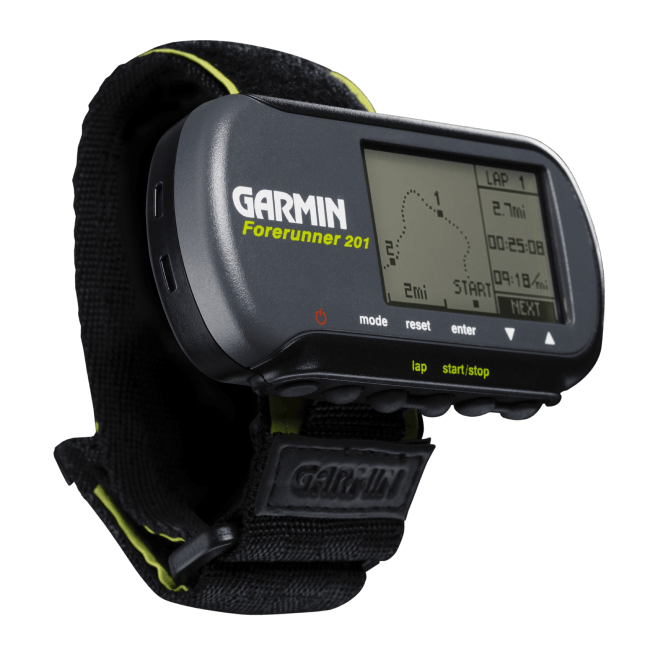
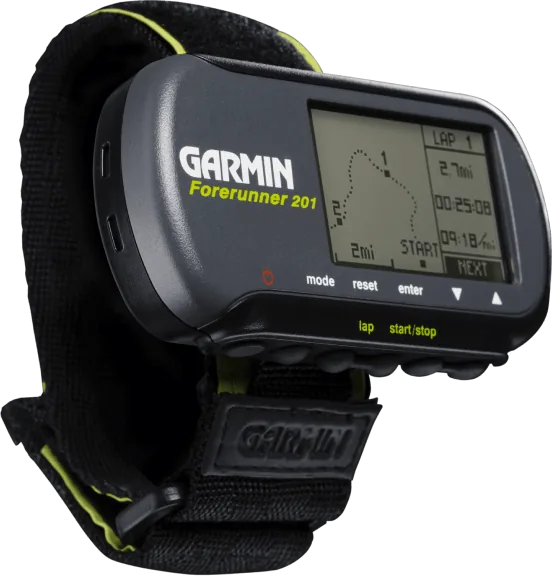
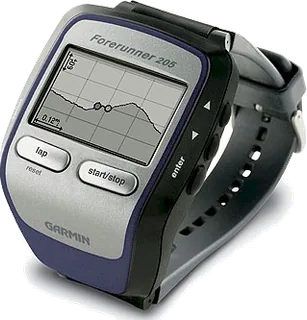
- Backlit monochrome LCD, 36.49 × 23.35 mm and 100 × 64 pixels, with buttons beside and below the screen.
Health and fitness
- ECG
- No
- Blood oxygen
- No
- Skin temperature
- No
- Sleep apnoea alerts
- No
- High blood pressure alerts
- No
- Body composition
- No
- Fall detection
- No
- Crash detection
- No
- GPS
- Single-band
- Sensors
- Built-in 12-channel GPS receiver and patch antenna; no heart-rate sensor.
- Fitness features
- Speed, pace, distance, laps, elevation and calories; Auto Pause, Auto Lap, interval training, pace and distance alerts, and Virtual Partner goals.
- Safety features
- Stores up to 100 locations and can guide the wearer back to the starting point; a basic route map and pointer are shown on the screen.
Battery and connections
- Battery life (maker's claim)
- Up to 15 hours
- Mobile data option
- No
- Works with
- No phone pairing
- Battery life detail
- Rechargeable lithium-ion battery, up to fifteen hours of typical use.
- Charging
- A/C desktop cradle with charging and computer data contacts.
- Connectivity
- Serial port connection to a PC for Garmin Training Center transfers; no direct phone connection.
- Storage
- Up to 5,000 laps, with approximately two years of training history in Garmin's 2004 specification.
Design
- Weight (lightest version)
- 78 g
- Software
- Garmin
- Case materials
- Sealed high-impact plastic alloy case with a textile wrist strap; IPX7 immersion rating, tested to 1 m for 30 minutes, rather than a swimming depth rating.
- Size
- 82.80 × 43.44 × 17.53 mm and approximately 78 g. The widest case dimension appears in the size comparison.
- In the box
- Watch, wrist and expander straps, A/C charging cradle with PC interface and manual.
Pros and cons
Pros
- GPS measures pace and distance without calibration
- Navigation back to the start and a virtual training partner
- Up to fifteen hours of typical battery use
Cons
- Wide 82.8 mm case and 78 g weight
- No heart-rate monitoring or phone connection
- Training history transfers through a serial computer port
Closest rivals
Model | Type | Sizes | Movement | Power reserve | Display | Battery | Water | GPS | Weight | Released |
|---|---|---|---|---|---|---|---|---|---|---|
| Smart and sports | 83 mm | – | – | – | 15 h | – | Single-band | 74 g | 2004 | |
| Smart and sports | 82.8 mm | – | – | – | 14 h | – | Single-band | 78 g | 2005 | |
| Smart and sports | 53.3 mm | – | – | – | 10 h | – | Single-band | 77 g | 2006 |
Sources
- static.garmin.com/pumac/Forerunner201_OwnersManual.pdf
- www8.garmin.com/specs/Forerunner_series.pdf
- garmin.com/en-GB/blog/twenty-years-of-running-with-garmin
Photo: garmin.com.cn