
Garmin · Forerunner
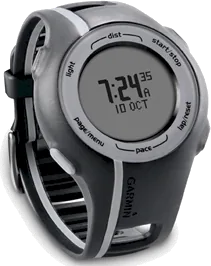
Forerunner 210
A compact GPS running watch with instant pace, interval workouts, ANT+ foot-pod support and USB uploads.
- Type
- Smart and sports
- Sizes
- 45 mm
- Movement
- –
- Power reserve
- –
- Display
- –
- Battery
- 8 h
- Water
- –
- GPS
- Single-band
- Weight
- 52 g
What reviewers say
DC Rainmaker and BikeRadar valued the straightforward controls and compact fit, with useful battery life for running. BikeRadar found GPS distance reasonably accurate but reported variable satellite acquisition times. DC Rainmaker liked the added instant pace, intervals and foot-pod support, while finding the fixed data fields and lack of custom workouts restrictive for advanced training.
From dcrainmaker.com and bikeradar.com
Specifications
Report a wrong or missing specDisplay
- Case sizes
- 45 mm
- Always-on display
- Yes
- Display detail
- Backlit monochrome screen, 25 mm diameter and 52 × 30 pixels; four physical buttons and fixed training pages. Garmin does not publish the panel technology.
Health and fitness
- ECG
- No
- Blood oxygen
- No
- Skin temperature
- No
- Sleep apnoea alerts
- No
- High blood pressure alerts
- No
- Body composition
- No
- Fall detection
- No
- Crash detection
- No
- GPS
- Single-band
- Sensors
- High-sensitivity GPS receiver with HotFix satellite prediction; optional ANT+ heart-rate chest strap and foot pod for indoor speed, distance and cadence. No optical wrist sensor.
- Fitness features
- Time, distance, calories, instant pace, lap-average pace and run-average pace; manual laps, Auto Lap and time- or distance-based interval workouts with optional warm-up and cool-down.
Battery and connections
- Battery life (maker's claim)
- Up to 8 hours
- In low-power mode
- Up to 21 days
- Mobile data option
- No
- Works with
- No phone pairing
- Battery life detail
- Rechargeable 200 mAh lithium-ion battery; up to eight hours with GPS, three weeks in power-save mode or one week with forty-five minutes of GPS training each day.
- Charging
- USB contact charging clip and AC adapter.
- Connectivity
- USB computer activity transfers and Garmin Connect; ANT+ sensor connections. No direct phone pairing.
- Storage
- Up to 1,000 laps; the oldest data is overwritten when memory is full.
Design
- Weight (lightest version)
- 52 g
- Software
- Garmin
- Case materials
- IPX7 immersion protection, one metre for thirty minutes; the owner's manual says the watch is not intended for swimming.
- Size
- 45 × 69 × 14 mm and 52 g. Width is used as the case size.
- In the box
- Watch, charging/data cable, AC adapter and documentation; heart-rate strap and foot pod included in some bundles.
Pros and cons
Pros
- Instant, lap-average and run-average pace options
- Time- or distance-based interval workouts
- Optional ANT+ heart-rate and foot-pod sensors
Cons
- No custom workout downloads or configurable data fields
- No phone pairing or wrist heart-rate sensor
- IPX7 protection is not a swimming rating
Closest rivals
Model | Type | Sizes | Movement | Power reserve | Display | Battery | Water | GPS | Weight | Released |
|---|---|---|---|---|---|---|---|---|---|---|
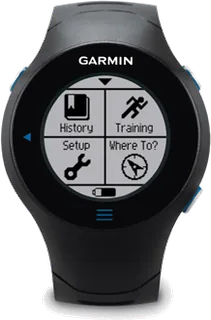
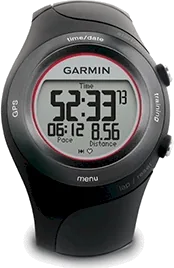
| Smart and sports | 45 mm | – | – | – | 8 h | – | Single-band | 52 g | 2010 | |
| Smart and sports | 45.7 mm | – | – | – | 8 h | – | Single-band | 72 g | Apr 2011 | |
| Smart and sports | 48 mm | – | – | – | 8 h | – | Single-band | 60 g | 2010 |
Sources
- garmin.com/sv-SE/compare
- static.garmin.com/pumac/Forerunner_210_OM_EN.pdf
- garmin.com/en-US/newsroom/press-release/outdoor/2010-garmin-expands-forerunner-…
- www8.garmin.com/aboutGarmin/invRelations/reports/2010_Annual_Report_10-K.pdf
Photo: tramsoft.ch
