Photo 1 of 5
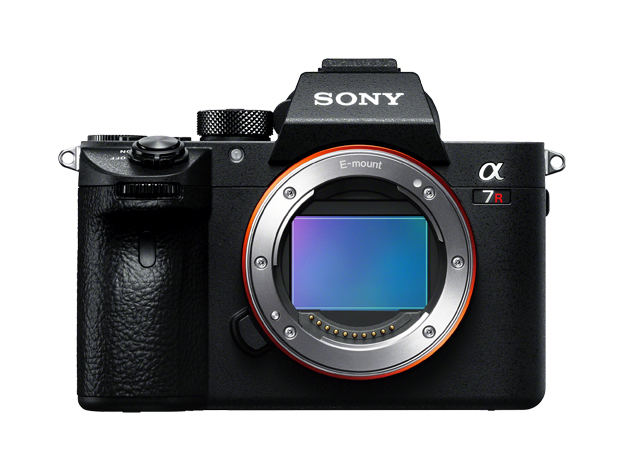
Sony Alpha 7R III · Photo source
Sony · Alpha
Alpha 7R III
A 42.4 MP full-frame E-mount mirrorless camera with five-axis stabilisation, 10 fps AF/AE tracking and two memory-card slots.
- Type
- Mirrorless
- Sensor
- Full frame
- Megapixels
- 42.4
- Lens
- Sony E-mount
- Video
- 3840 × 2160 at 30 fps
- Body weight
- 572 g
What reviewers say
Reviewers praised the combination of detailed images, fast bursts, improved autofocus and longer battery life. The grip, focus joystick and clearer viewfinder also helped handling. PhotographyBlog disliked the complicated menus, limited touch controls and awkward pixel-shift software. Digital Camera World found action tracking effective but still dependent on suitable focus settings and practice.
Specifications
Report a wrong or missing specImage and sensor
- Camera type
- Mirrorless
- Sensor format
- Full frame
- Sensor type
- Back-illuminated Exmor R CMOS
- Sensor dimensions
- 35.9 × 24 mm
- Effective resolution
- 42.4 MP
- Largest image
- 7952 × 5304
- RAW recording
- Yes
- Standard ISO range
- 100–32000
- Sensor detail
- Approximately 43.6 million total pixels; 3:2 back-illuminated sensor without an optical low-pass filter. Pixel Shift Multi Shooting combines four exposures into a 7952 × 5304 output, not a higher pixel-count still image; requires a static camera/subject and computer processing.
- Image formats
- JPEG, RAW and RAW+JPEG; Sony ARW 2.3, compressed or uncompressed RAW. Maker launch footnote limits compressed RAW continuous shooting, Bulb and long-exposure noise reduction to 12-bit output; other supported modes allow 14-bit.
- ISO detail
- Standard still-image ISO 100–32000; expanded ISO 50–102400.
- Image processor
- BIONZ X and front-end LSI.
Lens and shooting
- Lens mount
- Sony E-mount
- Stabilisation
- Sensor shift
- Maximum continuous burst
- 10 fps
- Autofocus
- Fast Hybrid AF with 399 full-frame phase-detection points and 425 contrast points; Eye AF supported. Phase-point coverage differs with APS-C lenses and crop modes.
- Shutter
- Focal-plane shutter; 30 seconds to 1/8000 second plus Bulb; flash sync 1/250 second. Electronic first curtain and silent shooting supported.
- Burst detail
- Up to approximately 10 fps in Hi+ with AF/AE tracking using mechanical or silent shutter; up to approximately 8 fps with live view in Hi. Maker buffer claims 76 compressed RAW/JPEG or 28 uncompressed RAW frames under Sony test conditions with UHS-II SDXC; actual speed depends on settings and lens compatibility.
- Stabilisation detail
- Five-axis sensor shift; Sony claims 5.5 stops under CIPA pitch/yaw conditions with Planar T* FE 50mm F1.4 ZA and long-exposure noise reduction off. Correction depends on lens compatibility.
Video
- Highest video resolution
- 3840 × 2160 at 30 fps
- Video detail
- Japanese specification lists XAVC S 4K at 30p or 24p and up to 100 Mbps; headline maximum reflects Japanese/NTSC mode. Super 35mm recording provides full-pixel readout without binning; full-frame 4K is a separate mode. HLG, S-Log2 and S-Log3; 8-bit 4:2:2 HDMI output. Full HD 120p is a lower-resolution mode.
- Audio
- Stereo microphone; 3.5 mm microphone and headphone sockets.
Screen and viewfinder
- Viewfinder
- Electronic
- Screen size
- 3″
- Screen dots
- 1,440,000
- Touchscreen
- Yes
- Tilting screen
- Yes
- Display detail
- TFT LCD tilts approximately 107° up and 41° down; touch focus/touchpad operation supported. This is the original ILCE-7RM3's 1,440,000-dot panel, not the later ILCE-7RM3A display.
- Viewfinder detail
- 0.5-inch electronic viewfinder with 3,686,400 dots, 100% coverage and approximately 0.78× magnification with a 50 mm lens at infinity; selectable 60/120 fps display.
Connections and design
- Wi-Fi
- Yes
- Battery life (maker's claim)
- 650 photographs
- Body weight
- 572 g
- Release detail
- Sony Japan specifies 25 November 2017 for the ILCE-7RM3 body; this is the Japanese sale date, not a UK release claim. Reservations began earlier and are not the release date.
- Recording media
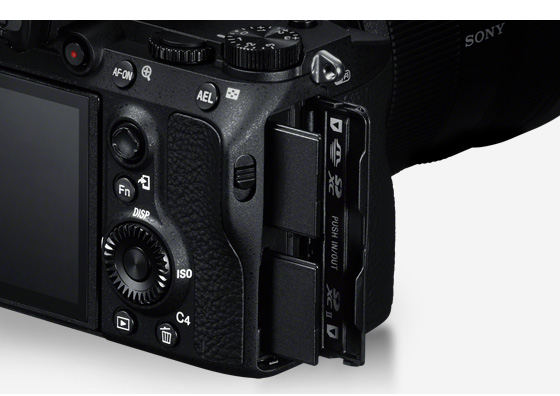
- Two media slots; slot 1 supports UHS-II SD, while the other supports SD/Memory Stick. Simultaneous, relay and separate-media recording supported.
- Ports
- USB Type-C with SuperSpeed USB 3.1 Gen 1, Multi/Micro USB, Micro HDMI, microphone and headphone sockets, sync terminal and Multi Interface Shoe.
- Wireless connections
- Wi-Fi IEEE 802.11b/g/n at 2.4 GHz and NFC.
- Battery life detail
- NP-FZ100; CIPA approximately 650 photographs using the LCD or 530 using the viewfinder. In-camera charging and power via USB Type-C or Multi/Micro USB.
- Dimensions
- Approximately 126.9 × 95.6 × 73.7 mm (width × height × maximum depth); grip-to-monitor depth 62.7 mm.
- Weight detail
- Approximately 572 g body only; 657 g with battery and memory card; lens excluded.
- Materials
- Magnesium-alloy body; dust- and moisture-resistant design does not guarantee protection against ingress.
- In the box
- Power cord, NP-FZ100 battery, cable protector, BC-QZ1 charger, shoulder strap, body cap, accessory shoe cap, eyepiece cup and USB Type-C cable, according to Sony Japan.
Pros and cons
Pros
- 10 fps continuous shooting with AF/AE tracking
- Five-axis sensor-shift stabilisation
- Dual memory-card slots and internal 4K video
Cons
- Only one card slot supports UHS-II
- Screen tilts rather than fully articulating
Closest rivals
Model | Type | Sensor | Megapixels | Lens | Video | Body weight | Released |
|---|---|---|---|---|---|---|---|
| Mirrorless | Full frame | 24.2 | Sony E-mount | 3840 × 2160 at 30 fps | 588 g | May 2017 | |
| Mirrorless | Full frame | 26.2 | Canon RF | 3840 × 2160 at 25 fps | 440 g | Mar 2019 | |
| Mirrorless | Full frame | 24.2 | L-Mount | 3840 × 2160 at 60 fps | 899 g | Mar 2019 |


Sources
Photo: sony.jp
- Sony Alpha 7R III, rear controls and open memory-card slot cover: Sony, official exact-model Japan product feature photograph; corresponding physical layout explicitly published on both Alpha 7R III and Alpha 7R IIIA exact-model feature pages
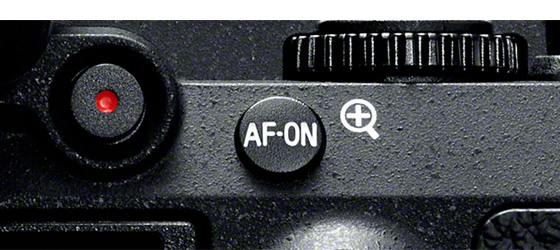
- Sony Alpha 7R III, AF-ON button and rear controls detail: Sony, official exact-model Japan product feature photograph; corresponding physical layout explicitly published on both Alpha 7R III and Alpha 7R IIIA exact-model feature pages
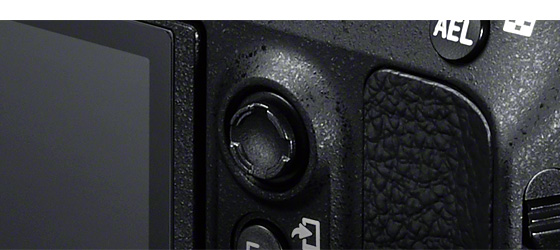
- Sony Alpha 7R III, multi-selector and rear grip detail: Sony, official exact-model Japan product feature photograph; corresponding physical layout explicitly published on both Alpha 7R III and Alpha 7R IIIA exact-model feature pages
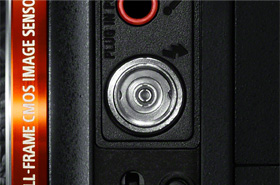
- Sony Alpha 7R III, flash synchronisation terminal detail: Sony, official exact-model Japan product feature photograph; corresponding physical layout explicitly published on both Alpha 7R III and Alpha 7R IIIA exact-model feature pages