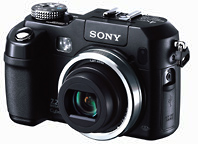
Sony Cyber-shot DSC-V3 · Sony Japan archived DSC-V3 photograph, native 440 × 330 pixels; complete supplied canvas and white background retained
Sony · Cyber-shot
Cyber-shot DSC-V3
A seven-megapixel manual compact with RAW recording, infrared night shooting and separate Memory Stick and CompactFlash slots.
- Type
- Compact
- Sensor
- 1/1.8-type
- Megapixels
- 7.2
- Lens
- 34–136 mm equivalent
- Video
- 640 × 480 at 30 fps
- Body weight
- 360 g
What reviewers say
Both reviewers praised the comfortable grip, quick autofocus and large screen, while finding startup slower than everyday shooting. ITmedia considered its conventional controls and expandable design well balanced, and found higher-ISO images useful despite noise. DPReview was more critical of noise reduction, sharpening halos and the tendency to select small apertures that soften detail; RAW saving and burst clearing interrupt shooting.
From dpreview.com, itmedia.co.jp, itmedia.co.jp and itmedia.co.jp
Specifications
Report a wrong or missing specImage and sensor
- Camera type
- Compact
- Sensor format
- 1/1.8-type
- Sensor type
- Super HAD CCD
- Effective resolution
- 7.2 MP
- Largest image
- 3072 × 2304
- RAW recording
- Yes
- Standard ISO range
- 100–800
- Sensor detail
- 1/1.8-type interlaced Super HAD CCD with primary-colour filter; approximately 7.41 million total and 7.201 million effective photosites. Optical format is not physical sensor dimensions
- Image formats
- JPEG Fine/Standard, RAW plus JPEG, or uncompressed TIFF plus JPEG; maximum 3072 × 2304 or 3072 × 2048 in 3:2
- Image processor
- Real Imaging Processor
Lens and shooting
- Built-in lens
- 34–136 mm equivalent
- Maximum aperture
- f/2.8–4
- Optical zoom
- 4×
- Maximum continuous burst
- 1 fps
- Lens detail
- Carl Zeiss Vario-Sonnar, actual 7–28 mm, 34–136 mm equivalent; optional conversion lenses and adapter
- Autofocus
- Five-area Multipoint, Center or movable Flexible Spot AF; Single, Monitor and Continuous AF modes. Hologram AF laser-pattern assist; fourteen preset manual-focus distances from 0.1 m to infinity. Macro approximately 10 cm wide or 40 cm telephoto
- Shutter
- Auto 1/8–1/2000 second, Program 1–1/2000, shutter-priority and Manual 30–1/1000; slow-shutter noise reduction
- Burst detail
- Normal full-resolution Burst has approximately 1.0-second intervals, up to fifteen Fine or twenty-eight Standard JPEGs at 7M. Brief Speed Burst uses approximately 0.4-second intervals, up to eight full-resolution JPEGs; flash disabled. Reduced Multi Burst combines sixteen frames into one 1M image. No RAW/TIFF bursts
- Flash
- Built-in rotating pop-up flash; hot shoe and ACC terminal for external flash. Manual recommends ISO Auto range 0.4–3.0 m wide or 0.4–2.5 m telephoto; red-eye reduction and slow sync
- Exposure controls
- P/A/S/M, Auto and seven scene modes; multi-pattern, centre-weighted and spot metering; ±2 EV in 1/3 EV steps, AE lock and live histogram. NightShot records infrared photographs; NightFraming uses infrared framing followed by flash for natural-colour photographs
Video
- Highest video resolution
- 640 × 480 at 30 fps
- Video detail
- MPEG Movie VX Fine, 640 × 480 at 30 effective fps, requires Memory Stick PRO or PRO Duo with adapter. Standard 640 × 480 at approximately 16.6 fps or 160 × 112 at approximately 8.3 fps; recording to available media capacity
- Audio
- MPEG1 mono sound, electret condenser microphone and built-in speaker
Screen and viewfinder
- Viewfinder
- Optical
- Screen size
- 2.5″
- Screen dots
- 123,000
- Touchscreen
- No
- Tilting screen
- No
- Display detail
- Fixed 2.5-type TFT LCD with 123000 dots; live histogram and adjustable brightness
- Viewfinder detail
- Optical zoom viewfinder without dioptre adjustment; DPReview measured approximately 84% coverage
Connections and design
- Battery life (maker's claim)
- 300 photographs
- Body weight
- 360 g
- Release detail
- Sony US announcement specifies availability in late October 2004; Sony Japan specifies 5 November. October month precision retained without assuming an international first-sale day
- Recording media
- Separate Memory Stick and CompactFlash Type I slots selected by rear switch; Memory Stick Duo/PRO Duo require adapter. Type II and Microdrive not supported
- Ports
- Mini-B USB 2.0 Hi-Speed with PictBridge, mono A/V minijack with NTSC/PAL output, DC input and 2.5 mm ACC accessory jack
- Battery life detail
- NP-FR1 InfoLITHIUM, 4.4 Wh/1220 mAh; manual claims approximately 300 photographs/150 minutes with LCD on or 400/200 minutes off at 25°C, CIPA-based Fine JPEG, one shot every 30 seconds, alternating zoom ends, flash every second shot, power cycle every ten shots and Single AF
- Charging
- NP-FR1 charges inside camera through supplied AC-LS5/LS5B adapter and DC input
- Dimensions
- 119.8 × 72.0 × 63.0 mm (width × height × depth), excluding maximum protrusions
- Weight detail
- Approximately 360 g body only in Sony Japan announcement; manual gives 410 g including NP-FR1, Memory Stick and shoulder strap
- Colours
- Black
- In the box
- NP-FR1 and battery case, AC adapter/mains lead, USB and A/V cables, shoulder strap, two software CD-ROMs and instructions; supplied memory card varies by market
Pros and cons
Pros
- P/A/S/M and RAW plus JPEG recording
- Hologram AF assist and infrared NightShot
- Dual card slots and external flash support
Cons
- Fixed low-resolution screen and viewfinder without dioptre adjustment
- Speed Burst limited to eight frames
- No RAW continuous shooting
Closest rivals
Model | Type | Sensor | Megapixels | Lens | Video | Body weight | Released |
|---|---|---|---|---|---|---|---|
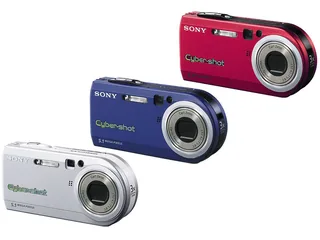
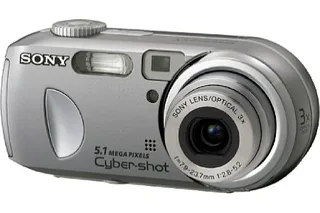
| Compact | 1/1.8-type | 5.1 | 38–114 mm equivalent | 640 × 480 at 30 fps | 147 g | 2004 | |
| Compact | 1/1.8-type | 7.2 | 38–114 mm equivalent | 640 × 480 at 30 fps | 147 g | 2004 | |
| Compact | 1/1.8-type | 5.1 | 38–114 mm equivalent | 640 × 480 at 30 fps | 175 g | 2004 |

Sources
- sony.jp/CorporateCruise/Press/200409/09-0909
- sony.jp/cyber-shot/emdown/data/V3_opening.pdf
- sony.mediaroom.com/2004-08-30-Versatility-Quality-and-Design-Collide-in-Sonys-N…
- dpreview.com/reviews/5114325929/sonydscv3
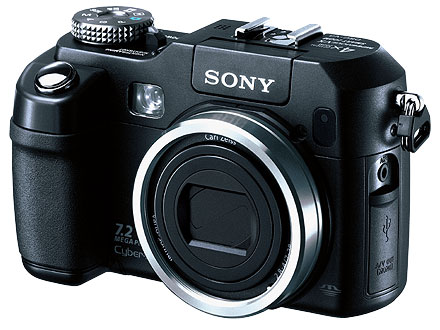
- Sony Cyber-shot DSC-V3 with lens extended: Sony Japan DSC-V3 launch photograph, native 198 × 144 pixels; complete supplied canvas and white background retained