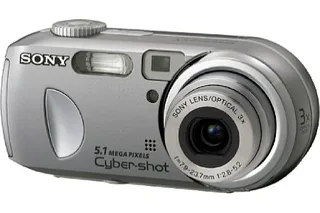
Sony Cyber-shot DSC-P93 vs Sony Cyber-shot DSC-V3
Better figure, where one is clearly better
| SonyCyber-shot DSC-P93 | SonyCyber-shot DSC-V3 | |
|---|---|---|
| Overview | ||
| Released | 2004 | October 2004 |
| Image and sensor | ||
| Camera type | Compact | Compact |
| Sensor format | 1/1.8-type | 1/1.8-type |
| Sensor type | Super HAD CCD | Super HAD CCD |
| Effective resolution | 5.1 MP | 7.2 MP |
| Largest image | 2592 × 1944 | 3072 × 2304 |
| RAW recording | No | Yes |
| Standard ISO range | 100–400 | 100–800 |
| Sensor detail | 1/1.8-type Super HAD CCD with 5.1 million effective photosites in Sony UK specifications; Sony operating instructions 3-091-340-12(1), DSC-P73/P93, mirrored at Manualzilla, give P93 effective 5,090,000 and total 5,255,000 photosites | 1/1.8-type interlaced Super HAD CCD with primary-colour filter; approximately 7.41 million total and 7.201 million effective photosites. Optical format is not physical sensor dimensions |
| Image formats | JPEG still images and MPEG-1 movies; Exif, DCF and DPOF compatibility. No RAW recording listed in maker recording formats | JPEG Fine/Standard, RAW plus JPEG, or uncompressed TIFF plus JPEG; maximum 3072 × 2304 or 3072 × 2048 in 3:2 |
| ISO detail | Auto or ISO 100, 200 or 400 | – |
| Image processor | Real Imaging Processor in the Sony US announcement; 14-bit DXP, Clear Luminance NR, Clear Colour NR and NR Slow Shutter in exact UK specifications | Real Imaging Processor |
| Lens and shooting | ||
| Built-in lens | 38–114 mm equivalent | 34–136 mm equivalent |
| Maximum aperture | f/2.8–5.2 | f/2.8–4 |
| Optical zoom | 3× | 4× |
| Maximum continuous burst | – | 1 fps |
| Lens detail | Physical focal length 7.9–23.7 mm, equivalent to 38–114 mm, F2.8–5.2. Macro from 10 cm wide or 60 cm tele. Smart Zoom up to 12× total at VGA; Precision Digital Zoom up to 6× total, separate from 3× optical zoom. Conversion lenses require optional VAD-PEB adaptor; UK table gives 30 mm filter diameter with adaptor compatibility; exact P93 manual gives normal focus from 50 cm wide or 60 cm tele | Carl Zeiss Vario-Sonnar, actual 7–28 mm, 34–136 mm equivalent; optional conversion lenses and adapter |
| Autofocus | Multi-point or centre autofocus with AF illuminator; focus presets 0.5, 1, 3, 7 m and infinity. Sony UK explicitly distinguishes presets from continuous manual focus | Five-area Multipoint, Center or movable Flexible Spot AF; Single, Monitor and Continuous AF modes. Hologram AF laser-pattern assist; fourteen preset manual-focus distances from 0.1 m to infinity. Macro approximately 10 cm wide or 40 cm telephoto |
| Shutter | Auto 1/8–1/2000 second; Manual 30–1/1000 second in the exact UK table. NR Slow Shutter processing; do not substitute manual-mode range for Auto | Auto 1/8–1/2000 second, Program 1–1/2000, shutter-priority and Manual 30–1/1000; slow-shutter noise reduction |
| Burst detail | Sony UK gives approximately 0.8-second interval and nine-image burst. Sony US launch specifies nine shots at 1.2 fps; limited burst, not unrestricted continuous shooting. Multi Burst records sixteen subframes in one composite rather than sixteen full-resolution stills | Normal full-resolution Burst has approximately 1.0-second intervals, up to fifteen Fine or twenty-eight Standard JPEGs at 7M. Brief Speed Burst uses approximately 0.4-second intervals, up to eight full-resolution JPEGs; flash disabled. Reduced Multi Burst combines sixteen frames into one 1M image. No RAW/TIFF bursts |
| Flash | Built-in Auto, forced, slow-sync and off modes, red-eye reduction and Auto Daylight Synchronized Flash. Published range 0.2–3.5 m wide or 0.6–2.5 m tele. No hot, accessory or advanced accessory shoe | Built-in rotating pop-up flash; hot shoe and ACC terminal for external flash. Manual recommends ISO Auto range 0.4–3.0 m wide or 0.4–2.5 m telephoto; red-eye reduction and slow sync |
| Exposure controls | Auto and manual aperture/shutter settings, ±2 EV in 1/3 EV steps, multi-pattern metering, histogram and three-step contrast/saturation/sharpness adjustments. No aperture-priority mode; Twilight, Twilight Portrait, Soft Snap, Landscape, Beach and Candle scenes | P/A/S/M, Auto and seven scene modes; multi-pattern, centre-weighted and spot metering; ±2 EV in 1/3 EV steps, AE lock and live histogram. NightShot records infrared photographs; NightFraming uses infrared framing followed by flash for natural-colour photographs |
| Video | ||
| Highest video resolution | 640 × 480 at 30 fps | 640 × 480 at 30 fps |
| Video detail | MPEG VX Fine 640×480 at 30 fps; Sony US launch requires suitable high-speed Memory Stick PRO for this mode. Maximum frame rate does not describe every card or recording-quality mode; Sony manual documents MPEG-1 mono audio and no zoom adjustment during movie recording | MPEG Movie VX Fine, 640 × 480 at 30 effective fps, requires Memory Stick PRO or PRO Duo with adapter. Standard 640 × 480 at approximately 16.6 fps or 160 × 112 at approximately 8.3 fps; recording to available media capacity |
| Audio | – | MPEG1 mono sound, electret condenser microphone and built-in speaker |
| Screen and viewfinder | ||
| Viewfinder | Optical | Optical |
| Screen size | 1.5″ | 2.5″ |
| Screen dots | 134,000 | 123,000 |
| Touchscreen | No | No |
| Tilting screen | No | No |
| Display detail | Fixed 1.5-inch TFT LCD, 134,000 dots and 100% published coverage; dots are colour-subpixel counts, not recorded-image pixels. Histogram indicator and automatic bright monitoring; shared DSC-P73/P93 maker manual gives exact 134,400 dots (560×240), versus UK table rounded 134,000 | Fixed 2.5-type TFT LCD with 123000 dots; live histogram and adjustable brightness |
| Viewfinder detail | Real-image optical finder, separate from the LCD | Optical zoom viewfinder without dioptre adjustment; DPReview measured approximately 84% coverage |
| Connections and design | ||
| Bluetooth | No | – |
| Battery life (maker's claim) | 410 photographs | 300 photographs |
| Body weight | 175 g (better) | 360 g |
| Release detail | Sony US announced planned May 2004 availability on 11 February. Pixinfo full test dated 23 July 2004 describes contemporary pricing and actual use, establishing actual sale in 2004; first actual retail month unresolved, so year precision retained. This record is DSC-P93; later DSC-P93A manual and hardware are not substituted. No explicit maker predecessor relationship established | Sony US announcement specifies availability in late October 2004; Sony Japan specifies 5 November. October month precision retained without assuming an international first-sale day |
| Recording media | Memory Stick and Memory Stick PRO with parallel PRO interface. UK supplied card is 32 MB MSA-32AN, while generic US launch says 16 MB across the range; exact UK bundle retained | Separate Memory Stick and CompactFlash Type I slots selected by rear switch; Memory Stick Duo/PRO Duo require adapter. Type II and Microdrive not supported |
| Ports | USB with explicitly confirmed USB 2.0 Hi-Speed, PTP and PictBridge; A/V out. No multi-use or accessory terminal in UK table | Mini-B USB 2.0 Hi-Speed with PictBridge, mono A/V minijack with NTSC/PAL output, DC input and 2.5 mm ACC accessory jack |
| Battery life detail | Two AA NH-AA-DA nickel-metal hydride rechargeable cells supplied; AA alkaline also supported. Maker claims 410 shots / 205 minutes in normal shooting conditions measured by CIPA; do not treat minutes as continuous movie duration; manual conditions: LCD on, Fine quality, Single AF, 25°C, one shot every 30 seconds, alternating zoom ends, flash every second shot and power restart every ten. Manual 9,200 images / 460 minutes is playback, not shooting | NP-FR1 InfoLITHIUM, 4.4 Wh/1220 mAh; manual claims approximately 300 photographs/150 minutes with LCD on or 400/200 minutes off at 25°C, CIPA-based Fine JPEG, one shot every 30 seconds, alternating zoom ends, flash every second shot, power cycle every ten shots and Single AF |
| Charging | Supplied external BC-CS2 battery charger; full charge time not established in the exact UK specification | NP-FR1 charges inside camera through supplied AC-LS5/LS5B adapter and DC input |
| Dimensions | 117.2×53.7×35.8 mm width×height×depth in exact UK specifications; manual excludes protruding parts | 119.8 × 72.0 × 63.0 mm (width × height × depth), excluding maximum protrusions |
| Weight detail | 175 g camera weight and 236 g with accessories are separate Sony UK figures; main weight uses camera-only figure; manual specifies loaded 236 g includes two batteries, Memory Stick and wrist strap | Approximately 360 g body only in Sony Japan announcement; manual gives 410 g including NP-FR1, Memory Stick and shoulder strap |
| Colours | – | Black |
| In the box | Two NH-AA-DA AA Ni-MH rechargeable cells, BC-CS2 charger, A/V cable, USB cable, 32 MB Memory Stick MSA-32AN, wrist strap and software CD in the UK specification | NP-FR1 and battery case, AC adapter/mains lead, USB and A/V cables, shoulder strap, two software CD-ROMs and instructions; supplied memory card varies by market |

More comparisons
- Sony Cyber-shot DSC-RX100 VII vs Sony Cyber-shot DSC-V3
- Sony Cyber-shot DSC-HX99 vs Sony Cyber-shot DSC-V3
- Sony Cyber-shot DSC-HX99 vs Sony Cyber-shot DSC-P93
- Sony Cyber-shot DSC-HX350 vs Sony Cyber-shot DSC-V3
- Sony Cyber-shot DSC-HX350 vs Sony Cyber-shot DSC-P93
- Sony Cyber-shot DSC-HX80 vs Sony Cyber-shot DSC-V3
- Sony Cyber-shot DSC-HX80 vs Sony Cyber-shot DSC-P93
- Sony Cyber-shot DSC-HX90V vs Sony Cyber-shot DSC-V3
- Sony Cyber-shot DSC-HX90V vs Sony Cyber-shot DSC-P93
- Sony Cyber-shot DSC-V3 vs Sony Cyber-shot DSC-WX500
- Sony Cyber-shot DSC-P93 vs Sony Cyber-shot DSC-WX500
- Sony Cyber-shot DSC-HX400V vs Sony Cyber-shot DSC-V3
- Sony Cyber-shot DSC-HX60V vs Sony Cyber-shot DSC-V3
- Sony Cyber-shot DSC-HX400V vs Sony Cyber-shot DSC-P93
- Sony Cyber-shot DSC-HX60V vs Sony Cyber-shot DSC-P93
- Sony Cyber-shot DSC-H400 vs Sony Cyber-shot DSC-V3