Apple AppleVision 850 vs Apple AppleVision 850AV
Better figure, where one is clearly better
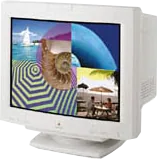
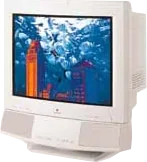
| AppleAppleVision 850 | AppleAppleVision 850AV | |
|---|---|---|
| Overview | ||
| Released | May 1997 | 1997 |
| Display | ||
| Screen size | 19″ | 19″ |
| Panel | CRT (Nominal 20-inch Trinitron CRT, 19-inch viewable image, 0.26 mm stripe pitch and 0.25 mm grille pitch per Service Source; no fixed native pixel matrix) | CRT (Nominal 20-inch Trinitron CRT, 19-inch viewable image, 0.26 mm stripe pitch and 0.25 mm grille pitch per Service Source; no fixed native pixel matrix) |
| Colour modes | DigitalColor calibration to original factory measurements, with ambient-light and phosphor-age adjustments; ColorSync support for screen-to-print matching. Brochure white-point selection 4100–9300 K and gamma controls. | DigitalColor internal calibration to original factory measurements, with ambient-light and phosphor-age adjustments; ColorSync support. Maker TIL specifies variable white point 4100–9300 K and gamma controls. |
| Supported signal modes | Service Source lists 640 × 480 at 60, 67, 72, 75 or 85 Hz; 800 × 600 at 56, 60, 72, 75 or 85 Hz; 832 × 624 at 75 Hz; 1024 × 768 at 60, 70, 75 or 85 Hz, plus 87 Hz interlaced; 1152 × 870 at 75 Hz; 1280 × 1024 at 75 or 85 Hz; and 1600 × 1200 at 75 Hz. Horizontal scan range 30–94 kHz and vertical range 48–120 Hz. These are supported CRT signal modes, not native resolution or native refresh. November 1997 brochure instead prints 55 Hz for the two lowest modes; Service Source's detailed timing tables are retained. | Service Source lists 640 × 480 at 60, 67, 72, 75 or 85 Hz; 800 × 600 at 56, 60, 72, 75 or 85 Hz; 832 × 624 at 75 Hz; 1024 × 768 at 60, 70, 75 or 85 Hz, plus 87 Hz interlaced;1152 × 870 at 75 Hz; 1280 × 1024 at 75 or 85 Hz; and 1600 × 1200 at 75 Hz. Horizontal scan range 30–94 kHz and vertical range 48–120 Hz. These are supported signal modes, not native resolution or native refresh; availability depends on computer and video card. |
| Screen coating | Multilayer antireflection panel and antistatic coating | Multilayer antireflection panel and antistatic coating |
| Connections | ||
| Video inputs | DA-15 | DA-15 |
| USB-C charging | None | None |
| Speakers | No | Yes |
| Other connections | Captive Macintosh DA-15 analogue RGB video cable with integrated ADB connection; supplied PC VGA adaptor. Two ADB pass-through output ports. Non-AV 850 has neither integrated speakers nor microphone; AV connections and audio specifications are not copied. | Captive Macintosh DA-15 analogue RGB video cable with ADB connection; supplied PC VGA adaptor and two ADB pass-through device ports. Built-in directional microphone, microphone input and stereo headphone connector. |
| Speaker detail | – | Stereo speakers with ported bass-reflex enclosure; Service Source states greater than 90 dB SPL at 1 kHz at 0.5 m, and 80 Hz–17 kHz ±6 dB response. These are maker audio claims. TIL's ambiguous 5 volts RMS wording is not converted to watts. |
| Design | ||
| Stand adjusts | Tilt, swivel | Tilt, swivel |
| Weight with stand | 30 kg | 35 kg |
| Tilt | −5° to +15° | −5° to +15° |
| Swivel | At least ±45° | At least ±45° |
| Size with stand | Service Source gives 474 × 484 × 515 mm, each ±3 mm (height × width × depth); November 1997 brochure gives 47.5 × 48.5 × 51.5 cm | Service Source 553 × 484 × 545 mm, each ±3 mm (height × width × depth); archived TIL instead gives 55.5 × 48.5 × 59.5 cm. Both are maker figures with differing depth. |
| Weight detail | Service Source publishes 30 kg (67 lb); November 1997 maker brochure instead gives 30.6 kg (67.4 lb), distinct from 35.7 kg fully boxed. Main field retains Service Source's monitor weight. | Service Source gives 35 kg (77 lb); archived TIL gives 35.4 kg (78 lb) for the display and 41.9 kg (92.1 lb) fully boxed. Main field retains Service Source monitor weight; shipping weight is not substituted. |
| Controls | Front power, brightness, contrast and five buttons for on-screen controls. Additional geometry, colour and gamma controls through Mac Monitors & Sound control panel or Windows on-screen controls; automatic power-on degauss. | Front power, brightness, contrast and five on-screen control buttons; bass, treble, volume, microphone and speaker mute. Additional picture controls through Mac Monitors & Sound panel or Windows on-screen controls. Automatic power-on degauss. |
| Power and support | ||
| Power use | Service Source and November 1997 maker brochure 150 W maximum; brochure less than 30 W standby and less than 5 W suspend/CPU energy-saving. EveryMac's secondary 180 W figure is not substituted. | Service Source 190 W maximum; archived TIL instead 180 W operating maximum, less than 30 W standby and 5 W with speakers off or 30 W with speakers on in suspend/CPU energy-saving |
| Power supply | 90–264 V AC, 47–63 Hz; these mains ratings are not screen refresh rates | Service Source 90–264 V AC, 47–63 Hz; TIL instead separates 90–132 and 198–264 V bands. Mains frequency is not display refresh. |
| Software | System 7.1 or later and 68040 or later Macintosh processors for AppleVision software; Windows 95 compatibility with supplied adaptor. Maker 5 May 1997 press release says non-AV850 available immediately worldwide while 850AV was expected in June; no AV date substituted. Service Source explicitly describes the November 1997 ColorSync Display rename as the only product change at that point; no duplicate renamed model or unsupported successor link. Brightness and contrast ratio are unpublished. | System 7.1 or later, 68040 or later Macintosh processors for AppleVision software; Windows 95 compatibility via supplied adaptor. Maker 5 May 1997 press release expected 850AV availability in June, while non-AV 850 was immediately available; actual first retail month remains unverified, so year 1997 is retained. Service Source says November 1997 ColorSync AV rename alone changed no product hardware. No duplicate renamed model or inferred successor link. Brightness and contrast ratio unpublished. |
| Certifications | Original TCO 92, MPR II, EPA Energy Star and VESA DPMS. Service Source identifies later TCO 95 replacement plastics from January 1998 only for non-AV ColorSync units carrying the rear TCO 95 mark. | TCO 92, MPR II, EPA Energy Star and VESA DPMS; later TCO 95 non-AV ColorSync housing change does not apply to this AV model according to Service Source |
More comparisons
- Apple AppleVision 850 vs Apple Studio Display (2026)
- Apple AppleVision 850 vs Apple Studio Display XDR
- Apple AppleVision 850AV vs Apple Studio Display (2026)
- Apple AppleVision 850AV vs Apple Studio Display XDR
- Apple AppleVision 850 vs Sony GDM-F520
- Apple AppleVision 850AV vs Sony GDM-F520
- Apple AppleVision 850 vs Sony GDM-FW900
- Apple AppleVision 850 vs Apple Studio Display (21-inch CRT, 1999)
- Apple AppleVision 750 Display vs Apple AppleVision 850
- Apple AppleVision 750 Display vs Apple AppleVision 850AV
- Apple AppleVision 850 vs Apple Multiple Scan 20 Display
- Apple AppleVision 1710AV vs Apple AppleVision 850
- Apple AppleVision 1710AV vs Apple AppleVision 850AV
- Apple AppleVision 850AV vs Apple Multiple Scan 20 Display