Apple iBook (1999) vs Apple MacBook (Retina, 12-inch, Early 2016)
Better figure, where one is clearly better
| AppleiBook (1999) | AppleMacBook (Retina, 12-inch, Early 2016) | |
|---|---|---|
| Overview | ||
| Released | September 1999 | April 2016 |
| Display | ||
| Screen size | 12.1″ | 12″ |
| Resolution | 800 × 600 | 2304 × 1440 (better) |
| Panel | – | IPS LCD |
| Touchscreen | No | No |
| Display type | 12.1-inch active-matrix TFT SVGA display; exact size confirmed by SFGate's full original-model review. Panel technology, brightness and built-in refresh unpublished. | Retina display; LED-backlit IPS; 16:10 aspect ratio; millions of colours |
| Pixel density | – | 226 ppi |
| Display features | – | Scaled resolutions of 1440 × 900, 1280 × 800 or 1024 × 640 |
| Performance | ||
| Processor | PowerPC G3 300 MHz (iBook 1999) | Intel Core m3-6Y30, Intel Core m5-6Y54 or Intel Core m7-6Y75 |
| CPU cores | 1 | 2 |
| CPU threads | – | 4 |
| Graphics | ATI Rage Mobility (4 MB) | Intel HD Graphics 515 |
| Memory | 32 MB or 288 MB | 8 GB (better) |
| Storage | 3.2 GB | 256 GB to 512 GB (better) |
| CPU | 300 MHz PowerPC G3; 66 MHz data path, 64 KB L1 cache and 512 KB L2 cache. Exact supplier and silicon model omitted because the maker sheet does not publish them. | Dual-core Intel Core m3 at Apple's configured 1.1 GHz, up to 2.2 GHz; Core m5 at 1.2 GHz, up to 2.7 GHz; or Core m7 at 1.3 GHz, up to 3.1 GHz. All have 4 MB L3 cache. Exact m3-6Y30, m5-6Y54 and m7-6Y75 identifiers confirmed by Notebookcheck; Apple's configured base clocks differ from Intel's nominal frequencies. |
| GPU | ATI Rage Mobility with 4 MB video memory and AGP 2× support (SFGate and Macworld exact-model reviews). | Intel HD Graphics 515 |
| Memory type | 32 MB onboard and one SO-DIMM slot. The retained maker sheet supports 288 MB total for the original; contemporary reviews described the earlier 160 MB maximum. | 8 GB of 1866 MHz LPDDR3 onboard memory |
| Storage type | 3.2 GB IDE hard drive and 24× CD-ROM drive; the 6 GB stocks belong to the February 2000 refresh. | PCIe-based onboard flash storage; 256 GB with the Core m3 base or 512 GB with Core m5; either can be ordered with Core m7 |
| Cooling | – | Fanless design with no moving parts or vents |
| Battery and size | ||
| Battery life (maker's claim) | Up to 6 hours | Up to 11 hours |
| Battery capacity | 45 Wh (better) | 41.4 Wh |
| Weight | – | 0.92 kg |
| Thickness | – | 13.1 mm |
| Width × depth | – | 280.5 × 196.5 mm |
| Battery life detail | 45 Wh lithium-ion battery; Apple’s six-hour claim is reported in the exact SFGate review. The maker publishes 6.7 pounds and dimensions 11.6 H × 13.5 W × 1.8 D inches; ambiguous axes and unpublished metric figures are not converted. | Up to 10 hours wireless web, 11 hours iTunes movie playback or 30 days standby; lithium-polymer. Maker specification sheet says 41.4 Wh; TechRadar's spec table says 39.4 Wh. Chassis tapers from 3.5 to 13.1 mm; weight varies by configuration and manufacturing process. |
| Charger | – | 29 W USB-C Power Adapter |
| Materials | Coloured clamshell enclosure with rubber bumpers, translucent plastics and retractable handle (Macworld). | Aluminium unibody enclosure |
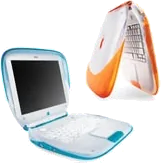
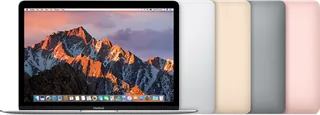
| Colours | Blueberry and white; Tangerine and white | Rose Gold, Space Grey, Gold, Silver |
| Connections | ||
| Ports | USB-A, Ethernet, headphone jack | USB-C, headphone jack |
| Wi-Fi | Optional AirPort 802.11b | Wi-Fi 5 |
| Bluetooth | – | 4.0 |
| Webcam | – | 480p FaceTime |
| Operating system | macOS | macOS |
| Port detail | One USB port, 10/100BASE-T Ethernet, internal 56K modem and stereo headphone output. No FireWire, video-out, PC Card slot or audio input. AirPort requires an optional internal card. | USB-C supports charging, USB 3.1 Gen 1 up to 5 Gb/s and native DisplayPort 1.2; VGA and HDMI through separate multiport adaptors. The 3.5 mm jack supports iPhone headsets with remote and microphone. No Thunderbolt support (Macworld). |
| External displays | No built-in external display output | One display up to 3840 × 2160 at 30 Hz alongside the built-in display, at millions of colours |
| Keyboard | Full-size keyboard and embedded numeric keypad; lift-out keyboard provides memory access (Macworld). | Full-size keyboard with 78 US or 79 ISO individually backlit keys, 12 function keys, four arrow keys and an ambient light sensor; shallow butterfly mechanism (Macworld) |
| Trackpad | Built-in trackpad with a separate button | Force Touch with pressure sensing, Force clicks, accelerators, pressure-sensitive drawing and Multi-Touch gestures |
| Speakers | Single built-in speaker | Stereo speakers |
| Microphones | No built-in microphone | Dual microphones |
| In the box | Mac OS 8.6 at launch. Apple’s spokesperson confirmed September 1999 shipping in Bryan Chaffin’s Mac Observer report; the July 1999 introduction is not the on-sale date. Macworld’s retail test is labelled January 2000 in the article despite its incorrect migrated webpage date. | MacBook; 29 W USB-C Power Adapter; USB-C Charge Cable (2 m) |
More comparisons
- Apple MacBook (Retina, 12-inch, Early 2016) vs Apple MacBook Air 13″ (M5)
- Apple iBook (1999) vs Apple MacBook Air 13″ (M5)
- Apple MacBook (Retina, 12-inch, Early 2016) vs Apple MacBook Air 13″ (M1)
- Apple MacBook (Retina, 12-inch, 2017) vs Apple MacBook (Retina, 12-inch, Early 2016)
- Apple iBook (1999) vs Apple MacBook (Retina, 12-inch, 2017)
- Apple MacBook (Retina, 12-inch, Early 2015) vs Apple MacBook (Retina, 12-inch, Early 2016)
- Apple MacBook (Retina, 12-inch, Early 2016) vs Apple MacBook (13-inch, Mid 2010)
- Apple MacBook (Retina, 12-inch, Early 2016) vs Apple MacBook (13-inch, Late 2009)
- Apple MacBook (Retina, 12-inch, Early 2016) vs Apple MacBook (13-inch, Mid 2009)
- Apple MacBook (Retina, 12-inch, Early 2016) vs Apple MacBook (13-inch, Early 2009)
- Apple MacBook (Retina, 12-inch, Early 2016) vs Apple MacBook (13-inch, Aluminum, Late 2008)
- Apple MacBook (Retina, 12-inch, Early 2016) vs Apple MacBook (13-inch, Late 2008)
- Apple MacBook (Retina, 12-inch, Early 2016) vs Apple MacBook (13-inch, Early 2008)
- Apple MacBook (Retina, 12-inch, Early 2016) vs Apple MacBook (13-inch, Late 2007)
- Apple MacBook (Retina, 12-inch, Early 2016) vs Apple MacBook (13-inch, Mid 2007)
- Apple MacBook (Retina, 12-inch, Early 2016) vs Apple MacBook (13-inch, Late 2006)