Apple iMac G4 (15-inch, Flat Panel) vs Apple iMac (Retina 4K, 21.5-inch, 2019)
Better figure, where one is clearly better
| AppleiMac G4 (15-inch, Flat Panel) | AppleiMac (Retina 4K, 21.5-inch, 2019) | |
|---|---|---|
| Overview | ||
| Released | January 2002 | March 2019 |
| Performance | ||
| Processor | Motorola PowerPC G4 700 MHz (iMac Flat Panel) or Motorola PowerPC G4 800 MHz (iMac Flat Panel) | Intel Core i3-8100, Intel Core i7-8700 or Intel Core i5-8500 |
| CPU cores | 1 | 4 or 6 |
| CPU threads | – | 4, 6 or 12 |
| Graphics | NVIDIA GeForce2 MX (32 MB) | Radeon Pro 555X (2 GB GDDR5), Radeon Pro 560X (4 GB GDDR5) or Radeon Pro Vega 20 (4 GB HBM2) |
| Memory | 128 MB, 256 MB or 1 GB | 8 GB, 16 GB or 32 GB (better) |
| Storage | 40 GB to 60 GB | 256 GB to 1 TB (better) |
| CPU | 700 or 800 MHz PowerPC G4 with 256 KB on-chip L2 cache and 100 MHz system bus. Generic maker-clock chip records retain the single-core identity cross-checked with exact EveryMac sources; an uncertain silicon revision is not inferred. | 3.6 GHz quad-core Core i3 without Turbo Boost, or 3.0 GHz six-core Core i5 with Turbo Boost up to 4.1 GHz; both configurable to 3.2 GHz six-core Core i7 with Turbo Boost up to 4.6 GHz |
| GPU | NVIDIA GeForce2 MX with 32 MB dedicated DDR video memory and AGP 2x support. | Radeon Pro 555X with 2 GB GDDR5 in the lower base; Radeon Pro 560X with 4 GB GDDR5 in the upper base, configurable to Radeon Pro Vega 20 with 4 GB HBM2 |
| Memory type | SDRAM, expandable to 1 GB, with one 168-pin DIMM and one user-accessible SO-DIMM slot. Launch CD-RW base: 128 MB; Combo and SuperDrive bases: 256 MB. Configurations conservatively show those published bases and the maker's maximum. | 8 GB standard, configurable to 16/32 GB; lower base uses 2400 MHz DDR4 and upper base 2666 MHz DDR4. Memory is not readily user-accessible. |
| Storage type | Launch combinations: 700 MHz with CD-RW and 40 GB hard drive; 700 MHz with Combo drive and 40 GB; 800 MHz with SuperDrive and 60 GB. Optical options on the 700 MHz model account for its different base memory. Drives use Ultra ATA. Combo reads DVDs and writes CDs; SuperDrive writes DVDs and CDs. | The current Apple sheet lists 256 GB SSD or 1 TB Fusion Drive for both bases, and these are the configurations shown. Apple made SSD storage standard in August 2020. Launch reviews describe a 1 TB hard drive in the lower base and 1 TB Fusion Drive in the upper base, with larger SSD options (Macworld and TechRadar); these historical options are not flattened into the current matrix. |
| Display | ||
| Screen size | 15″ | 21.5″ |
| Resolution | 1024 × 768 | 4096 × 2304 (better) |
| Panel | – | IPS LCD |
| Brightness | 200 nits | 500 nits (better) |
| Display type | TFT active-matrix LCD with millions of colours and typical 300:1 contrast. Panel technology and refresh rate are not established by the exact maker sheet. | LED-backlit Retina 4K display; IPS panel confirmed by EveryMac; Apple does not publish native refresh rate in this model’s specification sheet |
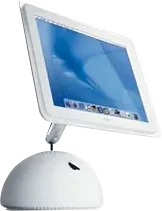
| Display features | Typical viewing angles: 120° horizontal and 90° vertical. Articulated arm adjusts the display's height and angle. | Wide colour (P3); supports one billion colours |
| Connections | ||
| Ports | 3 × USB-A, Ethernet, headphone jack | 2 × Thunderbolt 3, 4 × USB-A, SD card slot, Ethernet, headphone jack |
| Ethernet | 0.1 Gb/s | 1 Gb/s (better) |
| External displays | – | Up to 2 |
| Wi-Fi | – | 802.11ac |
| Bluetooth | – | 4.2 |
| Camera | – | FaceTime HD |
| Back ports | Three USB 1.1 ports on the computer, plus two on the keyboard; two FireWire 400 ports with 8 W shared power, Mini-VGA, 10/100BASE-T Ethernet, 56K V.90 modem, headphone jack and Apple speaker minijack. Original AirPort 802.11b card is optional; wireless networking is not standard. | Four USB-A ports; two Thunderbolt 3 USB-C ports with DisplayPort, Thunderbolt up to 40 Gb/s and USB 3.1 Gen 2 up to 10 Gb/s; SDXC, Gigabit Ethernet and 3.5 mm headphone jack; Kensington lock slot. Thunderbolt 2, HDMI, DVI and VGA require separately sold adapters. |
| External displays | Mini-VGA provides video mirroring through an optional VGA adapter: 640 × 480 at 60 Hz, 800 × 600 at 75 Hz or 1024 × 768 at 75 Hz. The original model does not list S-video or composite output. | Built-in display at full native resolution alongside one 5120 × 2880 display at 60 Hz with one billion colours, two 3840 × 2160 displays at 60 Hz with one billion colours, or two 4096 × 2304 displays at 60 Hz with millions of colours |
| Speakers | Built-in speaker and microphone; selected configurations include Apple Pro Speakers rated at 9 W each with an internal 18 W amplifier. | Stereo speakers |
| Microphones | – | Built-in microphone |
| Keyboard and mouse | Apple Pro Keyboard and Apple Pro Mouse; Apple Pro Speakers are included with the Combo and SuperDrive launch configurations. | Rechargeable Magic Keyboard and Magic Mouse 2; optional Magic Keyboard with Numeric Keypad and Magic Trackpad 2 |
| Design and power | ||
| Type | All-in-one | All-in-one |
| Weight | 9.7 kg | 5.48 kg (better) |
| Width × depth × height | – | 528 × 175 × 450 mm |
| Operating system | macOS | macOS |
| Size and weight detail | Adjustable maker ranges: height 329–509 mm, width 384–415 mm and depth 270–415 mm; base diameter 270 mm. The reference weight varies by configuration and manufacturing process, so no single fixed-position dimension is selected. | Dimensions include the stand; current Apple sheet lists 5.48 kg and warns that weight varies by configuration. Launch reviews tested heavier hard-drive/Fusion configurations. A built-in VESA mount version was also available. |
| Power supply | 90–264 V AC, 47–63 Hz, single phase; maximum continuous power 130 W. | 100–240 V AC, 50–60 Hz, single phase |
| Materials | – | Recyclable aluminium enclosure; arsenic-free glass and mercury-free LED backlight |
| In the box | Launch software: Mac OS X 10.1.2 and Mac OS 9.2.2, with iTunes, iMovie and iPhoto; iDVD requires SuperDrive. The 800 MHz SuperDrive configuration was stated to ship in late January 2002, the 700 MHz Combo in February and CD-RW in March. The release month records the first configuration, not the 7 January announcement. | iMac, Magic Keyboard, Magic Mouse 2, power lead and Lightning to USB cable |

More comparisons
- Apple iMac 24″ (M4) vs Apple iMac (Retina 4K, 21.5-inch, 2019)
- Apple iMac (Retina 4K, 21.5-inch, 2019) vs Apple Mac mini (M4 or M4 Pro)
- Apple iMac 24″ (M4) vs Apple iMac G4 (15-inch, Flat Panel)
- Apple iMac 24″ (M3) vs Apple iMac (Retina 4K, 21.5-inch, 2019)
- Apple iMac 24″ (M3) vs Apple iMac G4 (15-inch, Flat Panel)
- Apple iMac 24″ (M1) vs Apple iMac (Retina 4K, 21.5-inch, 2019)
- Apple iMac 24″ (M1) vs Apple iMac G4 (15-inch, Flat Panel)
- Apple iMac (Retina 4K, 21.5-inch, 2019) vs Apple iMac (Retina 5K, 27-inch, 2020)
- Apple iMac G4 (15-inch, Flat Panel) vs Apple iMac (Retina 5K, 27-inch, 2020)
- Apple iMac (Retina 4K, 21.5-inch, 2017) vs Apple iMac (Retina 4K, 21.5-inch, 2019)
- Apple iMac (Retina 4K, 21.5-inch, 2019) vs Apple iMac (Retina 5K, 27-inch, 2019)
- Apple iMac (21.5-inch, 2017) vs Apple iMac (Retina 4K, 21.5-inch, 2019)
- Apple iMac (21.5-inch, Mid 2011) vs Apple iMac (Retina 4K, 21.5-inch, 2019)
- Apple iMac (21.5-inch, Mid 2010) vs Apple iMac (Retina 4K, 21.5-inch, 2019)
- Apple iMac (20-inch, Early 2008) vs Apple iMac (Retina 4K, 21.5-inch, 2019)
- Apple iMac Pro (2017) vs Apple iMac (Retina 4K, 21.5-inch, 2019)