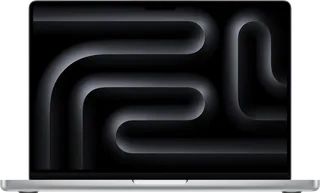
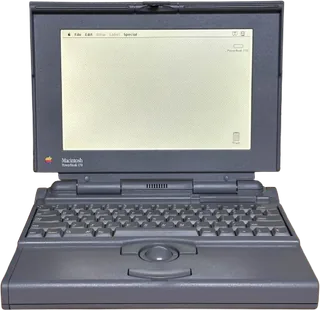
Apple MacBook Pro 14″ (M5) vs Apple Macintosh PowerBook 170
Better figure, where one is clearly better
| AppleMacBook Pro 14″ (M5) | AppleMacintosh PowerBook 170 | |
|---|---|---|
| Overview | ||
| Released | October 2025 | October 1991 |
| Display | ||
| Screen size | 14.2″ | 10″ |
| Resolution | 3024 × 1964 (better) | 640 × 400 |
| Panel | Mini-LED | – |
| Refresh rate | 120 Hz | – |
| Brightness | 1,000 nits | – |
| HDR peak brightness | 1,600 nits | – |
| Touchscreen | No | No |
| Display type | Liquid Retina XDR display | 10-inch backlit active-matrix monochrome LCD, 640 × 400 pixels at 1-bit colour. Apple's 1991 product information rounds the diagonal to 10 inches; some later catalogues call it 9.8 inches. |
| Pixel density | 254 ppi | – |
| Colour range | Wide colour (P3); 1 billion colours | – |
| Screen finish | Standard, or nano-texture as an option | – |
| Display features | 1,000,000:1 contrast; 1,000 nits sustained full-screen XDR brightness; ProMotion up to 120 Hz, with fixed 47.95, 48, 50, 59.94 and 60 Hz rates; True Tone | – |
| Performance | ||
| Processor | Apple M5 | 68030 25 MHz (PowerBook 170) |
| CPU cores | 10 | 1 |
| Graphics | 10-core GPU | – |
| Memory | 16 GB, 24 GB or 32 GB (better) | 4 MB |
| Storage | 1 TB to 4 TB (better) | 40 MB |
| CPU | 10-core CPU with 4 super cores and 6 efficiency cores | 25 MHz Motorola 68030 and 25 MHz Motorola 68882 floating-point coprocessor; a Power Saver mode could run the processor at 16 MHz on battery. |
| GPU | Neural Accelerators; hardware-accelerated ray tracing; Media Engine with H.264, HEVC, ProRes and ProRes RAW acceleration and AV1 decode | – |
| AI engine | 16-core Neural Engine | – |
| Memory type | Unified memory | 4 MB original configuration, comprising 2 MB on the logic board and a 2 MB expansion card; 8 MB maximum. Apple's later support sheet lists 2 MB as the minimum across its service configurations. |
| Memory bandwidth | 153 GB/s | – |
| Storage type | SSD, configurable up to 4 TB | Original 40 MB internal SCSI hard drive with a built-in 1.4 MB SuperDrive floppy drive. Apple's later support sheet lists 40–80 MB drives. |
| Battery and size | ||
| Battery life (maker's claim) | Up to 24 hours | Up to 3 hours |
| Battery capacity | 72.4 Wh | – |
| Weight | 1.55 kg (better) | 3.03 kg |
| Thickness | 15.5 mm | – |
| Width × depth | 312.6 × 221.2 mm | – |
| Battery life detail | Up to 16 hours wireless web; lithium-polymer battery | Removable nickel-cadmium battery; Apple claimed 2–3 hours of use, with about 30 minutes more in its 16 MHz Power Saver mode. |
| Charger | Sold separately in the UK (70 W or 96 W Apple USB-C adapters offered); needs at least 60 W over USB PD | – |
| Fast charging | With a 96 W or higher USB PD power source | – |
| Materials | 100% recycled aluminium enclosure; 45% recycled content overall | – |
| Colours | Space Black, Silver | – |
| Connections | ||
| Ports | 3 × Thunderbolt 4, HDMI, SD card slot, MagSafe 3, headphone jack | – |
| Wi-Fi | Wi-Fi 6E | – |
| Bluetooth | 5.3 | – |
| Webcam | 12MP Center Stage | – |
| Operating system | macOS | macOS |
| Port detail | 3 × Thunderbolt 4 (USB-C) with charging, DisplayPort, Thunderbolt 4 and USB 4 (up to 40 Gb/s); HDMI with multichannel audio output; SDXC card slot; MagSafe 3; 3.5 mm headphone jack with high-impedance headphone support | One Apple Desktop Bus (ADB) port, HDI-30 SCSI connector, two RS-422 serial ports, mono audio input and stereo output. A 2400-baud internal modem was standard. |
| External displays | Up to two over any mix of Thunderbolt and HDMI at 6K 60 Hz or 4K 144 Hz, or one at up to 8K 60 Hz, 5K 120 Hz or 4K 240 Hz, alongside the built-in display | – |
| Keyboard | Backlit Magic Keyboard, 78 (ANSI) or 79 (ISO) keys including 12 full-height function keys | Built-in keyboard with a centred 30 mm trackball below the keys. |
| Trackpad | Force Touch trackpad | Built-in trackball. |
| Speakers | Six-speaker sound system with force-cancelling woofers; wide stereo; Spatial Audio with Dolby Atmos | – |
| Microphones | Studio-quality three-mic array with directional beamforming; Voice Isolation and Wide Spectrum modes | – |
| Biometrics | Touch ID | – |
| In the box | 14-inch MacBook Pro, USB-C to MagSafe 3 Cable (2 m), polishing cloth (nano-texture display only); power adapter sold separately | System 7.0.1, battery and AC adapter. Apple dates the model's introduction to 21 October 1991; the technical sheet does not state a separate first-sale day. |
More comparisons
- Apple MacBook Pro 14″ (M5) vs Apple MacBook Pro 14″ (M5 Pro or M5 Max)
- Apple MacBook Pro 14″ (M5) vs Apple MacBook Pro 16″ (M5 Pro or M5 Max)
- Apple MacBook Pro 14″ (M1 Pro / M1 Max) vs Apple MacBook Pro 14″ (M5)
- Apple MacBook Pro 14″ (M2 Pro / M2 Max) vs Apple MacBook Pro 14″ (M5)
- Apple MacBook Pro 14″ (M4) vs Apple MacBook Pro 14″ (M5)
- Apple MacBook Pro 14″ (M3) vs Apple MacBook Pro 14″ (M5)
- Apple MacBook Pro (13-inch, 2020, Four Thunderbolt 3 ports) vs Apple MacBook Pro 14″ (M5)
- Apple MacBook Pro (13-inch, 2019, Two Thunderbolt 3 ports) vs Apple MacBook Pro 14″ (M5)
- Apple MacBook Pro 14″ (M5) vs Apple MacBook Pro (Retina, 13-inch, Early 2015)
- Apple MacBook Pro (13-inch, 2017, Two Thunderbolt 3 ports) vs Apple MacBook Pro 14″ (M5)
- Apple MacBook Pro (13-inch, 2017, Four Thunderbolt 3 ports) vs Apple MacBook Pro 14″ (M5)
- Apple MacBook Pro (13-inch, 2019, Four Thunderbolt 3 ports) vs Apple MacBook Pro 14″ (M5)
- Apple MacBook Pro (13-inch, 2018, Four Thunderbolt 3 ports) vs Apple MacBook Pro 14″ (M5)
- Apple MacBook Pro (13-inch, 2016, Four Thunderbolt 3 ports) vs Apple MacBook Pro 14″ (M5)
- Apple MacBook Pro 14″ (M5) vs Apple MacBook Pro (Retina, 13-inch, Late 2013)
- Apple MacBook Pro 14″ (M5) vs Apple MacBook Pro (Retina, 13-inch, Late 2012)