Apple Multiple Scan 17 Display vs Apple Multiple Scan 1705 Display
Better figure, where one is clearly better
| AppleMultiple Scan 17 Display | AppleMultiple Scan 1705 Display | |
|---|---|---|
| Overview | ||
| Released | April 1994 | 1995 |
| Display | ||
| Screen size | 16.1″ | 15.8″ |
| Panel | CRT (Nominal 17-inch Trinitron CRT, 16.1-inch viewable image and 0.26 mm stripe pitch; no fixed native pixel matrix) | CRT (Nominal 17-inch flat-square shadow-mask colour CRT, 15.8-inch viewable diagonal, P22 phosphor and 0.28 mm dot pitch. Analogue CRT has no fixed native pixel matrix.) |
| Pixel pitch | – | Maker 0.28 mm dot pitch |
| Colour modes | Digital controls for colour temperature; TidBITS launch coverage reports 5000, 6500 and 9300 K settings | – |
| Supported signal modes | Apple's support sheet lists 640 × 480 at 59.95, 66.7 or 75 Hz; 800 × 600 at 55.98, 60 or 75 Hz; 832 × 624 at 75 Hz; and 1024 × 768 at 60 or 75 Hz. Service Source gives horizontal scan range 29–82 kHz and vertical range 50–150 Hz; ranges are not a native refresh rate. Supported modes depend on computer and adaptor. | Current maker support and owner's guide list 640 × 480 at 60, 67 or 75 Hz, 800 × 600 at 60 or 75 Hz, 832 × 624 at 75 Hz and 1024 × 768 at 75 Hz. Apple Facts additionally publishes 1280 × 1024 at 60 Hz for Windows; the owner's guide confirms a 640 × 480 to 1280 × 1024 range. Service Source's separate 1280 × 1024 at 84 Hz entry conflicts with its scan range and other maker tables, so it is not treated as a confirmed operating mode. These are supported analogue signals, not a native matrix or native refresh rate. |
| Screen coating | Bonded glass panel with multilayer antiglare and antistatic coating | Owner's guide specifies antistatic and antiglare surface treatment |
| Connections | ||
| Video inputs | DA-15 | VGA |
| USB-C charging | None | None |
| Speakers | – | No |
| Other connections | Captive Macintosh 15-pin DA-15 analogue RGB video cable. Two front ADB device ports and rear ADB pass-through; front microphone input and speaker/headphone output with rear sound-in and sound-out connections to the computer. These are pass-through audio ports, not a claim of integrated speakers. MCmicrocomputer describes the supplied VGA adaptor and audio/ADB cables. | Physical monitor video socket is VGA DE-15; original detachable Apple cable connects it to the Macintosh DA-15 computer connector. Owner's guide describes a supplied PC adapter at the computer end, or a DDC display cable without that adapter; exact-model cable inspection by Siber-Sonic corroborates the DE-15 monitor connection. The cable's Macintosh end is not a second monitor input. |
| Design | ||
| Stand adjusts | Tilt, swivel | Tilt, swivel |
| Weight with stand | 22.5 kg | 20.5 kg |
| Tilt | – | Built-in tilt-and-swivel stand; numerical range unpublished |
| Swivel | – | Built-in tilt-and-swivel stand; numerical range unpublished |
| Size with stand | Apple support lists 16.7 × 15.9 × 17.8 inches (height × width × depth); Service Source separately publishes 424 × 405 × 452.3 mm | Owner's guide publishes 437 × 420 × 477 mm ±5 mm (height × width × depth), paired with 17.2 × 16.5 × 18.8 inches ±0.2 inch. Service Source instead gives 437 × 420 × 479 mm with differing inch values; Apple Facts gives 43.7 × 41.9 × 47.8 cm. Maker differences retained rather than converted or combined. |
| Weight detail | Service Source publishes 22.5 kg (50 lb); no conversion from the pounds-only support sheet | Owner's guide and Service Source publish 20.5 kg; owner's guide also gives approximately 45.2 lb, matching current maker support. Apple Facts instead pairs 45.2 lb with 20.3 kg; maker difference retained. |
| Controls | Front-panel power, reset, brightness and contrast; image position, size, rotation, convergence and colour temperature. Automatic degauss on power-up. | Front power, brightness, contrast, degauss, select, up and down controls; additional controls adjust horizontal/vertical shift and size, curvature and side alignment. Pressing up and down together recalls factory settings. |
| Power and support | ||
| Power use | Maximum 150 W; Energy Star power conservation | Current maker support gives 165 W maximum; owner's guide and Service Source instead publish 100 W maximum. Energy Star and VESA DPMS power-saving support confirmed; exact idle wattage unpublished. |
| Power supply | 90–132 or 198–260 V AC, 47–63 Hz; mains figures are not display refresh rates | Current maker support lists regional 90–132 or 198–264 V AC, 47–63 Hz; owner's guide gives 100–240 V, 50/60 Hz and Service Source describes a universal 90–264 V supply. Mains frequency is not display refresh. |
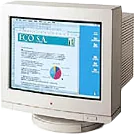
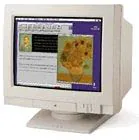
| Software | System 7.1 or later; older Macintosh models may require additional adaptors beyond 640 × 480. Contemporary Apple press release reproduced in the newsletter dated 11 April 1994 states availability that month, corroborated by TidBITS 25 April. Apple's later support archive instead lists March 1994 introduction; April retail month is retained. Brightness and contrast ratio are unpublished. | Owner's guide supplies display software and ColorSync support for Macintosh; compatible video hardware and suitable cable or adapter determine usable modes. Current Apple support dates introduction 23 September 1995 and the exact model is present in October 1995 Apple Facts; actual first on-sale day/month remains unverified, so year 1995 retained. No direct successor inferred. Low-resolution photograph is the exact Apple Computer image credited by EveryMac. |
| Certifications | EPA Energy Star; MPR II emissions compliance described in TidBITS launch coverage | – |
More comparisons
- Apple Multiple Scan 1705 Display vs Apple Studio Display (2026)
- Apple Multiple Scan 17 Display vs Apple Studio Display (2026)
- Apple Multiple Scan 17 Display vs Apple Studio Display XDR
- Apple Multiple Scan 17 Display vs Apple Studio Display (17-inch CRT ADC, 2000)
- Apple Multiple Scan 1705 Display vs Apple Studio Display (17-inch CRT, 1999)
- Apple AppleVision 750 Display vs Apple Multiple Scan 17 Display
- Apple Multiple Scan 17 Display vs Apple Multiple Scan 720 Display
- Apple Multiple Scan 1705 Display vs Apple Multiple Scan 720 Display
- Apple AppleVision 1710AV vs Apple Multiple Scan 17 Display
- Apple AppleVision 1710AV vs Apple Multiple Scan 1705 Display
- Apple Multiple Scan 14 Display vs Apple Multiple Scan 1705 Display
- Apple Multiple Scan 14 Display vs Apple Multiple Scan 17 Display
- Apple Multiple Scan 15 Display vs Apple Multiple Scan 1705 Display
- Apple Multiple Scan 1705 Display vs Apple Multiple Scan 20 Display
- Apple Multiple Scan 15 Display vs Apple Multiple Scan 17 Display
- Apple Multiple Scan 17 Display vs Apple Multiple Scan 20 Display