Apple Multiple Scan 1705 Display vs Apple Multiple Scan 20 Display
Better figure, where one is clearly better
| AppleMultiple Scan 1705 Display | AppleMultiple Scan 20 Display | |
|---|---|---|
| Overview | ||
| Released | 1995 | March 1994 |
| Display | ||
| Screen size | 15.8″ | 19.1″ |
| Panel | CRT (Nominal 17-inch flat-square shadow-mask colour CRT, 15.8-inch viewable diagonal, P22 phosphor and 0.28 mm dot pitch. Analogue CRT has no fixed native pixel matrix.) | CRT (Original nominal 20-inch Trinitron CRT, 19.1-inch viewable image and 0.31 mm stripe pitch; no fixed native matrix. Later Revision B uses a different 0.26 mm tube and is not substituted here.) |
| Pixel pitch | Maker 0.28 mm dot pitch | – |
| Supported signal modes | Current maker support and owner's guide list 640 × 480 at 60, 67 or 75 Hz, 800 × 600 at 60 or 75 Hz, 832 × 624 at 75 Hz and 1024 × 768 at 75 Hz. Apple Facts additionally publishes 1280 × 1024 at 60 Hz for Windows; the owner's guide confirms a 640 × 480 to 1280 × 1024 range. Service Source's separate 1280 × 1024 at 84 Hz entry conflicts with its scan range and other maker tables, so it is not treated as a confirmed operating mode. These are supported analogue signals, not a native matrix or native refresh rate. | Apple's support sheet lists 640 × 480 at 59.95, 66.7 or 75 Hz; 800 × 600 at 75 Hz; 832 × 624 at 75 Hz; 1024 × 768 at 74.93 or 75 Hz; 1152 × 870 at 75 Hz; and 1280 × 1024 at 75 Hz. Service Source gives horizontal scan range 29–82 kHz and vertical range 50–150 Hz. These are supported CRT signal modes, not a native pixel matrix or native refresh rate; modes depend on the computer and adaptor. |
| Screen coating | Owner's guide specifies antistatic and antiglare surface treatment | Bonded glass panel with multilayer antiglare and antistatic coating |
| Connections | ||
| Video inputs | VGA | DA-15 |
| USB-C charging | None | None |
| Speakers | No | – |
| Other connections | Physical monitor video socket is VGA DE-15; original detachable Apple cable connects it to the Macintosh DA-15 computer connector. Owner's guide describes a supplied PC adapter at the computer end, or a DDC display cable without that adapter; exact-model cable inspection by Siber-Sonic corroborates the DE-15 monitor connection. The cable's Macintosh end is not a second monitor input. | Macintosh 15-pin DA-15 analogue RGB cable; VGA computers need a video adaptor. Two front ADB device ports and rear ADB pass-through port. |
| Design | ||
| Stand adjusts | Tilt, swivel | Tilt, swivel |
| Weight with stand | 20.5 kg | 30 kg |
| Tilt | Built-in tilt-and-swivel stand; numerical range unpublished | −5° to +15° |
| Swivel | Built-in tilt-and-swivel stand; numerical range unpublished | At least ±45° |
| Size with stand | Owner's guide publishes 437 × 420 × 477 mm ±5 mm (height × width × depth), paired with 17.2 × 16.5 × 18.8 inches ±0.2 inch. Service Source instead gives 437 × 420 × 479 mm with differing inch values; Apple Facts gives 43.7 × 41.9 × 47.8 cm. Maker differences retained rather than converted or combined. | Apple support publishes 18.7 × 18.7 × 19.7 inches (height × width × depth); Service Source separately lists 474 × 474 × 501.5 mm |
| Weight detail | Owner's guide and Service Source publish 20.5 kg; owner's guide also gives approximately 45.2 lb, matching current maker support. Apple Facts instead pairs 45.2 lb with 20.3 kg; maker difference retained. | Service Source gives monitor weight 30 kg (66 lb), distinct from the 36 kg boxed shipping weight. The later 1995 Apple Facts sheet for the 0.26 mm tube instead gives 29.7 kg. |
| Controls | Front power, brightness, contrast, degauss, select, up and down controls; additional controls adjust horizontal/vertical shift and size, curvature and side alignment. Pressing up and down together recalls factory settings. | Front-panel power, reset, brightness and contrast; image position, size, rotation, convergence and colour-temperature controls. Automatic power-on degauss. |
| Power and support | ||
| Power use | Current maker support gives 165 W maximum; owner's guide and Service Source instead publish 100 W maximum. Energy Star and VESA DPMS power-saving support confirmed; exact idle wattage unpublished. | Maximum 165 W; less than 15 W in Energy Saver mode |
| Power supply | Current maker support lists regional 90–132 or 198–264 V AC, 47–63 Hz; owner's guide gives 100–240 V, 50/60 Hz and Service Source describes a universal 90–264 V supply. Mains frequency is not display refresh. | Service Source specifies 90–132 or 198–264 V AC, 47–63 Hz; support archive instead gives the upper band as 198–260 V. These are mains ratings. |
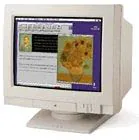
| Software | Owner's guide supplies display software and ColorSync support for Macintosh; compatible video hardware and suitable cable or adapter determine usable modes. Current Apple support dates introduction 23 September 1995 and the exact model is present in October 1995 Apple Facts; actual first on-sale day/month remains unverified, so year 1995 retained. No direct successor inferred. Low-resolution photograph is the exact Apple Computer image credited by EveryMac. | System 7.1 or later; older Macs may need additional adaptors. Apple support identifies March 1994 introduction, and InfoWorld's 14 March 1994 shipping section reports rollout that week; month precision retained. Service Source distinguishes original 0.31 mm hardware from later Revision B 0.26 mm hardware with different deflection board, controller and power supply. No Revision B retail date is inferred. Brightness and contrast ratio are unpublished. |
| Certifications | – | US EPA Energy Star power conservation |
More comparisons
- Apple Multiple Scan 1705 Display vs Apple Studio Display (2026)
- Apple Multiple Scan 20 Display vs Apple Studio Display (2026)
- Apple Multiple Scan 20 Display vs Apple Studio Display XDR
- Apple Multiple Scan 20 Display vs Sony GDM-F520
- Apple Multiple Scan 20 Display vs Sony GDM-FW900
- Apple Multiple Scan 20 Display vs Apple Studio Display (21-inch CRT, 1999)
- Apple Multiple Scan 1705 Display vs Apple Studio Display (17-inch CRT, 1999)
- Apple AppleVision 850 vs Apple Multiple Scan 20 Display
- Apple AppleVision 850AV vs Apple Multiple Scan 20 Display
- Apple Multiple Scan 1705 Display vs Apple Multiple Scan 720 Display
- Apple Multiple Scan 20 Display vs Apple Multiple Scan 720 Display
- Apple AppleVision 1710AV vs Apple Multiple Scan 1705 Display
- Apple Multiple Scan 17 Display vs Apple Multiple Scan 1705 Display
- Apple Multiple Scan 14 Display vs Apple Multiple Scan 1705 Display
- Apple Multiple Scan 14 Display vs Apple Multiple Scan 20 Display
- Apple Multiple Scan 15 Display vs Apple Multiple Scan 1705 Display