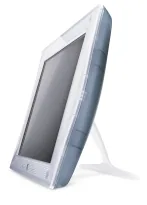
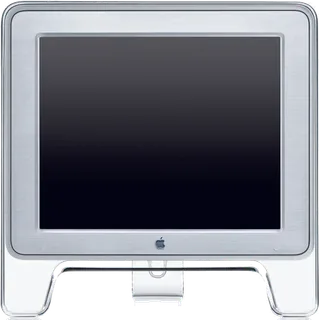
Apple Studio Display (15-inch DVI, 1999) vs Apple Studio Display (17-inch LCD, 2001)
Better figure, where one is clearly better
| AppleStudio Display (15-inch DVI, 1999) | AppleStudio Display (17-inch LCD, 2001) | |
|---|---|---|
| Overview | ||
| Released | December 1999 | June 2001 |
| Display | ||
| Screen size | 15.1″ | 17″ |
| Resolution | 1024 × 768 | 1280 × 1024 (better) |
| Sharpness | 85 pixels per inch | 96 pixels per inch (better) |
| Panel | LCD (TFT active-matrix LCD; Apple does not identify the panel subtype) | LCD (TFT active-matrix LCD; Apple does not identify the panel subtype) |
| Refresh rate | 75 Hz | – |
| Brightness (typical) | 200 nits | 200 nits |
| Contrast ratio | 200:1 | 350:1 |
| Shape | Flat | Flat |
| Colour depth | 24-bit colour, 8 bits per colour channel; up to 16.7 million colours | 24-bit colour; up to 16.7 million colours |
| Viewing angles | Typical 120° horizontal and 90° vertical | Typical 160° horizontal and vertical |
| Connections | ||
| Video inputs | DVI | Apple Display Connector |
| USB-C charging | None | None |
| USB ports | 2 × USB-A | 2 × USB-A |
| Other connections | 24-pin digital DVI connector using TMDS; two downstream USB 1.1 ports and an upstream USB lead. Display cable branches to DVI, USB and external power adaptor. No analogue computer, composite, S-video or audio input. | Integrated ADC cable carries digital video, power and USB; two powered downstream USB ports |
| Design | ||
| Stand adjusts | Height, tilt, swivel (better) | Tilt |
| Weight with stand | 5.5 kg | 6.6 kg |
| Size with stand | Desktop stand, 39.9 × 38.1–49.0 × 24.9 cm (width × height × depth). Picture-frame stand, 15.7 × 11.6 × 6.9 inches, weighing 3.5 kg. Apple datasheet's metric picture-frame height is inconsistent with its inch figure, so the published imperial dimensions are retained. | 44.7 × 43.9 × 17.6–24.9 cm (width × height × depth) |
| Controls | Power/system startup and sleep, plus two brightness buttons on underside of display; software colour calibration through USB | Touch-sensitive system power control |
| Colours | Translucent Graphite and white; distinct digital DVI hardware rather than a colour-only revision | Crystal-clear acrylic enclosure with silver-coloured frame |
| Power and support | ||
| Power use | Below 35 W operating, from December 1999 Apple datasheet. Archived support page labels 35 W as Energy Saver consumption and leaves maximum unknown; datasheet's operating specification retained. | Archived Apple support sheet specifies maximum 40 W operating and 5 W or less in energy-saving mode. Original May 2001 French datasheet instead gives maximum 50 W and less than 35 W respectively; these surviving maker figures conflict. |
| Power supply | External power adaptor, 100–240 V AC at 50–60 Hz; mains frequency is not a published display refresh rate | 24.5 V or 28 V DC through ADC, from Apple's archived technical specifications |
| Software | Apple service manual and revision-specific support note place this DVI model in December 1999; the August date repeated by some secondary histories is not used. Apple Canada's 6 December announcement says it could be ordered and was expected to ship before year-end; first retail month is retained without inventing a day. Native resolution is 1024 × 768; Apple's Japanese support sheet explicitly specifies 70 or 75 Hz at native resolution; the English archived support sheet and December datasheet omit the refresh rates. Maker compatibility is Power Mac G4 with ATI RAGE 128 Pro graphics and built-in USB, running Mac OS 9.0 or later. Maker support lists 15.1-inch viewable size while the datasheet rounds to 15 inches. | Announced 21 May 2001 with first shipments expected in early June; June is used for retail timing. Native refresh is unpublished and omitted. Requires an ADC-equipped computer; Apple's later support sheet also lists compatible DVI Power Mac G4 and PowerBook G4 systems through the powered Apple DVI to ADC Adapter M8661LL/A. Co-marketed with the 15-inch ADC display, so no direct predecessor link is inferred. |
| In the box | Display, desktop stand, picture-frame stand, power cord and adaptor, Apple Displays software and user manual | – |
More comparisons
- Apple Studio Display (17-inch LCD, 2001) vs Apple Studio Display (2026)
- Apple Studio Display (17-inch LCD, 2001) vs Apple Studio Display XDR
- Apple Studio Display (15-inch DVI, 1999) vs Apple Studio Display (2026)
- Apple Studio Display (15-inch DVI, 1999) vs Apple Studio Display XDR
- Apple Studio Display (17-inch LCD, 2001) vs Apple Studio Display (2022)
- Apple Studio Display (15-inch DVI, 1999) vs Apple Studio Display (2022)
- Apple Studio Display (15-inch LCD, 1998) vs Apple Studio Display (17-inch LCD, 2001)
- Apple Studio Display (15-inch LCD, 1999) vs Apple Studio Display (17-inch LCD, 2001)
- Apple Studio Display (15-inch ADC, 2000) vs Apple Studio Display (17-inch LCD, 2001)
- Apple Studio Display (17-inch LCD, 2001) vs Apple Studio Display (17-inch CRT ADC, 2000)
- Apple Studio Display (17-inch LCD, 2001) vs Apple Studio Display (17-inch CRT, 1999)
- Apple Studio Display (17-inch LCD, 2001) vs Apple Studio Display (21-inch CRT, 1999)
- Apple Studio Display (15-inch ADC, 2000) vs Apple Studio Display (15-inch DVI, 1999)
- Apple Studio Display (15-inch DVI, 1999) vs Apple Studio Display (17-inch CRT ADC, 2000)
- Apple Studio Display (15-inch LCD, 1999) vs Apple Studio Display (15-inch DVI, 1999)
- Apple Studio Display (15-inch LCD, 1998) vs Apple Studio Display (15-inch DVI, 1999)