ASUS ROG Ally (2023) vs Nintendo Switch Lite
Better figure, where one is clearly better
| ASUSROG Ally (2023) | NintendoSwitch Lite | |
|---|---|---|
| Overview | ||
| Released | June 2023 | September 2019 |
| Performance | ||
| Type | Handheld | Handheld |
| CPU | AMD Ryzen Z1 or Ryzen Z1 Extreme (Zen 4) | NVIDIA customised Tegra processor |
| GPU | AMD Radeon RDNA 3 (4 CUs with Z1; 12 CUs with Z1 Extreme) | NVIDIA customised Tegra processor (integrated GPU) |
| Memory | 16 GB (better) | 4 GB |
| Storage | 512 GB (better) | 32 GB |
| Disc drive | No | No |
| CPU | Ryzen Z1 Extreme has 8 cores, 16 threads, 24 MB total cache and up to 5.10 GHz boost; Ryzen Z1 has 6 cores, 12 threads, 22 MB total cache and up to 4.90 GHz boost. Both use a 4 nm process and have a published 9–30 W TDP range. | NVIDIA customised Tegra processor (Tegra X1-based ODNX10-A1, according to iFixit) |
| GPU | Ryzen Z1 Extreme has 12 RDNA 3 compute units at up to 2.7 GHz and up to 8.6 TFLOPS; Ryzen Z1 has 4 compute units at up to 2.5 GHz and up to 2.8 TFLOPS. These figures depend on the processor configuration. The three reviews cover the Z1 Extreme model. | – |
| Memory detail | 16 GB LPDDR5-6400 onboard memory in dual channel, shared with integrated graphics | 4 GB LPDDR4X in two 16 Gb Samsung chips (iFixit; not published by Nintendo) |
| Storage detail | 512 GB PCIe 4.0 NVMe M.2 2230 SSD. The Z1 Extreme version first went on sale on 13 June 2023; ASUS announced the Z1 version as available on 18 September 2023. Both current US specification entries list 512 GB; an early 256 GB mention in reviews is not used here. | 32 GB; about 6.2 GB is reserved for the system |
| Storage expansion | UHS-II microSD card reader supports SD, SDHC and SDXC. ASUS's ROG community administrator confirmed in July 2023 that the reader could malfunction under certain thermal stress conditions, announced fan-speed changes and advised affected owners to seek inspection and repair. | microSD, microSDHC and microSDXC cards |
| Display and video | ||
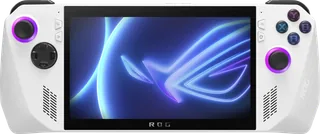
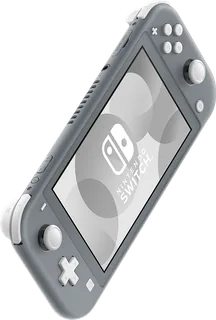
| Built-in screen | 7″ LCD, 1920 × 1080, 120 Hz | 5.5″ LCD, 1280 × 720 |
| Built-in screen | IPS-level touchscreen with 10-point touch, 500 nits brightness, 100% sRGB and 75.35% Adobe RGB coverage; 7 ms response time; Gorilla Glass Victus and Gorilla Glass DXC; anti-glare and low-reflection finish | Capacitive touch screen; 5.5-inch LCD; 1280 × 720. Nintendo doesn't publish the refresh rate |
| Video output | USB-C supports DisplayPort 1.4. The proprietary XG Mobile interface supports ASUS external GPUs; an external GPU's output capabilities are separate from the handheld's integrated graphics. | None |
| Variable refresh rate | AMD FreeSync Premium variable refresh rate | – |
| Audio | Two speakers with Smart Amplifier Technology, Dolby Atmos, built-in microphone array and AI noise cancellation; Hi-Res certification for headphones | Stereo speakers; 3.5 mm headset jack |
| Design and power | ||
| Battery life (maker's claim) | – | Up to 7 hours |
| Weight | 608 g | 275 g (better) |
| Battery life detail | 40 Wh, four-cell lithium-ion battery; ASUS does not publish a gaming runtime in the current specification | About 3 to 7 hours (Nintendo support); the product page says more than six hours depending on the game (roughly four hours in The Legend of Zelda - Breath of the Wild); 3570 mAh; charges in about 3 hours |
| Power use | 65 W USB-C AC adapter, 20 V DC at 3.25 A, with universal 100–240 V input. ASUS says charger inclusion varies by country, region and model. | 4 W while gaming |
| Colours | White. Dimensions are 28.0 × 11.1 × 2.12–3.24 cm (width × depth × height). | Blue, Coral, Yellow, Grey |
| Connections | ||
| Ports | One USB 3.2 Gen 2 Type-C connector within the ROG XG Mobile combo interface; one 3.5 mm headphone/microphone socket; one UHS-II microSD reader | USB-C (charging only) |
| Wi-Fi and Bluetooth | Tri-band Wi-Fi 6E (802.11ax), 2×2 antennas. Current ASUS specifications list Bluetooth 5.4 subject to OS version; the May 2023 launch specification and contemporary reviews list 5.2. | Wi-Fi 5 (IEEE 802.11 a/b/g/n/ac), Bluetooth 4.1, NFC |
| Controller | Offset analogue sticks, D-pad, ABXY buttons, Hall effect analogue triggers, shoulder buttons, two assignable rear grip buttons, View and Menu buttons, Command Center and Armoury Crate buttons; HD haptics, 6-axis IMU and Aura Sync lighting. Fingerprint sensor in the power button and Microsoft Pluton security processor. | Built-in controls with a +Control Pad; Joy-Con can be paired separately |
| Backward compatibility | Windows 11 Home with Armoury Crate SE; supports compatible PC games from launchers including Steam, Xbox, Epic Games Store, EA and GOG. Game compatibility and performance vary by title. | Nintendo Switch game cards only; games must support handheld mode |
More comparisons
- ASUS ROG Ally (2023) vs ASUS ROG Xbox Ally
- ASUS ROG Ally (2023) vs ASUS ROG Xbox Ally X
- Nintendo Switch 2 vs Nintendo Switch Lite
- ASUS ROG Ally (2023) vs MSI Claw 7 AI+
- ASUS ROG Ally (2023) vs ASUS ROG Ally X (2024)
- ASUS ROG Ally (2023) vs MSI Claw A1M
- ASUS ROG Ally (2023) vs Valve Steam Deck OLED
- ASUS ROG Ally (2023) vs Sony PlayStation Portal
- Nintendo Switch Lite vs Sony PlayStation Portal
- ASUS ROG Ally (2023) vs Lenovo Legion Go (2023)
- ASUS ROG Ally (2023) vs Valve Steam Deck LCD
- Nintendo Switch Lite vs Valve Steam Deck LCD
- Nintendo Switch Lite vs Nintendo Switch – OLED Model
- Nintendo Switch Lite vs Sony PSPgo
- Nintendo Switch Lite vs Sony PSP-3000
- Nintendo DS Lite vs Nintendo Switch Lite