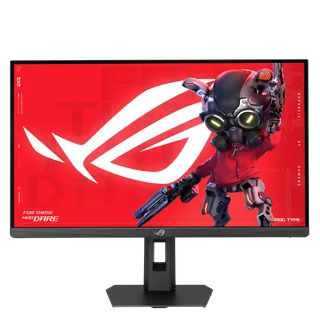
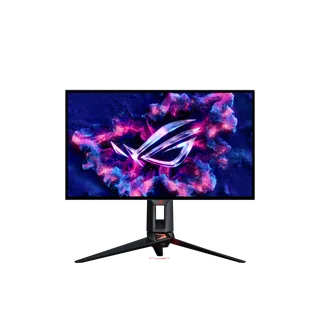
ASUS ROG Strix Pulsar XG27AQNGV vs ASUS ROG Swift OLED PG27UCWM
Better figure, where one is clearly better
| ASUSROG Strix Pulsar XG27AQNGV | ASUSROG Swift OLED PG27UCWM | |
|---|---|---|
| Overview | ||
| Released | January 2026 | July 2026 |
| Display | ||
| Screen size | 27″ | 26.5″ |
| Resolution | 2560 × 1440 (QHD) | 3840 × 2160 (4K) (better) |
| Sharpness | 109 pixels per inch | 166 pixels per inch (better) |
| Panel | IPS (Ultrafast IPS) | OLED (Tandem RGB-stripe WOLED; Dual mode: 1080p at 480 Hz) |
| Refresh rate | 360 Hz (better) | 240 Hz |
| Response time (grey to grey) | 1 ms | 0.03 ms (better) |
| Brightness (typical) | 400 nits (better) | 250 nits |
| HDR peak brightness | 500 nits | 1,000 nits (better) |
| HDR certification | – | DisplayHDR True Black 400 |
| HDR formats | HDR10 | HDR10, Dolby Vision |
| Contrast ratio | 1,000:1 | 1,500,000:1 |
| Colour range | 90% DCI-P3 | 99% DCI-P3, 130% sRGB |
| DCI-P3 coverage | 90% | 99% (better) |
| Screen finish | Matte | Glossy |
| Shape | Flat | Flat |
| Adaptive sync | G-Sync, VESA AdaptiveSync | G-Sync Compatible, FreeSync Premium Pro, VESA AdaptiveSync |
| Subpixel layout | – | RGB stripe (no white subpixel) |
| Colour depth | 10-bit, 1073.7M colours (ASUS's user guide lists 16.7M colours) | 10-bit (1073.7M colours) |
| sRGB coverage | – | 130% |
| Colour accuracy | Delta E < 2 | Delta E < 2 |
| Colour modes | GameVisual: Scenery, Racing, Cinema, RTS/RPG, G-SYNC Esports, sRGB | GameVisual: Scenery, Racing, Cinema, RTS/RPG, FPS, sRGB, MOBA |
| HDR detail | – | ASUS notes the 1,000 cd/m² HDR peak may vary due to colour pre-calibration |
| Response time detail | Overdrive modes: Extreme, Esports, Normal, Off | – |
| Motion blur reduction | NVIDIA G-SYNC Pulsar (variable-frequency backlight strobing with VRR), Pulsar Low FPS; ULMB 2 when G-SYNC is off | Extreme Low Motion Blur (ELMB) |
| Viewing angles | 178° / 178° (CR ≥ 10) | 178° / 178° (CR ≥ 10) |
| Pixel pitch | 0.233 mm | 0.153 mm |
| Eye care | TÜV-certified Flicker-free and Low Blue Light (hardware solution); G-SYNC Ambient Adaptive brightness and colour temperature via a built-in light sensor | TÜV-certified Flicker-free, OLED Anti-Flicker |
| Burn-in protection | – | ASUS OLED Care Pro (pixel cleaning, screen move, boundary detection, logo and taskbar detection, outer and global dimming, target mode); Neo Proximity Sensor with five sensitivity levels and a 1–15 minute auto-away timer; custom heatsink; GaNFET power supply |
| Calibration | Colour pre-calibration report in the box | Factory pre-calibrated; calibration report via DisplayWidget Center |
| Connections | ||
| Video inputs | 2 × HDMI 2.1, DisplayPort 1.4 | 2 × HDMI 2.1, DisplayPort 2.1 UHBR20, USB-C |
| USB-C charging | None | Up to 90 W (better) |
| USB ports | 3 × USB-A | 3 × USB-A |
| KVM switch | No | Yes |
| Ethernet | No | No |
| Speakers | No | No |
| HDMI detail | 2 × HDMI 2.1 (FRL); 50–120 Hz vertical range | 2 × HDMI 2.1 (FRL, 48 Gbps) |
| DisplayPort detail | DisplayPort 1.4 with DSC; 59–360 Hz vertical range | Full 80 Gbps bandwidth (listed as DisplayPort 2.1a in ASUS's press release) |
| USB-C detail | – | DisplayPort Alt Mode |
| USB hub detail | 3 × USB 3.2 Gen 1 Type-A, 1 × USB 3.2 Gen 1 Type-B upstream | 3 × USB 3.2 Gen 1 Type-A (5 V / 0.9 A), USB-B upstream |
| Picture by picture | – | PIP and PBP |
| Audio out | Earphone jack | Earphone jack |
| Design | ||
| Stand adjusts | Height, tilt, swivel, pivot | Height, tilt, swivel, pivot |
| VESA mount | Yes | Yes |
| Weight with stand | 6.5 kg | 8.1 kg |
| Height adjustment | 0–110 mm | 0–110 mm |
| Tilt | +20° to −5° | +20° to −5° |
| Swivel | +45° to −45° | +30° to −30° |
| Pivot | +90° to −90° | +90° to −90° |
| VESA pattern | 100 × 100 mm | 100 × 100 mm |
| Size with stand | 61.4 × 50.3 × 18.8 cm (W × H × D) | 60.6 × 54.8 × 25.6 cm (W × H × D, highest position) |
| Size without stand | 61.4 × 36.7 × 8.6 cm (W × H × D) | 60.6 × 36.9 × 6.3 cm (W × H × D) |
| Weight without stand | 4.3 kg | 5.4 kg |
| Controls | 5-way button, close button, two shortcut buttons (GamePlus and GameVisual by default) and power button | 5-way control button and close button on the back; hotkeys for Dual Mode, GamePlus, GameVisual, volume and pixel cleaning |
| Colours | Black | Black |
| Power and support | ||
| Power use | Under 38 W on; under 0.5 W standby; under 0.3 W off | Under 50 W on; under 0.5 W power saving; under 0.3 W off |
| Energy class | F (SDR), G (HDR) | F (SDR), G (HDR) |
| Power supply | External AC adapter, 20 V 9 A | 100–240 V AC, 50/60 Hz |
| Software | – | DisplayWidget Center; ASUS Display Control CLI and Agent Skill |
| Certifications | G-SYNC Pulsar, TÜV Flicker-free, TÜV Low Blue Light (Hardware Solution) | TÜV Flicker-free; VESA AdaptiveSync Display (240 Hz and 480 Hz) |
| Warranty | – | 3 years (including panel burn-in) |
| In the box | DisplayPort cable, power adapter, power cord, colour pre-calibration report, ROG pouch, quick start guide, warranty card | DisplayPort 2.1 (DP80) cable, HDMI Ultra High Speed cable, USB-C cable, USB 3.2 cable, power cord, VESA mount kit, microfiber cloth, ROG pouch, ROG sticker, quick start guide, warranty card |
More comparisons
- ASUS ROG Swift OLED PG27UCWM vs Dell Alienware 27 4K QD-OLED (AW2725Q)
- ASUS ROG Swift OLED PG27UCWM vs Samsung Odyssey OLED G8 G81SF 27-inch
- ASUS ROG Strix OLED XG27UCDMG vs ASUS ROG Swift OLED PG27UCWM
- ASUS ROG Swift OLED PG27UCWM vs ASUS ROG Swift OLED PG32UCDM
- ASUS ROG Strix Pulsar XG27AQNGV vs Dell Alienware 27 280Hz (AW2726DL)
- AOC Q27G4SRU vs ASUS ROG Strix Pulsar XG27AQNGV
- ASUS ROG Strix Pulsar XG27AQNGV vs MSI MAG 275QF X32
- ASUS ROG Strix OLED XG27UCDMG vs ASUS ROG Strix Pulsar XG27AQNGV
- ASUS ROG Strix Pulsar XG27AQNGV vs ASUS ROG Swift OLED PG32UCDM