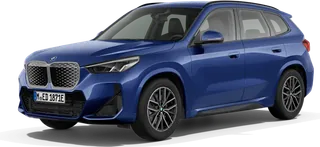
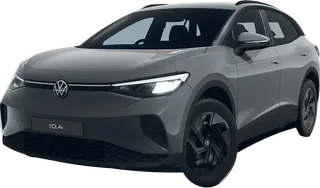
BMW iX1 vs Volkswagen ID.4
Better figure, where one is clearly better
| BMWiX1 | VolkswagenID.4 | |
|---|---|---|
| Overview | ||
| Released | November 2022 | January 2021 |
| Performance | ||
| Powertrain | Electric | Electric |
| Power | 201–308 bhp | 187–335 bhp (better) |
| 0–62 mph | 5.6–8.6 s | 5.4–8.5 s (better) |
| Top speed | 106–112 mph | 99–112 mph |
| Engine or motors | eDrive20: front motor, 150 kW (204 hp); xDrive30: two motors, 230 kW (313 hp); bhp converted from BMW's kW figures | Rear motor, 190 PS (140 kW) or 286 PS (210 kW); 4MOTION adds a front motor for 299 PS (220 kW) or 340 PS (250 kW); bhp converted from Volkswagen's PS figures |
| Torque | 250 Nm (eDrive20), 494 Nm (xDrive30) | 350 Nm (190 PS), 545 Nm (286 PS) |
| Gearbox | Single-speed automatic | Single-speed automatic |
| Drive | Front-wheel drive (eDrive20) or all-wheel drive (xDrive30) | Rear-wheel drive; four-wheel drive on 4MOTION versions |
| Range and charging | ||
| Zero-emission range (WLTP) | 286–318 miles | 268–351 miles (better) |
| Battery | 64.7 kWh | 58–79 kWh (better) |
| Fastest charging | 130 kW | 105–185 kW (better) |
| Range detail | WLTP: eDrive20 Sport 297–318 miles, xLine 288–313, M Sport 283–312, Shadow Edition 283–308; xDrive30 xLine 269–289, M Sport 265–288, Shadow Edition 265–286 | WLTP combined: 265–268 miles (Pure), 342–351 miles (Pro), 336–341 miles (Pro 4MOTION), 325 miles (GTX Edition); city 349–454 miles |
| Charging | 64.7 kWh usable battery (BMW UK press information; current technical page lists 65–65.2 kWh capacity); DC up to 130 kW, 10–80% in 29 minutes; AC 11 kW (6.5 hours) or optional 22 kW (3.75 hours) | 10–80% DC in 26 min (Pure, 105 kW), 29 min (Pro and Pro 4MOTION, 165 kW) or 27 min (GTX, 185 kW); 11 kW AC takes 6 h 30 min to 8 h 30 min to full; bi-directional charging and vehicle-to-load added in 2026 |
| Efficiency | 3.9–4.3 miles/kWh (eDrive20), 3.6–4 miles/kWh (xDrive30), WLTP combined | WLTP combined: 16.1–16.3 kWh/62 miles (Pure), 15.6–16.0 (Pro), 16.3–16.6 (Pro 4MOTION), 16.8 (GTX Edition) |
| CO2 emissions | 0 g/km | 0 g/km at the tailpipe |
| Practicality | ||
| Body | SUV | SUV |
| Seats | 5 | 5 |
| Boot | 490 litres | 533 litres (better) |
| Length | 4,500 mm | 4,584 mm |
| Width | 1,845 mm | 1,852 mm |
| Weight | – | From 2,065 kg |
| Boot | 490 litres, 1,495 litres with the rear seats folded | 533 litres; 1,565 litres with the rear seats folded |
| Towing | 750 kg braked (eDrive20), 1,200 kg (xDrive30) | 1,000 kg braked (rear-wheel drive), 1,800 kg (4MOTION) |
| Size | 4,500 mm long, 1,845 mm wide (2,104 mm with mirrors), 1,616 mm high; 2,692 mm wheelbase; EC unladen weight including a 75 kg driver is 1,940 kg (eDrive20) or 2,085 kg (xDrive30) | 4,582–4,584 mm long, 1,852 mm wide (excluding mirrors), 2,108 mm with mirrors, 1,619–1,634 mm high; 2,771–2,773 mm wheelbase; 11.6 m turning circle (12 m 4MOTION); weight is Volkswagen's unladen figure with driver, 2,065 kg (Pure) to 2,233 kg (GTX); Volkswagen UK's press pack gives kerb weights of 1,990–2,158 kg |
| Tech and safety | ||
| Driver assistance | – | LED headlights standard |
| Safety rating | – | Euro NCAP 5 stars |
| Warranty | – | 3 years or 60,000 miles; high-voltage battery 8 years or 100,000 miles (70% capacity) |
More comparisons
- BMW iX1 vs Volvo EX30
- Audi Q4 e-tron vs BMW iX1
- Audi Q4 Sportback e-tron vs BMW iX1
- BMW iX1 vs BMW X1
- BMW iX1 vs Toyota bZ4X (2022)
- Audi Q4 Sportback e-tron vs Volkswagen ID.4
- Audi Q4 e-tron vs Volkswagen ID.4
- Mercedes-Benz EQB vs Volkswagen ID.4
- Mercedes-Benz EQA vs Volkswagen ID.4
- Tesla Model Y (2020) vs Volkswagen ID.4