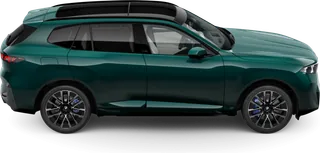
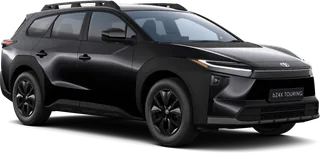
BMW iX5 vs Toyota bZ4X Touring
Better figure, where one is clearly better
| BMWiX5 | ToyotabZ4X Touring | |
|---|---|---|
| Overview | ||
| Released | Coming spring 2027 (early information) | June 2026 |
| Performance | ||
| Powertrain | Electric | Electric |
| Power | 570 bhp (better) | 221–376 bhp |
| 0–62 mph | 4.6 s | 4.5–7.3 s (better) |
| Top speed | 130 mph (better) | 99–111 mph |
| Engine or motors | Two electric motors, one on each axle; 425 kW (578 hp) combined system output; bhp converted from BMW's kW figure | Permanent-magnet synchronous motors: FWD 221 bhp (224 DIN hp, 165 kW); AWD 376 bhp (380 DIN hp, 280 kW). Lithium-ion battery, 74.7 kWh gross (71 kWh usable), 104 cells, 391 V |
| Torque | 805 Nm system torque | 268.6 Nm per motor (front, and rear on AWD) |
| Gearbox | Two-stage single-speed transmission | Single-speed automatic |
| Drive | Electric xDrive all-wheel drive | Front-wheel drive (Design) or all-wheel drive (Excel) with Downhill Assist Control |
| Range and charging | ||
| Zero-emission range (WLTP) | 525 miles (better) | 298–366 miles |
| Battery | 141 kWh (better) | 71 kWh |
| Fastest charging | 460 kW (better) | 150 kW |
| Range detail | Provisional WLTP range 401–525 miles, depending on configuration | WLTP combined: up to 366 miles (Design FWD); up to 298 miles (Excel AWD; Toyota's press specifications say 297) |
| Charging | 800 V architecture; 22 kW AC, 0–100% in 7 hours 30 minutes; up to 460 kW DC, 10–80% in 23 minutes; all figures provisional. Bidirectional charging support is planned for a later date. | 150 kW DC, 10–80% in 28 minutes; 11 kW AC on Design, 22 kW AC on Excel |
| Efficiency | Provisional WLTP combined 2.6–3.1 miles/kWh | WLTP combined: 4.44 miles/kWh (FWD), 3.74 miles/kWh (AWD) |
| CO2 emissions | – | 0 g/km at the tailpipe |
| Practicality | ||
| Body | SUV | SUV |
| Seats | 5 | 5 |
| Boot | 650 litres | 669 litres (better) |
| Length | 4,994 mm | 4,830 mm |
| Width | 2,000 mm | 1,860 mm |
| Weight | From 2,825 kg | From 1,900 kg |
| Boot | BMW's current UK page gives 650–1,850 litres at the rear plus 53 litres under the bonnet; its June 2026 technical PDF lists 655 litres with the seats up | 669 litres with the rear seats up and 1,718 litres with them folded, both measured to the roof; load floor 1,096 mm long |
| Towing | Up to 2,700 kg braked | 750 kg braked (FWD); 1,500 kg braked (AWD); 750 kg unbraked |
| Size | 4,994 mm long, 2,000 mm wide, 1,742 mm high on BMW's current UK page; the preliminary June 2026 technical PDF lists 1,748 mm high. Wheelbase 3,035 mm; DIN kerb weight 2,825 kg. | 4,830 mm long, 1,860 mm wide (excluding mirrors), 1,675 mm high; 2,850 mm wheelbase; 212 mm (Design) or 216 mm (Excel) ground clearance; 5.6 m turning radius (tyres); approach 17.3°, departure 21.1°; 500 mm wading depth; kerb weight 1,900–1,965 kg (FWD), 2,015–2,095 kg (AWD) |
| Tech and safety | ||
| Infotainment | BMW Panoramic iDrive with Central Display and Panoramic Vision; Passenger Screen optional | 14-inch Toyota Smart Connect+ multimedia with wireless phone charger; JBL audio optional on Excel |
| Driver assistance | Driving Assistant Plus standard; Motorway Assistant and Parking Assistant Plus optional | Toyota Safety Sense; Panoramic View Monitor on both grades; Front Cross Traffic Alert, Lane Change Assist, Advanced Parking Assist and digital rear-view mirror on Excel |
| Warranty | – | 3 years or 60,000 miles; battery 8 years or 100,000 miles |