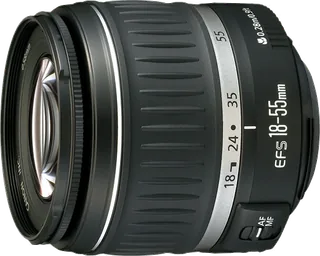
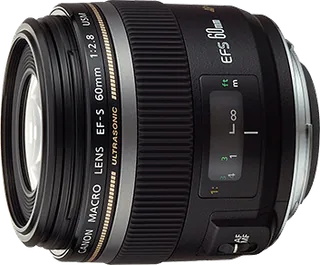
Canon EF-S 18–55mm f/3.5–5.6 II vs Canon EF-S 60mm f/2.8 Macro USM
Better figure, where one is clearly better
| CanonEF-S 18–55mm f/3.5–5.6 II | CanonEF-S 60mm f/2.8 Macro USM | |
|---|---|---|
| Overview | ||
| Released | March 2005 | March 2005 |
| Optics | ||
| Lens type | Zoom | Prime |
| Focal length | 18–55 mm | 60 mm |
| Maximum aperture | f/3.5–5.6 | f/2.8 |
| Minimum aperture | f/22–36 | f/32 |
| Optical construction | 11 elements in nine groups | 12 elements in eight groups; three-group floating internal-focus system |
| Coatings | – | Canon describes optimised coatings to reduce flare and ghosting from sensor reflections |
| Aperture detail | – | Camera-displayed aperture assumes infinity focus; effective maximum aperture becomes f/5.84 at life-size magnification according to Canon's manual |
| Special elements | Aspherical element shown in Canon Camera Museum's optical diagram | – |
| Diaphragm | Six blades with a circular aperture according to Canon Camera Museum | Seven blades according to Canon Camera Museum and Canon Japan |
| Angle of view | – | Horizontal 20°40′, vertical 14°10′, diagonal 24°30′ |
| Mount and compatibility | ||
| Mounts | Canon EF-S | Canon EF-S |
| Image circle | APS-C | APS-C |
| Compatibility | Canon EF-S compatible APS-C cameras | Canon EF-S compatible APS-C cameras; equivalent angle of view to 96 mm on full frame |
| Teleconverter support | – | Canon EF1.4X II and EF2X II extenders cannot be used |
| Focus and stabilisation | ||
| Autofocus | Yes | Yes |
| Minimum focus distance | 0.28 m | 0.2 m |
| Maximum magnification | 0.28× | 1× |
| Optical stabilisation | No | No |
| Autofocus detail | Micromotor autofocus; no full-time manual override according to The Digital Picture | USM autofocus; full-time manual focusing after One-Shot AF with the shutter button held halfway |
| Focus distance detail | Front element rotates during focusing; narrow manual focus grip on the extending front barrel according to Photozone and The Digital Picture | 0.2 m minimum focus measured from the focal plane; approximately 90 mm working distance from the lens front at life-size magnification |
| Magnification detail | Maximum 0.28× at 55 mm according to The Digital Picture; Canon Camera Museum confirms 0.28× maximum magnification | EF12 II extension tube gives 0.20–1.28×; EF25 II gives 0.44–1.61×. Optional 250D close-up lens gives 0.25–1.33× and 500D gives 0.12–1.18× |
| Stabilisation detail | No optical stabilisation according to The Digital Picture | No optical stabilisation according to The Digital Picture's exact-model specifications |
| Design | ||
| Dust and moisture resistant | – | No |
| Filter diameter | 58 mm | 52 mm |
| Maximum diameter | 68.5 mm | 73 mm |
| Length | 66 mm | 69.8 mm |
| Weight | 190 g (better) | 335 g |
| Controls | – | AF/MF switch; distance window with magnification scale |
| Filter detail | – | Front filter thread accommodates a filter and compatible macro flash together; front element does not rotate during focusing according to Photozone and The Digital Picture |
| Weather resistance | – | Canon Japan lists no dust or drip resistance |
| Zoom design | Shortest around 35 mm; extends towards both ends of the zoom range according to Photozone and The Digital Picture | – |
| Dimensions detail | 68.5 mm maximum diameter × 66 mm length according to Canon Camera Museum | 73 mm maximum diameter × 69.8 mm from mount surface to lens front; cap and rear cap excluded |
| Weight detail | – | Canon's manual specifies 335 g for the lens alone |
| Lens hood | EW-60C hood and LP814 pouch sold separately according to The Digital Picture | ET-67B hood and LP1016 case sold separately according to Canon's manual; Canon Japan's later accessory listing includes hood and case without clarifying regional package differences |
| Release detail | Canon Camera Museum records March 2005 marketing with the EOS 350D. No separately verified UK first-sale day is published in these sources. | Canon Camera Museum records March 2005 marketing. Canon Japan's February announcement planned 17 March, while its later exact-model support sheet records 19 March 2005 as the Japanese release date. The headline retains month precision; no UK first-sale day is established. |
More comparisons
- Canon EF-S 18–55mm f/3.5–5.6 II vs Canon RF-S 18–45mm F4.5–6.3 IS STM
- Canon EF-S 60mm f/2.8 Macro USM vs Canon RF 100mm F2.8 L Macro IS USM
- Canon EF 70–200mm f/2.8L IS III USM vs Canon EF-S 18–55mm f/3.5–5.6 II
- Canon EF 70–200mm f/2.8L IS III USM vs Canon EF-S 60mm f/2.8 Macro USM
- Canon EF 70–200mm f/4L IS II USM vs Canon EF-S 18–55mm f/3.5–5.6 II
- Canon EF 70–200mm f/4L IS II USM vs Canon EF-S 60mm f/2.8 Macro USM
- Canon EF 85mm f/1.4L IS USM vs Canon EF-S 18–55mm f/3.5–5.6 II
- Canon EF 85mm f/1.4L IS USM vs Canon EF-S 60mm f/2.8 Macro USM
- Canon EF-S 35mm f/2.8 Macro IS STM vs Canon EF-S 60mm f/2.8 Macro USM
- Canon EF-S 18–55mm f/3.5–5.6 II vs Canon EF-S 35mm f/2.8 Macro IS STM
- Canon EF-S 18–55mm f/3.5–5.6 II vs Canon EF-S 18–55mm f/4–5.6 IS STM
- Canon EF-S 18–55mm f/4–5.6 IS STM vs Canon EF-S 60mm f/2.8 Macro USM
- Canon EF 16–35mm f/2.8L III USM vs Canon EF-S 18–55mm f/3.5–5.6 II
- Canon EF 16–35mm f/2.8L III USM vs Canon EF-S 60mm f/2.8 Macro USM
- Canon EF-S 18–135mm f/3.5–5.6 IS USM vs Canon EF-S 18–55mm f/3.5–5.6 II
- Canon EF-S 18–135mm f/3.5–5.6 IS USM vs Canon EF-S 60mm f/2.8 Macro USM