Canon EF-S 18–55mm f/4–5.6 IS STM vs Canon RF-S 18–45mm F4.5–6.3 IS STM
Better figure, where one is clearly better
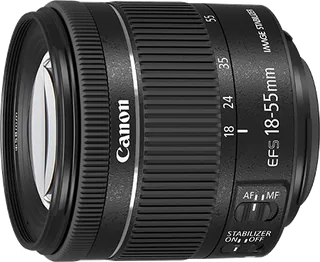
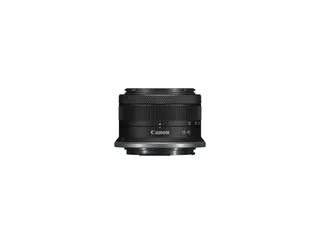
| CanonEF-S 18–55mm f/4–5.6 IS STM | CanonRF-S 18–45mm F4.5–6.3 IS STM | |
|---|---|---|
| Overview | ||
| Released | April 2017 | June 2022 |
| Optics | ||
| Lens type | Zoom | Zoom |
| Focal length | 18–55 mm | 18–45 mm |
| Maximum aperture | f/4–5.6 | f/4.5–6.3 |
| Minimum aperture | f/22–32 | f/22–32 |
| Optical construction | 12 elements in ten groups | Seven elements in seven groups |
| Special elements | Aspherical lens element | Two plastic-moulded aspherical elements; Super Spectra coating; no fluorine coating |
| Aperture detail | – | Minimum f/22 at 18 mm and f/32 at 45 mm, per UK and Japan specifications; Camera Museum table lists f/18 at 18 mm |
| Coatings | Super Spectra coatings | – |
| Diaphragm | Seven blades with a circular aperture | Seven blades |
| Angle of view | Horizontal 64°30′–23°20′; vertical 45°30′–15°40′; diagonal 74°20′–27°50′ according to the exact Canon manual | – |
| Mount and compatibility | ||
| Mounts | Canon EF-S | Canon RF |
| Image circle | APS-C | APS-C |
| Compatibility | Canon EF-S compatible APS-C cameras; 29–88 mm equivalent field of view | Canon RF mount with APS-C image circle; full-frame EOS R bodies crop to APS-C; RF extenders and EF extension tubes not compatible |
| Teleconverter support | Canon extenders cannot be used | – |
| Focus and stabilisation | ||
| Autofocus | Yes | Yes |
| Minimum focus distance | 0.25 m | 0.15 m (manual focus) |
| Maximum magnification | 0.25× | 0.26× (manual focus) |
| Optical stabilisation | Yes | Yes |
| Autofocus detail | Lead-screw STM; electronic manual adjustment after One-Shot autofocus while the shutter button remains half pressed, subject to camera settings | STM autofocus and electronic manual focusing |
| Focus distance detail | Manual focusing is unavailable with the camera off or lens asleep; internal focusing with a non-rotating front element according to both reviews | Autofocus minimum 0.20 m at 18 mm, 0.30 m at 35 mm and 0.35 m at 45 mm; manual-focus minimum 0.15 m, 0.24 m and 0.25 m at those focal lengths |
| Magnification detail | Maximum 0.25× at 55 mm; EF12 II gives 0.82–0.66× at 18 mm and 0.55–0.23× at 55 mm; EF25 II is incompatible at 18 mm and gives 0.91–0.51× at 55 mm | Autofocus maximum 0.14× at 18 mm, 0.15× at 35 mm and 0.16× at 45 mm; manual-focus maximum 0.25×, 0.21× and 0.26× respectively |
| Stabilisation detail | Four-stop CIPA claim at 55 mm using an EOS 7D Mark II; automatic panning compensation; Canon recommends switching IS off on a tripod to conserve power | Optical IS rated four stops with EOS R10 at 45 mm under CIPA, yaw/pitch; coordinated IS rated 6.5 stops with EOS R7 at 45 mm under CIPA, yaw/pitch |
| Design | ||
| Dust and moisture resistant | – | No |
| Filter diameter | 58 mm | 49 mm |
| Maximum diameter | 66.5 mm | 69 mm |
| Length | 61.8 mm | 44.3 mm |
| Weight | 215 g | 130 g (better) |
| Controls | – | Combined focus/control ring and zoom ring; AF/MF and IS controlled through camera settings |
| Zoom design | Barrel extends when zoomed to 55 mm according to The Digital Picture | Retractable barrel; lens must be extended for shooting |
| Weather resistance | – | No dust or moisture resistance |
| Dimensions detail | 66.5 mm maximum diameter × 61.8 mm retracted length; dimensions and 215 g weight are lens only, excluding caps | Approximately 69 mm maximum diameter × 44.3 mm length, retracted |
| Weight detail | – | Approximately 130 g lens |
| Lens hood | EW-63C sold separately; exact manual and Canon Japan list LP1014 optional case, while the UK overview lists LP1016 | EW-53 hood and LP814 pouch, sold separately |
| In the box | – | Lens, E-49 front cap, RF lens dust cap and user manual |
| Release detail | Canon Japan's exact support specification gives first sale on 7 April 2017; Camera Museum gives April. The day is the Japanese release, not a separately confirmed UK day. | June 2022 marketed month in Canon Camera Museum |
More comparisons
- Canon RF 20-50mm F4L IS USM PZ vs Canon RF-S 18–45mm F4.5–6.3 IS STM
- Canon RF 14mm F1.4L VCM vs Canon RF-S 18–45mm F4.5–6.3 IS STM
- Canon RF 7-14mm F2.8-3.5L FISHEYE STM vs Canon RF-S 18–45mm F4.5–6.3 IS STM
- Canon RF 45mm F1.2 STM vs Canon RF-S 18–45mm F4.5–6.3 IS STM
- Canon RF 85mm F1.4L VCM vs Canon RF-S 18–45mm F4.5–6.3 IS STM
- Canon RF 75–300mm F4–5.6 vs Canon RF-S 18–45mm F4.5–6.3 IS STM
- Canon RF-S 14–30mm F4–6.3 IS STM PZ vs Canon RF-S 18–45mm F4.5–6.3 IS STM
- Canon RF 20mm F1.4 L VCM vs Canon RF-S 18–45mm F4.5–6.3 IS STM
- Canon RF-S 10–18mm F4.5–6.3 IS STM vs Canon RF-S 18–45mm F4.5–6.3 IS STM
- Canon RF 28mm F2.8 STM vs Canon RF-S 18–45mm F4.5–6.3 IS STM
- Canon RF 24–50mm F4.5–6.3 IS STM vs Canon RF-S 18–45mm F4.5–6.3 IS STM
- Canon EF-S 10–18mm f/4.5–5.6 IS STM vs Canon RF-S 18–45mm F4.5–6.3 IS STM
- Canon EF-S 18–135mm f/3.5–5.6 IS USM vs Canon RF-S 18–45mm F4.5–6.3 IS STM
- Canon EF-S 18–55mm f/3.5–5.6 IS II vs Canon RF-S 18–45mm F4.5–6.3 IS STM
- Canon EF-S 18–55mm f/3.5–5.6 IS STM vs Canon RF-S 18–45mm F4.5–6.3 IS STM
- Canon EF-S 18–55mm f/3.5–5.6 IS vs Canon RF-S 18–45mm F4.5–6.3 IS STM