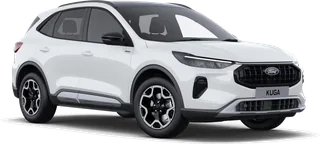
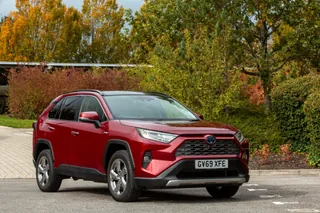
Ford Kuga vs Toyota RAV4 (2019)
Better figure, where one is clearly better
| FordKuga | ToyotaRAV4 (2019) | |
|---|---|---|
| Overview | ||
| Released | December 2019 | December 2018 |
| Performance | ||
| Powertrain | Petrol, Hybrid, Plug-in hybrid | Hybrid, Plug-in hybrid |
| Power | 148–240 bhp | 215–302 bhp (better) |
| 0–62 mph | 7.3–9.5 s | 6–8.4 s (better) |
| Top speed | 121–125 mph (better) | 112 mph |
| Engine or motors | 1.5-litre EcoBoost petrol, 150 PS (110 kW); 2.5-litre Duratec self-charging hybrid, 180 PS (132 kW) FWD or 183 PS (134 kW) AWD; 2.5-litre Duratec plug-in hybrid, 243 PS (178 kW); bhp converted from Ford's PS figures | 2.5-litre four-cylinder petrol hybrid, 215 bhp (FWD) or 219 bhp (AWD-i) system output with nickel-metal hydride battery; RAV4 Plug-in 302 bhp (306 DIN hp, 225 kW) with 18.1 kWh lithium-ion battery |
| Torque | 240 Nm (1.5 EcoBoost); Ford doesn't list system torque for the hybrids | Engine 221 Nm (hybrid) or 227 Nm (Plug-in); front motor 202 Nm (hybrid) or 270 Nm (Plug-in); rear motor 121 Nm |
| Gearbox | 6-speed manual (1.5 EcoBoost) or CVT automatic (hybrids) | CVT |
| Drive | Front-wheel drive; all-wheel drive with the 183 PS hybrid | Front-wheel drive or AWD-i all-wheel drive; Plug-in is AWD-i only |
| Range and charging | ||
| Zero-emission range (WLTP) | 42.9 miles | 46 miles (better) |
| Battery | 10.3 kWh | – |
| Economy (WLTP) | 44.1–313.9 mpg (better) | 48.7–282.5 mpg |
| Range detail | Plug-in hybrid: WLTP equivalent all-electric range 41.0–42.9 miles combined and 21–23 miles Extra High (motorway), depending on trim | RAV4 Plug-in WLTP electric range 46.47 miles |
| Charging | Plug-in hybrid: 10.3 kWh usable battery; about 3.5 hours on a 7 kW wallbox or 6 hours from a domestic socket; no DC charging | RAV4 Plug-in 18.1 kWh battery with 6.6 kW on-board charger |
| Efficiency | WLTP combined: 42.2–44.1 mpg (1.5 EcoBoost), 49.6–52.3 mpg (hybrid FWD), 47.1–48.7 mpg (hybrid AWD), 282.5–313.9 mpg weighted (plug-in hybrid) | WLTP combined: 48.7–49.5 mpg (hybrid FWD), 47.0–48.7 mpg (hybrid AWD-i), 282.5 mpg weighted (Plug-in) |
| CO2 emissions | 21–154 g/km (WLTP) | 129–137 g/km (hybrid), 22 g/km (Plug-in), WLTP combined |
| Practicality | ||
| Body | SUV | SUV |
| Seats | 5 | 5 |
| Boot | 536 litres | 580 litres (better) |
| Length | 4,622 mm | 4,600 mm |
| Width | 1,882 mm | 1,855 mm |
| Weight | From 1,526 kg | From 1,590 kg |
| Boot | 536 litres to the parcel shelf with the rear seats slid forward; 1,517 litres to the roof with the rear seats folded | 580 litres (hybrid) or 520 litres (Plug-in) with the rear seats in place; 1,690 or 1,604 litres folded to the roof |
| Towing | Braked: 1,900 kg (1.5 EcoBoost, 8% gradient; 1,730 kg at 12%), 1,600 kg (hybrid FWD, 12% gradient), 2,100 kg (hybrid AWD and plug-in hybrid) | 800 kg braked (hybrid FWD), 1,650 kg (hybrid AWD-i), 1,500 kg (Plug-in); 750 kg unbraked |
| Size | 4,622–4,650 mm long depending on trim, 1,882 mm wide without mirrors, 1,681 mm high; 2,710 mm wheelbase; 11.4 m turning circle | 4,600 mm long, 1,855 mm wide, 1,685 mm high; 2,690 mm wheelbase; kerb weight 1,590–1,680 kg (FWD), 1,650–1,730 kg (AWD-i), 1,910–2,005 kg (Plug-in) |
| Tech and safety | ||
| Infotainment | SYNC 4 with a 13.2-inch touchscreen, connected navigation, wireless Apple CarPlay and Android Auto and Alexa Built-in; B&O audio on higher trims | – |
| Driver assistance | BlueCruise hands-off motorway driving on the BlueCruise Edition | – |
| Warranty | 3 years or 60,000 miles | 3 years or 60,000 miles |