Garmin Forerunner 305 vs Garmin Forerunner 405
Better figure, where one is clearly better
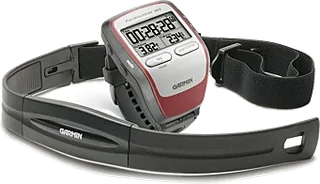
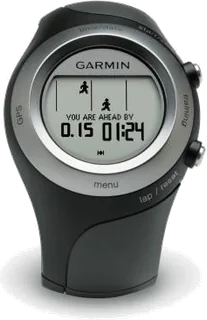
| GarminForerunner 305 | GarminForerunner 405 | |
|---|---|---|
| Overview | ||
| Released | 2006 | April 2008 |
| Display | ||
| Case sizes | 53.3 mm | 48 mm |
| Always-on display | Yes | Yes |
| Display detail | Backlit 33 × 20.3 mm monochrome display, 160 × 100 pixels; configurable training screens and physical buttons. Panel technology is not specified by Garmin. | Backlit monochrome screen, 1.06-inch diagonal and 124 × 95 pixels; a touch-sensitive bezel and two buttons control the watch. Panel technology is unpublished in the maker's specification. |
| Health and fitness | ||
| ECG | No | No |
| Blood oxygen | No | No |
| Skin temperature | No | No |
| Sleep apnoea alerts | No | No |
| High blood pressure alerts | No | No |
| Body composition | No | No |
| Fall detection | No | No |
| Crash detection | No | No |
| GPS | Single-band | Single-band |
| Sensors | High-sensitivity SiRFstarIII GPS receiver, included wireless heart-rate chest strap and optional GSC 10 cycling speed/cadence sensor; no optical wrist sensor. | High-sensitivity GPS receiver; optional ANT+ heart-rate chest strap, foot pod and cycling speed/cadence sensor. No optical wrist sensor. |
| Fitness features | Running, cycling and other-sport profiles; quick, interval and advanced workouts, course racing, Virtual Partner, Auto Pause, Auto Lap and heart-rate, pace, time and distance alerts. | Pace, distance, time, calories, custom and interval workouts, Virtual Partner, Auto Lap and Auto Pause. |
| Safety features | Stores 100 locations and 50 routes; basic route display, direction to a stored location and navigation back to the start. No base maps. | Stores up to 100 locations and provides direction to a saved location; no base maps. |
| Battery and connections | ||
| Battery life (maker's claim) | Up to 10 hours | Up to 8 hours |
| In low-power mode | – | Up to 14 days |
| Mobile data option | No | No |
| Works with | No phone pairing | No phone pairing |
| Battery life detail | Internal rechargeable lithium-ion battery; ten hours of typical use. | Rechargeable lithium-ion battery; approximately eight hours with GPS or two weeks in power-save mode. |
| Charging | Docking cradle with AC charger and USB cable. | Contact charging clip and AC adapter. |
| Connectivity | USB computer transfer through the cradle; Garmin Training Center software and MotionBased analysis were supplied at launch. Wireless heart-rate and cycling sensor connections; no direct phone pairing. | ANT+ Sport wireless data transfer to a computer through a USB ANT stick; Garmin Connect and Garmin Training Center analysis. No direct phone pairing. |
| Storage | Up to 1,000 laps; smart recording or one-second recording. | Around 1,000 lap records; Garmin Taiwan quotes approximately twenty hours of track points at one point every four seconds. |
| Design | ||
| Weight (lightest version) | 77 g | 60 g (better) |
| Software | Garmin | Garmin |
| Case materials | IPX7 immersion protection, one metre for thirty minutes; the owner's manual says it is not intended for swimming. | IPX7 immersion protection, one metre for thirty minutes; not intended for swimming. |
| Size | 53.3 × 68.6 × 17.8 mm and 77 g. Width is used as the case size. | 48 × 71 × 16 mm; approximately 60 g. Width is used as the case size; the English manual instead lists 47.75 × 70.5 × 16.4 mm. |
| Bands | Vinyl wrist strap with an expander strap; fabric strap available separately. | – |
| In the box | Watch, heart-rate chest strap, wrist and expander straps, docking cradle, AC charger, USB cable, Garmin Training Center software and documentation. | Watch, USB ANT stick, AC charger and manual; heart-rate strap included in some bundles. |
More comparisons
- Garmin Forerunner 170 vs Garmin Forerunner 405
- Garmin Forerunner 170 Music vs Garmin Forerunner 405
- Garmin Forerunner 405 vs Garmin Forerunner 70
- Garmin Forerunner 170 vs Garmin Forerunner 305
- Garmin Forerunner 170 Music vs Garmin Forerunner 305
- Garmin Forerunner 305 vs Garmin Forerunner 70
- Garmin Forerunner 305 vs Garmin Forerunner 970
- Garmin Forerunner 405 vs Garmin Forerunner 970
- Garmin Forerunner 405 vs Garmin Forerunner 570
- Garmin Forerunner 305 vs Garmin Forerunner 570
- Garmin Forerunner 165 vs Garmin Forerunner 405
- Garmin Forerunner 165 Music vs Garmin Forerunner 405
- Garmin Forerunner 165 vs Garmin Forerunner 305
- Garmin Forerunner 165 Music vs Garmin Forerunner 305
- Garmin Forerunner 265 vs Garmin Forerunner 405
- Garmin Forerunner 265 vs Garmin Forerunner 305