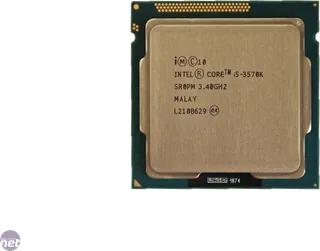
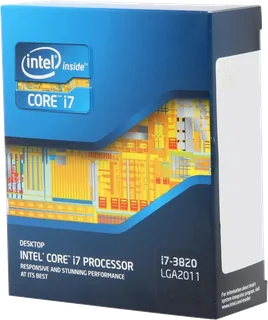
Intel Core i5-3570K vs Intel Core i7-3820
Better figure, where one is clearly better
| IntelCore i5-3570K | IntelCore i7-3820 | |
|---|---|---|
| Overview | ||
| Released | April 2012 | February 2012 |
| Cores and clocks | ||
| Cores | 4 | 4 |
| Threads | 4 | 8 (better) |
| Base clock | 3.4 GHz | 3.6 GHz |
| Boost clock | 3.8 GHz | 3.8 GHz |
| L3 cache | 6 MB | 10 MB (better) |
| Cores | Four cores without Hyper-Threading; Intel Turbo Boost 2.0 supported. Intel VT-x supported; VT-d is not supported on this model. | Four cores and eight threads; Sandy Bridge-E with Hyper-Threading. The multiplier is only partly unlocked, as both exact reviews explain; unlocked is false here because it is not fully unlocked. |
| Clocks | Maximum turbo is a single-core frequency; sustained clocks and overclocking depend on motherboard support and cooling. Intel publishes TDP without a separate maximum turbo-power figure. | Turbo Boost 2.0 up to 3.80 GHz from Intel’s current sheet; KitGuru’s engineering-sample review table instead states 3.90 GHz. Intel staff acknowledged release in February 2012; month precision is retained rather than treating the forum’s proposed day as verified sale. |
| Cache | – | 10 MB Intel Smart Cache; L3 level confirmed by both exact reviews. |
| Graphics and AI | ||
| Built-in graphics | Yes | No |
| Graphics | Intel HD Graphics 4000; 650 MHz base, up to 1.15 GHz; three displays; Quick Sync Video. Intel's launch information identifies DirectX 11 support; available outputs depend on the motherboard. | No integrated graphics or Quick Sync, confirmed by KitGuru’s exact-model review. |
| Platform | ||
| Socket | LGA1155 | LGA2011 |
| Base power | 77 W | 130 W |
| Unlocked | Yes | No |
| Cooler in the box | – | No |
| Memory support | Up to 32 GB; two channels; DDR3-1333/1600; 25.6 GB/s maximum bandwidth; ECC not supported. | Four channels of DDR3-1066/1333/1600; 51.2 GB/s maximum published bandwidth; no ECC. Intel’s anomalous 64.23 GB maximum-memory value is not normalised into a guessed capacity. |
| PCIe | PCIe 3.0; configurations up to 1×16, 2×8 or 1×8+2×4, as listed by Intel. Motherboard support determines available slot configurations. | 40 CPU lanes; Intel’s current sheet lists PCIe 2.0, while both contemporary reviews describe PCIe 3.0 capability. The manufacturer’s current literal figure is retained with this conflict explicit. |
| Chipsets | – | Intel X79; LGA2011. |
| Process | 22 nm; Ivy Bridge; 3D tri-gate transistors; 37.5 × 37.5 mm package; 67.4°C Tcase limit, not a junction-temperature limit. | 32 nm; Sandy Bridge-E. |
| Cooler | LGA1155-compatible cooling required. Intel announced the quad-core family on 23 April 2012; Ars Technica's contemporaneous launch report quotes Newegg confirming retail sale on 29 April. The archived maker sale notice could not be read, so the day is supported by named secondary retail coverage. | Exact BX80619I73820 Newegg listing states cooling device not included. Intel gives a case-temperature limit of 66.8°C. |
More comparisons
- Intel Core i5-3570K vs Intel Core i9-14900KS
- Intel Core i7-3820 vs Intel Core i9-14900KS
- Intel Core i5-14400F vs Intel Core i5-3570K
- Intel Core i5-14500 vs Intel Core i5-3570K
- Intel Core i5-14400F vs Intel Core i7-3820
- Intel Core i5-14500 vs Intel Core i7-3820
- Intel Core i5-14600K vs Intel Core i5-3570K
- Intel Core i5-3570K vs Intel Core i7-14700K
- Intel Core i5-3570K vs Intel Core i9-14900K
- Intel Core i5-14600K vs Intel Core i7-3820
- Intel Core i7-14700K vs Intel Core i7-3820
- Intel Core i7-3820 vs Intel Core i9-14900K
- Intel Core i5-3570K vs Intel Core i9-13900KS
- Intel Core i7-3820 vs Intel Core i9-13900KS
- Intel Core i3-13100F vs Intel Core i5-3570K
- Intel Core i3-13100F vs Intel Core i7-3820