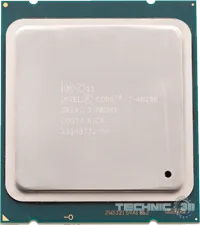
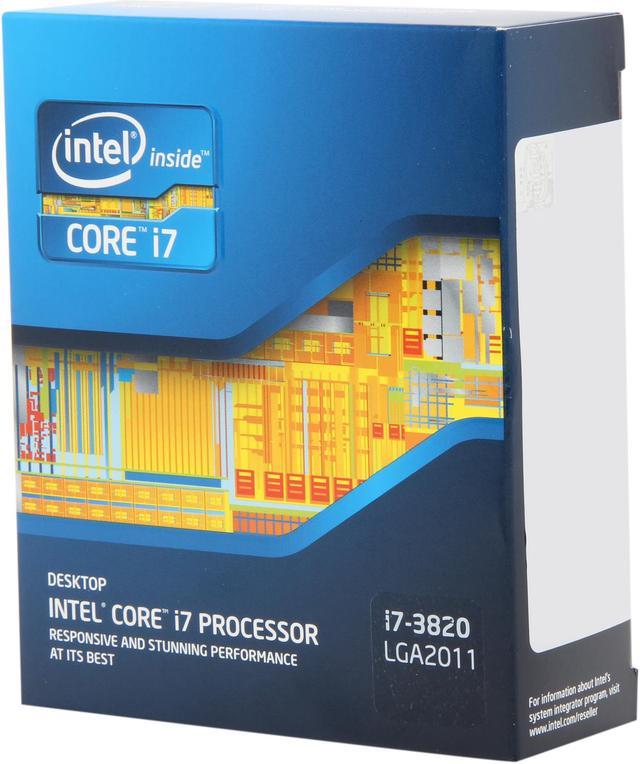
A four-core Sandy Bridge-E desktop processor with Hyper-Threading, quad-channel DDR3 and 40 CPU PCIe lanes for LGA2011 systems.
Cores
4/8
Boost
3.8 GHz
L3
10 MB
Power
130 W
Socket
LGA2011
What reviewers say
Both reviews liked its encoding performance and cheaper route into X79, while questioning the platform cost for existing mainstream owners. TechSpot found disappointing gaming results; KitGuru’s ASRock Extreme4-M system showed little gaming difference from 2600K/2700K systems. Both achieved substantial overclocks despite its limited multiplier, but neither established a compelling gaming upgrade from those processors.
Four cores and eight threads; Sandy Bridge-E with Hyper-Threading. The multiplier is only partly unlocked, as both exact reviews explain; unlocked is false here because it is not fully unlocked.
Clocks
Turbo Boost 2.0 up to 3.80 GHz from Intel’s current sheet; KitGuru’s engineering-sample review table instead states 3.90 GHz. Intel staff acknowledged release in February 2012; month precision is retained rather than treating the forum’s proposed day as verified sale.
Cache
10 MB Intel Smart Cache; L3 level confirmed by both exact reviews.
Graphics and AI
Built-in graphics
No
Graphics
No integrated graphics or Quick Sync, confirmed by KitGuru’s exact-model review.
Platform
Socket
LGA2011
Base power
130 W
Unlocked
No
Cooler in the box
No
Memory support
Four channels of DDR3-1066/1333/1600; 51.2 GB/s maximum published bandwidth; no ECC. Intel’s anomalous 64.23 GB maximum-memory value is not normalised into a guessed capacity.
PCIe
40 CPU lanes; Intel’s current sheet lists PCIe 2.0, while both contemporary reviews describe PCIe 3.0 capability. The manufacturer’s current literal figure is retained with this conflict explicit.
Chipsets
Intel X79; LGA2011.
Process
32 nm; Sandy Bridge-E.
Cooler
Exact BX80619I73820 Newegg listing states cooling device not included. Intel gives a case-temperature limit of 66.8°C.