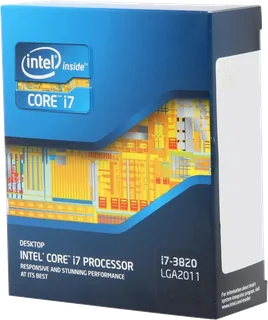
Intel Core i7-3820 vs Intel Core i7-7700K
Better figure, where one is clearly better
| IntelCore i7-3820 | IntelCore i7-7700K | |
|---|---|---|
| Overview | ||
| Released | February 2012 | January 2017 |
| Cores and clocks | ||
| Cores | 4 | 4 |
| Threads | 8 | 8 |
| Base clock | 3.6 GHz | 4.2 GHz |
| Boost clock | 3.8 GHz | 4.5 GHz (better) |
| L3 cache | 10 MB (better) | 8 MB |
| Cores | Four cores and eight threads; Sandy Bridge-E with Hyper-Threading. The multiplier is only partly unlocked, as both exact reviews explain; unlocked is false here because it is not fully unlocked. | Four cores with Hyper-Threading; Intel Turbo Boost 2.0 supported. |
| Clocks | Turbo Boost 2.0 up to 3.80 GHz from Intel’s current sheet; KitGuru’s engineering-sample review table instead states 3.90 GHz. Intel staff acknowledged release in February 2012; month precision is retained rather than treating the forum’s proposed day as verified sale. | Maximum turbo is a single-core frequency; overclocking requires an appropriate motherboard and cooling. Intel publishes TDP without a separate maximum turbo-power figure. |
| Cache | 10 MB Intel Smart Cache; L3 level confirmed by both exact reviews. | – |
| Graphics and AI | ||
| Built-in graphics | No | Yes |
| Graphics | No integrated graphics or Quick Sync, confirmed by KitGuru’s exact-model review. | Intel HD Graphics 630; 350 MHz base, up to 1.15 GHz; three displays; Quick Sync Video. Hardware HEVC 10-bit encode and decode, and VP9 10-bit decode, according to Intel's desktop product brief. |
| Platform | ||
| Socket | LGA2011 | LGA1151 |
| Base power | 130 W | 91 W |
| Unlocked | No | Yes |
| Cooler in the box | No | No |
| Memory support | Four channels of DDR3-1066/1333/1600; 51.2 GB/s maximum published bandwidth; no ECC. Intel’s anomalous 64.23 GB maximum-memory value is not normalised into a guessed capacity. | Up to 64 GB; two channels; DDR4-2133/2400 or DDR3L-1333/1600 at 1.35 V; ECC not supported. |
| PCIe | 40 CPU lanes; Intel’s current sheet lists PCIe 2.0, while both contemporary reviews describe PCIe 3.0 capability. The manufacturer’s current literal figure is retained with this conflict explicit. | PCIe 3.0; 16 CPU lanes, configured as 1×16, 2×8 or 1×8+2×4. |
| Chipsets | Intel X79; LGA2011. | – |
| Process | 32 nm; Sandy Bridge-E. | 14 nm; Kaby Lake; 37.5 × 37.5 mm package; 100°C maximum junction temperature. Intel describes the manufacturing process as 14 nm+ in its product brief. |
| Cooler | Exact BX80619I73820 Newegg listing states cooling device not included. Intel gives a case-temperature limit of 66.8°C. | Boxed processor includes no fan or heatsink. Intel announced the desktop family on 3 January 2017; TechSpot's contemporaneous launch review confirms availability that day. |
More comparisons
- Intel Core i7-7700K vs Intel Core i9-14900KS
- Intel Core i7-3820 vs Intel Core i9-14900KS
- Intel Core i5-14400F vs Intel Core i7-7700K
- Intel Core i5-14500 vs Intel Core i7-7700K
- Intel Core i5-14400F vs Intel Core i7-3820
- Intel Core i5-14500 vs Intel Core i7-3820
- Intel Core i5-14600K vs Intel Core i7-7700K
- Intel Core i7-14700K vs Intel Core i7-7700K
- Intel Core i7-7700K vs Intel Core i9-14900K
- Intel Core i5-14600K vs Intel Core i7-3820
- Intel Core i7-14700K vs Intel Core i7-3820
- Intel Core i7-3820 vs Intel Core i9-14900K
- Intel Core i7-7700K vs Intel Core i9-13900KS
- Intel Core i7-3820 vs Intel Core i9-13900KS
- Intel Core i3-13100F vs Intel Core i7-7700K
- Intel Core i3-13100F vs Intel Core i7-3820