LG OLED EF9500 vs LG OLED EG9600
Better figure, where one is clearly better
| LGOLED EF9500 | LGOLED EG9600 | |
|---|---|---|
| Overview | ||
| Released | 2015 | 2015 |
| Display | ||
| Panel | OLED | OLED |
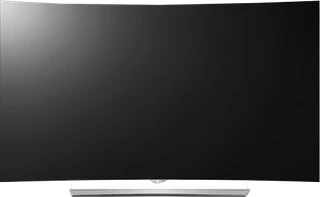
| Panel detail | Flat WRGB OLED with 10-bit panel and passive Cinema 3D | Curved WRGB OLED with passive Cinema 3D and Ultra Luminance |
| Resolution | 3840 × 2160 (4K) | 3840 × 2160 (4K) |
| Refresh rate | 120 Hz | – |
| HDR formats | HDR10 | None |
| HDR extras | LG UK announced HDR playback from streaming and external inputs; AVForums verified HDR on a UK EF950V. LG Netherlands specifies HDR10 after a software update. Dolby Vision and HLG are not established for this model. | – |
| Picture processing | Perfect Mastering Engine, Triple XD Engine, Ultra Luminance, pixel dimming, 4K upscaling and Real Cinema 24p | Triple XD Engine, 4K upscaling, Real Cinema 24p and HEVC decoding up to 4K 60p, per the exact European maker tables |
| Motion handling | 120 Hz native panel measured by HDTVTest on the exact 65EF950V; 300 motion lines with TruMotion off and 650 with it on in that test. The maker's motion marketing is not used as the refresh figure. | Native panel refresh rate unconfirmed; Absolute Motion Clarity and 4K 60p input compatibility are not native-Hz figures. |
| Sizes | ||
| Sizes | 55, 65″ | 55, 65″ |
| Largest size | 65″ | 65″ |
| Gaming | ||
| HDMI ports | 3 (0 HDMI 2.1 at 4K 120 Hz+) | 3 (0 HDMI 2.1 at 4K 120 Hz+) |
| Variable refresh rate | None | None |
| HDMI detail | Three side-facing HDMI inputs. AVForums confirms all three support HDMI 2.0a and HDCP 2.2 for HDR sources, with ARC on HDMI 2. No HDMI 2.1 bandwidth is claimed. | Three HDMI inputs; maker table specifically lists two side inputs supporting 4K 60p. HDTVTest identifies HDMI 1 and 2 as HDMI 2.0 with HDCP 2.2; ARC support confirmed by both exact UK reviews. AVForums claims MHL, conflicting with the French maker table's No, so MHL support is not asserted. |
| Input lag | 50 ms in Game mode (HDTVTest); 51 ms in Game mode (AVForums) | 49 ms in Game mode (HDTVTest); 52 ms (AVForums) |
| Smart TV and sound | ||
| Smart TV platform | webOS | webOS |
| Processor | Perfect Mastering Engine | Tru Ultra HD Engine |
| Speakers | 20 W, 2.0 channels | 20 W, 2.0 channels |
| Wi-Fi | Built-in Wi-Fi | Built-in Wi-Fi |
| Speaker detail | Harman Kardon tuned 20 W, 2.0-channel two-way system with four speakers and Ultra Surround | Harman Kardon 20 W, 2.0-channel system with tweeters and Ultra Surround |
| Audio features | Dolby Digital and DTS decoding, Clear Voice II, optical and wireless Sound Sync, and LG-listed aptX encoder | Dolby Digital and DTS decoding, Clear Voice II, optical and wireless Sound Sync; aptX encoder listed by LG France |
| Voice assistants | Voice control through the Magic Remote | Voice control through the Magic Remote |
| Casting | Miracast, WiDi, Wi-Fi Direct, Smart Share and LG remote app | DLNA, WiDi and Miracast |
| Software updates | webOS 2.0. LG Korea announced staggered domestic introduction from 27 July 2015, while LG USA planned September retail arrivals; an exact first EF9500 sale month is unverified, so released remains 2015. LG Netherlands says HDR10 follows a software update; exact UK review hardware displayed HDR in October 2015. | webOS 2.0. The UK launch reviews describe no HDR support; a bounded exact European firmware search did not verify its later availability. Separately, LG's US September 2015 release confirms EG9600 HDR streaming after a firmware update, and Japan's November release confirms network/USB HDR with HDMI explicitly unsupported. Japan's current page names HDR10. Those regional updates are not assigned to the UK EG960V main HDR fields. First-sale year remains 2015: the UK April review confirms retail availability, but an exact first worldwide sale month remains unresolved. |
| TV tuners | UK maker lists two RF inputs, CI slot, programme guide and USB hard-drive recording/time shift | DVB-T2, DVB-C and DVB-S2; CI+ 1.3; HbbTV and USB hard-drive recording/time shift. UK Freeview HD and satellite reception confirmed by the exact reviews. |
| USB | Three side-facing USB ports, one USB 3.0 and two USB 2.0 | Three USB inputs, one USB 3.0 and two USB 2.0 |
| Ethernet | Ethernet LAN port | Ethernet LAN port |
| Optical audio out | Optical digital audio output and headphone/analogue output | Optical digital audio output and headphone output |
| Design and power | ||
| Size | Without stand (W × H × D): 55″ 1228 × 718 × 49.9 mm; 65″ 1450 × 842 × 49.9 mm | Without stand (W × H × D): 55″ 1226 × 719 × 49.9 mm; 65″ 1447 × 826 × 49.9 mm |
| Stand | With stand (W × H × D; weight): 55″ 1228 × 760 × 215 mm, 17.2 kg; 65″ 1450 × 883 × 236 mm, 24.5 kg. Flat metal base with a transparent support; AVForums says it does not swivel. | With stand (W × H × D; weight): 55″ 1226 × 760 × 213 mm, 18.9 kg; 65″ 1447 × 884 × 237 mm, 25.1 kg. Fixed curved metal base with transparent support; no swivel. |
| Power use | – | Maker European energy-table on-mode/standby: 55″ 134/0.3 W; 65″ 142/0.3 W; 100–240 V AC, 50–60Hz supply. The pages' annual-consumption unit is inconsistent, so no annual figure is copied. |
| VESA pattern | AVForums reports the 65EF950V needs a specialised bracket rather than standard 400 × 400 mm VESA points; verify the correct bracket for the chosen size | – |
| In the box | AVForums' UK 65EF950V sample included standard and Magic remotes plus two pairs of passive 3D glasses; retail contents may vary | MR15 Magic Remote and two pairs of F310 passive 3D glasses in the European maker table; AVForums' review sample also included two clip-on pairs, which is not assumed for every retail package |

More comparisons
- LG OLED EG9600 vs LG OLED evo C6
- LG OLED EF9500 vs LG OLED evo C6
- LG OLED B6 vs LG OLED EF9500
- LG OLED B6 vs LG OLED EG9600
- Hisense A85Q vs LG OLED EF9500
- Hisense A85Q vs LG OLED EG9600
- LG OLED B5 vs LG OLED EF9500
- LG OLED B5 vs LG OLED EG9600
- LG OLED B4 vs LG OLED EF9500
- LG OLED EF9500 vs LG OLED evo G4
- LG OLED B4 vs LG OLED EG9600
- LG OLED EG9600 vs LG OLED evo G4
- LG OLED B3 vs LG OLED EF9500
- LG OLED B3 vs LG OLED EG9600
- LG OLED B2 vs LG OLED EF9500
- LG OLED B2 vs LG OLED EG9600