Logitech MX Anywhere 2 vs Logitech MX Anywhere 3S
Better figure, where one is clearly better
| LogitechMX Anywhere 2 | LogitechMX Anywhere 3S | |
|---|---|---|
| Overview | ||
| Released | June 2015 | June 2023 |
| Tracking | ||
| Shape | Compact | Compact |
| Hand | Right hand | Right hand |
| Sensitivity | Up to 1,600 DPI | Up to 8,000 DPI (better) |
| Sensor | Darkfield laser | Darkfield high precision |
| Buttons | 7 (better) | 6 |
| Free-spinning wheel | Yes | Yes |
| Thumb wheel | No | No |
| Quiet clicks | – | Yes |
| Sensor | Darkfield laser tracking, adjustable from 400 to 1,600 DPI in 200 DPI steps; glass must be at least 4 mm thick. | 200–8,000 DPI, adjustable in 50 DPI steps (1,000 DPI by default); tracks on almost any surface, including glass; Bluetooth report rate 88–133 Hz |
| Scroll wheel | Main wheel clicks to change between stepped and free-spinning vertical scrolling; it also tilts left and right for horizontal scrolling. | MagSpeed electromagnetic wheel with SmartShift, which switches between ratchet and free-spin as you scroll faster; up to 1,000 lines a second; horizontal scrolling by holding a side button while turning the wheel |
| Thumb wheel | No separate thumb wheel; the main wheel tilts for horizontal scrolling. | – |
| Gestures | The button below the wheel can trigger gestures through Logitech Options. | The top button, below the wheel, can be set as a gesture button in Logi Options+ |
| Connections and battery | ||
| Connects by | Bluetooth and USB receiver | Bluetooth and USB receiver |
| Devices it switches between | 3 | 3 |
| Power | Rechargeable | Rechargeable |
| Battery life (maker's claim) | Up to 2 months | Up to 70 days |
| Charging port | Micro-USB | USB-C |
| Receiver | Bluetooth Smart or the included Pico Unifying USB receiver, with Easy-Switch for three paired devices. | Works with a Logi Bolt USB receiver, not included (MX Anywhere 3S for Business comes with one); not compatible with other Logitech receivers |
| Charging | Micro-USB charging of a 500 mAh lithium-polymer battery; Logitech claims up to two months per charge and two hours of use from a one-minute charge. | USB-C; a 1-minute charge gives 3 hours of use; full charge in 2 hours; 500 mAh lithium-polymer battery |
| Works with | At launch, the receiver required Windows 7 or later or Mac OS X 10.8 or later; Bluetooth Smart required Windows 8 or later or Mac OS X 10.10 or later. | Bluetooth Low Energy with Windows 10, 11 or later, macOS 10.15 or later, iPadOS 14 or later, Android 8.0 or later, Linux and ChromeOS; the Mac version lists macOS 10.15 or later and iPadOS 14 or later |
| Software | Logitech Options supports cursor speed, button remapping and gesture controls. | Logi Options+ on Windows and macOS (Smart Actions, Logitech Flow); basic functions work without software on other systems |
| Design | ||
| Weight | 106 g | 99 g (better) |
| Size | 100.3 × 61.6 × 34.4 mm (length × width × height); 106 g including battery. | 100.5 × 65 × 34.4 mm (length × width × height) |
| Materials | – | Certified post-consumer recycled plastic, 78% in Graphite and 61% in Pale Grey and Rose; silicone side grips; left and right buttons rated for 10 million clicks |
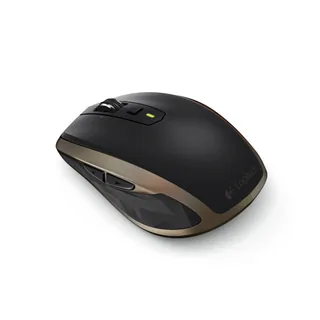
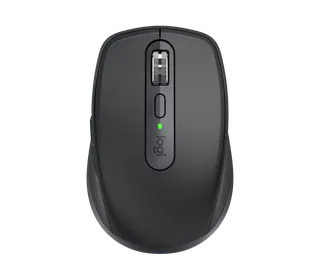
| Colours | Black with bronze trim on the launch model. | Graphite, Pale Grey, Rose; Mac version in Space Grey, Pale Grey |
| In the box | Mouse, Pico Unifying receiver, Micro-USB charging cable and documentation. | Mouse, USB-C charging cable (USB-A to USB-C, or USB-C to USB-C with the Mac version), documentation |
| Warranty | One-year limited hardware warranty on Logitech's 2015 datasheet. | 2-year limited hardware warranty |
More comparisons
- Logitech MX Anywhere 3S vs Logitech MX Master 4
- Logitech MX Anywhere 2 vs Logitech MX Master 4
- Logitech MX Anywhere 3S vs Logitech MX Ergo S
- Logitech MX Anywhere 2 vs Logitech MX Ergo S
- Logitech MX Anywhere 3S vs Logitech Pebble Mouse 2 M350s
- Logitech MX Anywhere 3S vs Logitech VX Nano Cordless Laser Mouse for Notebooks
- Logitech MX Anywhere 3 vs Logitech MX Anywhere 3S
- Logitech Anywhere Mouse MX vs Logitech MX Anywhere 3S
- Logitech MX Anywhere 2S vs Logitech MX Anywhere 3S
- Apple Magic Mouse 2 (Lightning) vs Logitech MX Anywhere 3S
- Logitech MX Anywhere 3S vs Razer Orochi V2
- Logitech M240 Silent vs Logitech MX Anywhere 3S
- Logitech MX Anywhere 3S vs Logitech MX Master 3S
- Logitech MX Anywhere 3S vs Logitech MX Master 3
- Logitech MX Anywhere 3S vs Logitech MX Vertical
- Logitech MX Anywhere 3S vs Logitech MX Master 2S