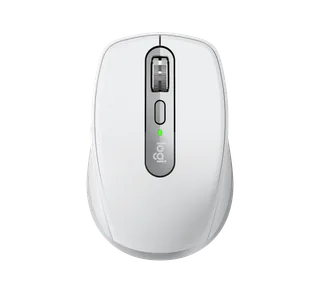
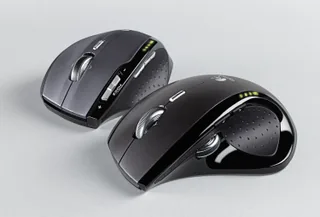
Logitech MX Anywhere 3 vs Logitech MX Revolution
Better figure, where one is clearly better
| LogitechMX Anywhere 3 | LogitechMX Revolution | |
|---|---|---|
| Overview | ||
| Released | September 2020 | August 2006 |
| Tracking | ||
| Shape | Compact | Ergonomic |
| Hand | Right hand | Right hand |
| Sensitivity | Up to 4,000 DPI (better) | Up to 800 DPI |
| Sensor | Darkfield high precision | Laser |
| Buttons | 6 | 7 (better) |
| Free-spinning wheel | Yes | Yes |
| Thumb wheel | No | Yes |
| Sensor | Darkfield tracking on almost any surface including glass; adjustable from 200 to 4,000 DPI. | Laser sensor; 800 DPI reported by Bare Feats |
| Scroll wheel | MagSpeed electromagnetic wheel with SmartShift, switching between stepped and free-spinning modes; Logitech claims up to 1,000 lines per second. | MicroGear Precision Scroll Wheel with SmartShift motorised automatic switching between stepped and free-spinning modes; can also be switched manually |
| Thumb wheel | No separate thumb wheel; horizontal scrolling uses a side button held while turning the main wheel. | Second wheel can zoom in documents and images or switch between applications |
| Connections and battery | ||
| Connects by | Bluetooth and USB receiver | USB receiver |
| Devices it switches between | 3 | – |
| Power | Rechargeable | Rechargeable |
| Battery life (maker's claim) | Up to 70 days | – |
| Charging port | USB-C | – |
| Receiver | The standard model includes a Logitech Unifying USB receiver; the Mac variant connects over Bluetooth and has no receiver in the box. | USB micro receiver using 2.4 GHz radio, reported by Bare Feats |
| Charging | USB-C, 500 mAh rechargeable lithium-polymer battery; Logitech claims three hours of use from a one-minute charge and up to 70 days from a full charge. | Rechargeable lithium-ion battery; mouse charges in an AC-powered desktop station, with battery-level LEDs |
| Works with | Standard edition uses Unifying or Bluetooth Low Energy with Windows, macOS, ChromeOS and Linux; Bluetooth also supports iPadOS 13.4 or later. The Mac variant uses Bluetooth. | Windows and Mac computers with a USB port; platform-specific Logitech software needed for custom functions |
| Software | Logitech Options at launch, with button customisation, application profiles and Flow between computers. | Logitech SetPoint on Windows or Logitech Control Center on Mac for button actions and scroll settings |
| Design | ||
| Weight | 99 g (better) | 148 g |
| Size | 100.5 × 65 × 34.4 mm (length × width × height); Logitech's consumer support sheet gives 99 g with battery. | – |
| Colours | Graphite, Pale Grey and Rose for the standard edition; Pale Grey for the Mac edition at launch. | – |
| In the box | Standard edition includes the mouse, Unifying receiver, USB-A-to-USB-C charging cable and documentation; Mac edition substitutes a USB-C-to-USB-C cable and omits the receiver. | Mouse, recharging station, AC power cord, USB micro receiver, SetPoint CD and guide |
More comparisons
- Logitech MX Master 4 vs Logitech MX Revolution
- Logitech MX Anywhere 3 vs Logitech MX Master 4
- Logitech MX Anywhere 3 vs Logitech MX Ergo S
- Logitech MX Ergo S vs Logitech MX Revolution
- Logitech MX Anywhere 3 vs Logitech MX Anywhere 3S
- Logitech MX Anywhere 3S vs Logitech MX Revolution
- Logitech MX Anywhere 3 vs Logitech MX Master 3S
- Logitech MX Master 3S vs Logitech MX Revolution
- Logitech MX Anywhere 3 vs Logitech POP Mouse
- Logitech MX Anywhere 3 vs Razer Orochi V2
- Logitech MX Anywhere 2S vs Logitech MX Anywhere 3
- Logitech MX Anywhere 3 vs Logitech MX Master 3
- Logitech MX Anywhere 3 vs Logitech MX Vertical
- Logitech MX Anywhere 3 vs Logitech MX Master 2S
- Logitech MX Anywhere 2 vs Logitech MX Anywhere 3
- Logitech MX Anywhere 3 vs Logitech MX Master