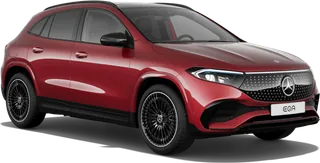
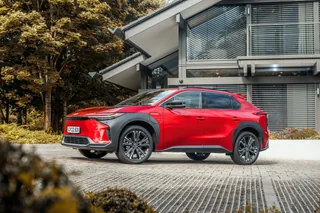
Mercedes-Benz EQA vs Toyota bZ4X (2022)
Better figure, where one is clearly better
| Mercedes-BenzEQA | ToyotabZ4X (2022) | |
|---|---|---|
| Overview | ||
| Released | 2021 | March 2022 |
| Performance | ||
| Powertrain | Electric | Electric |
| Power | 188–225 bhp (better) | 201–215 bhp |
| 0–62 mph | 7.7–8.6 s | 6.9–7.5 s (better) |
| Top speed | 99 mph | 100 mph (better) |
| Engine or motors | EQA 250+: 140 kW (190 hp); EQA 300 4MATIC: 168 kW (228 hp); bhp converted from Mercedes' kW figures | FWD: one front permanent-magnet synchronous motor, 201 bhp (204 DIN hp, 150 kW). AWD: front and rear 80 kW motors, 215 bhp (218 DIN hp, 160 kW) combined. Lithium-ion battery, 71.4 kWh gross, 96 cells, 355 V; Toyota didn't publish a usable capacity |
| Torque | 385 Nm (EQA 250+), 390 Nm (EQA 300 4MATIC) | 266 Nm (FWD); 337 Nm (AWD) |
| Gearbox | Single-speed automatic | Single-speed automatic |
| Drive | Front-wheel drive (EQA 250+); 4MATIC all-wheel drive (EQA 300 4MATIC) | Front-wheel drive, or all-wheel drive with X-MODE and Grip Control |
| Range and charging | ||
| Zero-emission range (WLTP) | 280–346 miles (better) | 286–317 miles |
| Battery | 70.5 kWh | – |
| Fastest charging | 100 kW | – |
| Range detail | WLTP range 311–346 miles (EQA 250+) or 272–280 miles (EQA 300 4MATIC), depending on specification | WLTP combined: 317 miles (Pure), 312 miles (Motion FWD), 277 miles (Vision FWD); AWD 286 miles (Motion), 259 miles (Vision), 257 miles (Premiere Edition) |
| Charging | EQA 250+ usable battery capacity 70.5 kWh (Mercedes). For the EQA 300 4MATIC, Mercedes' 2024 manual and current UK tax listing say 66.5 kWh usable, but its 2025 and April 2026 UK brochures list 70.5 kWh as standard equipment. DC up to 100 kW, 10–80% in 35 minutes (EQA 250+) or 32 minutes (EQA 300 4MATIC); 7.4 kW on-board AC charger, 10–100% in 7 hours 15 minutes on an 11 kW wallbox or 10 hours 45 minutes at 7.4 kW | DC fast charging to 80% in about 30 minutes on a 150 kW charger (Toyota's figure; the car's peak DC rate isn't stated); 6.6 kW on-board AC charger at launch, 11 kW three-phase from late 2022 |
| Efficiency | 145–163 Wh/km (EQA 250+), 180–185 Wh/km (EQA 300 4MATIC), WLTP combined | WLTP combined: 4.4 miles/kWh (FWD), 4.0 miles/kWh (AWD) |
| CO2 emissions | 0 g/km | 0 g/km at the tailpipe |
| Practicality | ||
| Body | SUV | SUV |
| Seats | 5 | 5 |
| Boot | 340 litres | 452 litres (better) |
| Length | 4,463 mm | 4,690 mm |
| Width | 1,834 mm | 1,860 mm |
| Weight | From 2,050 kg | From 1,910 kg |
| Boot | 340 litres, 1,320 litres with the rear seats folded | 452 litres (VDA) including under the deck board; 441 litres with the JBL subwoofer |
| Towing | 1,500 kg (EQA 250+) or 1,800 kg (EQA 300 4MATIC) braked; 750 kg unbraked | 750 kg |
| Size | 4,463 mm long, 1,834 mm wide without mirrors (2,020 mm with); 11.4 m turning circle; kerb weight 2,050 kg (EQA 250+), 2,115 kg (EQA 300 4MATIC) | 4,690 mm long, 1,860 mm wide (excluding mirrors), 1,650 mm high; 2,850 mm wheelbase; 177 mm ground clearance; 5.6 m turning radius (tyres); approach 17.4°, departure 25.6°; 500 mm wading depth; kerb weight 1,910–1,970 kg (FWD), 2,000–2,060 kg (AWD) |
| Tech and safety | ||
| Infotainment | – | 8-inch multimedia display (Pure) or 12.3-inch touchscreen with Toyota Smart Connect and cloud navigation; 7-inch driver's display set above the steering wheel; nine-speaker JBL audio on Premiere Edition |
| Driver assistance | – | Toyota T-Mate with Toyota Safety Sense: Pre-Collision System with intersection turn assistance and Emergency Steering Assist, Full-Range Adaptive Cruise Control, Lane Trace Assist, Emergency Driving Stop System, Road Sign Assist; Blind Spot Monitor with Safe Exit Assist; Remote Controlled Parking Assist on Vision |
| Warranty | Battery: 8 years or 100,000 miles | 3 years or 60,000 miles; battery 8 years or 100,000 miles, extendable to 10 years or 600,000 miles with an annual EV Care battery health check |