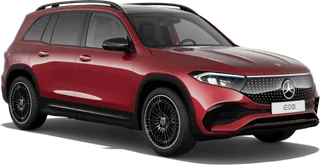
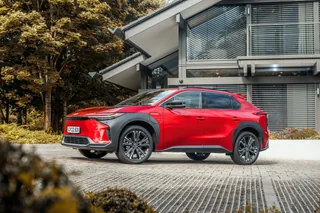
Mercedes-Benz EQB vs Toyota bZ4X (2022)
Better figure, where one is clearly better
| Mercedes-BenzEQB | ToyotabZ4X (2022) | |
|---|---|---|
| Overview | ||
| Released | 2021 | March 2022 |
| Performance | ||
| Powertrain | Electric | Electric |
| Power | 188–225 bhp (better) | 201–215 bhp |
| 0–62 mph | 8–8.9 s | 6.9–7.5 s (better) |
| Top speed | 99 mph | 100 mph (better) |
| Engine or motors | EQB 250+: 140 kW (190 hp); EQB 300 4MATIC: 168 kW (228 hp); bhp converted from Mercedes' kW figures | FWD: one front permanent-magnet synchronous motor, 201 bhp (204 DIN hp, 150 kW). AWD: front and rear 80 kW motors, 215 bhp (218 DIN hp, 160 kW) combined. Lithium-ion battery, 71.4 kWh gross, 96 cells, 355 V; Toyota didn't publish a usable capacity |
| Torque | 385 Nm (EQB 250+), 390 Nm (EQB 300 4MATIC) | 266 Nm (FWD); 337 Nm (AWD) |
| Gearbox | Single-speed automatic | Single-speed automatic |
| Drive | Front-wheel drive (EQB 250+); 4MATIC all-wheel drive (EQB 300 4MATIC) | Front-wheel drive, or all-wheel drive with X-MODE and Grip Control |
| Range and charging | ||
| Zero-emission range (WLTP) | 271–324 miles (better) | 286–317 miles |
| Battery | 70.5 kWh | – |
| Fastest charging | 100 kW | – |
| Range detail | WLTP range 293–324 miles (EQB 250+) or 265–271 miles (EQB 300 4MATIC), depending on specification | WLTP combined: 317 miles (Pure), 312 miles (Motion FWD), 277 miles (Vision FWD); AWD 286 miles (Motion), 259 miles (Vision), 257 miles (Premiere Edition) |
| Charging | 70.5 kWh usable lithium-ion battery in both UK versions (Mercedes); 400 V; DC up to 100 kW, 10–80% in 35 minutes; 11 kW AC, 10–100% in 7 hours 15 minutes (10 hours 45 minutes at 7.4 kW) | DC fast charging to 80% in about 30 minutes on a 150 kW charger (Toyota's figure; the car's peak DC rate isn't stated); 6.6 kW on-board AC charger at launch, 11 kW three-phase from late 2022 |
| Efficiency | 156–172 Wh/km (EQB 250+), 186–190 Wh/km (EQB 300 4MATIC), WLTP combined | WLTP combined: 4.4 miles/kWh (FWD), 4.0 miles/kWh (AWD) |
| CO2 emissions | 0 g/km | 0 g/km at the tailpipe |
| Practicality | ||
| Body | SUV | SUV |
| Seats | 7 (better) | 5 |
| Boot | 495 litres (better) | 452 litres |
| Length | 4,684 mm | 4,690 mm |
| Width | 1,834 mm | 1,860 mm |
| Weight | From 2,105 kg | From 1,910 kg |
| Boot | 495 litres, 1,710 litres with the seats folded | 452 litres (VDA) including under the deck board; 441 litres with the JBL subwoofer |
| Towing | – | 750 kg |
| Size | 4,684 mm long, 1,834 mm wide without mirrors; 11.7 m turning circle; kerb weight 2,105 kg (EQB 250+), 2,170 kg (EQB 300 4MATIC) | 4,690 mm long, 1,860 mm wide (excluding mirrors), 1,650 mm high; 2,850 mm wheelbase; 177 mm ground clearance; 5.6 m turning radius (tyres); approach 17.4°, departure 25.6°; 500 mm wading depth; kerb weight 1,910–1,970 kg (FWD), 2,000–2,060 kg (AWD) |
| Tech and safety | ||
| Infotainment | – | 8-inch multimedia display (Pure) or 12.3-inch touchscreen with Toyota Smart Connect and cloud navigation; 7-inch driver's display set above the steering wheel; nine-speaker JBL audio on Premiere Edition |
| Driver assistance | – | Toyota T-Mate with Toyota Safety Sense: Pre-Collision System with intersection turn assistance and Emergency Steering Assist, Full-Range Adaptive Cruise Control, Lane Trace Assist, Emergency Driving Stop System, Road Sign Assist; Blind Spot Monitor with Safe Exit Assist; Remote Controlled Parking Assist on Vision |
| Warranty | – | 3 years or 60,000 miles; battery 8 years or 100,000 miles, extendable to 10 years or 600,000 miles with an annual EV Care battery health check |