Nikon D50 vs Nikon D70S
Better figure, where one is clearly better
| NikonD50 | NikonD70S | |
|---|---|---|
| Overview | ||
| Released | 2005 | April 2005 |
| Image and sensor | ||
| Camera type | DSLR | DSLR |
| Sensor format | APS-C | APS-C |
| Sensor type | CCD | CCD |
| Sensor dimensions | 23.7 × 15.6 mm | 23.7 × 15.6 mm |
| Effective resolution | 6.1 MP | 6.1 MP |
| Largest image | 3008 × 2000 | 3008 × 2000 |
| RAW recording | Yes | Yes |
| Standard ISO range | 200–1600 | 200–1600 |
| Sensor detail | Nikon DX CCD with 6.1 million effective and 6.24 million total pixels; approximately 1.5× lens focal-length equivalent; Image Dust Off reference data for optional Nikon Capture correction | 6.24 million total pixels; Nikon DX-format primary-colour CCD |
| Image formats | Compressed 12-bit NEF RAW, JPEG and simultaneous RAW plus Basic JPEG; maximum 3008 × 2000 pixels; Image Optimisation settings | Compressed 12-bit NEF RAW, JPEG and RAW plus Basic JPEG; no in-camera TIFF recording |
| ISO detail | ISO 200–1600 in whole stops | ISO 200–1600 in one-third-stop increments; Auto ISO |
| Lens and shooting | ||
| Lens mount | Nikon F mount | Nikon F mount |
| Stabilisation | Optical lens stabilisation | Optical lens stabilisation |
| Maximum continuous burst | 2.5 fps | 3 fps |
| Lens detail | Body autofocus motor supports compatible AF NIKKOR lenses, including type G and D; AF-S lenses also supported. Other AF NIKKOR lenses lose 3D matrix metering; non-CPU lenses require manual exposure without metering; IX and F3AF lenses unsupported; E-type lenses incompatible according to current Nikon USA specification | AF coupling drives compatible screw-drive AF lenses. Supported non-CPU AI lenses work in manual exposure without metering; IX and F3AF lenses unsupported |
| Autofocus | Multi-CAM 900 phase-detection module; five selectable focus areas; -1 to +19 EV at ISO 100 equivalent, 20°C; AF-S/AF-C/AF-A and manual focus, single-area, dynamic-area and closest-subject-priority modes; AF-assist illuminator. Current US page lists Face-Priority AF, absent from the original manual specification; no face-detection capability inferred | Multi-CAM 900 phase detection with five focus areas; single-area, dynamic-area and closest-subject-priority modes; AF assist lamp |
| Shutter | Combined mechanical and CCD electronic shutter; 1/4000 to 30 seconds in half or one-third stops, Bulb and remote long exposures; flash synchronisation up to 1/500 second | Combined mechanical and CCD electronic shutter; 1/8000 to 30 seconds and Bulb; flash sync up to 1/500 second |
| Burst detail | Approximately 2.5 fps; US launch specifies up to 137 Normal Large JPEG frames on SanDisk UltraII 256 MB SD card. Original manual buffer table separately lists four RAW or nine Fine Large JPEG frames with long-exposure noise reduction off; card-dependent sustained shooting differs from buffer capacity | Approximately 3 fps; four RAW frames. Nikon claims up to 144 Large Normal JPEGs using specified fast CompactFlash cards; buffer capacity depends on image settings and card |
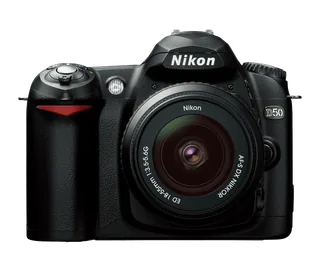
| Stabilisation detail | Optical VR depends on the attached lens; no sensor-shift stabilisation. Pictured original AF-S DX 18–55 mm ED kit lens has no VR | Optical VR depends on the attached lens; no sensor-shift stabilisation |
| Flash | Built-in pop-up i-TTL flash; original manual guide number approximately 15 m at ISO 200 (17 manual) or 11 m at ISO 100 (12 manual); accessory shoe | Pop-up i-TTL flash covering an 18mm lens; guide number approximately 11 at ISO 100 in metres, 12 at full manual output; commander support and hot shoe |
| Exposure controls | P/S/A/M, Auto and six scene modes; 420-segment RGB matrix, centre-weighted and spot metering; ±5 EV compensation in half or one-third stops; exposure/flash and white-balance bracketing | P/S/A/M and seven automatic scene programmes; 1005-pixel RGB 3D Colour Matrix Metering; ±5 EV compensation |
| Screen and viewfinder | ||
| Viewfinder | Optical | Optical |
| Screen size | 2″ | 2″ |
| Screen dots | 130,000 | 130,000 |
| Touchscreen | No | – |
| Tilting screen | No | No |
| Display detail | Fixed 2-inch low-temperature-polysilicon TFT with 130000 dots; top status LCD; contextual help and playback magnification; dots count subpixels | Fixed 2-inch TFT with approximately 130000 dots; removable monitor cover |
| Viewfinder detail | Pentamirror; approximately 95% coverage and 0.75× magnification; original manual specifies 18 mm eyepoint, conflicting with 8 mm on current US page | Pentamirror, approximately 95% coverage and 0.75× magnification with 50mm at infinity; 18 mm eyepoint; selectable grid |
| Connections and design | ||
| Wi-Fi | – | No |
| Battery life (maker's claim) | 400 photographs | 500 photographs |
| Body weight | 540 g (better) | 600 g |
| Release detail | Nikon USA original announcement dated 20 April 2005 states June US availability as a prospective schedule; actual first-sale month is unconfirmed, so year precision is retained | Nikon Japan records 27 April 2005 retail availability; Nikon's original US announcement specifies early May. Main uses the earlier documented Japanese date. The announcement explicitly calls D70 its predecessor |
| Recording media | One Secure Digital card slot; no SDHC compatibility inferred | One CompactFlash Type I/II slot; Microdrive supported |
| Ports | USB 2.0 Hi-Speed, NTSC/PAL video output and DC input; optional ML-L3 infrared remote | USB 2.0 Full Speed; NTSC/PAL analogue video output; dedicated MC-DC1 cable-release port. No HDMI |
| Wireless connections | – | Optional ML-L3 infrared shutter remote; no built-in Wi-Fi |
| Battery life detail | EN-EL3 lithium-ion battery; main 400 shots is original manual single-frame test with 18–55 mm ED lens, Normal Large JPEG and flash every other exposure, not labelled CIPA. Separate 2000-shot continuous test uses Basic Medium JPEG and limited monitor use; the launch announcement promotes that continuous figure | Supplied EN-EL3a. Manual claims approximately 500 shots in Nikon's single-frame test with AF-S DX 18–70mm f/3.5–4.5G IF-ED and full flash on alternate exposures; this is not labelled CIPA. Separate continuous test claims approximately 2500 shots. EN-EL3 or three CR2 cells with optional MS-D70 holder also supported |
| Charging | External MH-18a quick charger; optional EH-5 mains adapter | MH-18a external charger; optional EH-5 AC adapter |
| Dimensions | Approximately 133 × 102 × 76 mm | Approximately 140 × 111 × 78 mm |
| Weight detail | Approximately 540 g excluding battery, memory card and body cap | Approximately 600 g excluding battery, memory card, body cap and monitor cover |
| Colours | Black or silver | – |
| Video | ||
| Video detail | No movie recording or live-view composition; NTSC/PAL output is for playback, despite the current US page labelling it Movie File Format | No movie recording or live view |

More comparisons
- Nikon D70S vs Nikon Z50II
- Nikon D50 vs Nikon Z50II
- Nikon D6 vs Nikon D70S
- Nikon D50 vs Nikon D6
- Nikon D70S vs Nikon D780
- Nikon D50 vs Nikon D780
- Nikon D3500 vs Nikon D70S
- Nikon D3500 vs Nikon D50
- Nikon D70S vs Nikon D850
- Nikon D50 vs Nikon D850
- Nikon D50 vs Nikon D7500
- Nikon D70S vs Nikon D7500
- Nikon D5600 vs Nikon D70S
- Nikon D50 vs Nikon D5600
- Nikon D3400 vs Nikon D70S
- Nikon D3400 vs Nikon D50