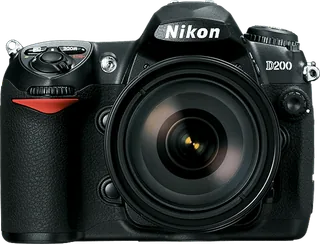
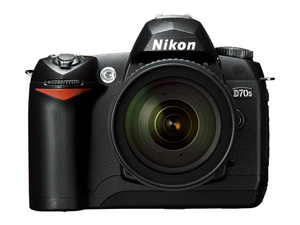
Both praise sturdy construction and comfortable handling, while finding limited improvements over the D70. Macworld praises sharp photographs, accurate colour and autofocus, but questions value beside higher-resolution rivals. TechRadar finds the autofocus improvement hard to notice and criticises inconsistent metering and ordinary JPEGs, preferring processed RAW files. Both consider it a capable camera for photographers prepared to learn its controls.
6.24 million total pixels; Nikon DX-format primary-colour CCD
Image formats
Compressed 12-bit NEF RAW, JPEG and RAW plus Basic JPEG; no in-camera TIFF recording
ISO detail
ISO 200–1600 in one-third-stop increments; Auto ISO
Lens and shooting
Lens mount
Nikon F mount
Stabilisation
Optical lens stabilisation
Maximum continuous burst
3 fps
Lens detail
AF coupling drives compatible screw-drive AF lenses. Supported non-CPU AI lenses work in manual exposure without metering; IX and F3AF lenses unsupported
Autofocus
Multi-CAM 900 phase detection with five focus areas; single-area, dynamic-area and closest-subject-priority modes; AF assist lamp
Shutter
Combined mechanical and CCD electronic shutter; 1/8000 to 30 seconds and Bulb; flash sync up to 1/500 second
Burst detail
Approximately 3 fps; four RAW frames. Nikon claims up to 144 Large Normal JPEGs using specified fast CompactFlash cards; buffer capacity depends on image settings and card
Stabilisation detail
Optical VR depends on the attached lens; no sensor-shift stabilisation
Flash
Pop-up i-TTL flash covering an 18mm lens; guide number approximately 11 at ISO 100 in metres, 12 at full manual output; commander support and hot shoe
Exposure controls
P/S/A/M and seven automatic scene programmes; 1005-pixel RGB 3D Colour Matrix Metering; ±5 EV compensation
Screen and viewfinder
Viewfinder
Optical
Screen size
2″
Screen dots
130,000
Tilting screen
No
Display detail
Fixed 2-inch TFT with approximately 130000 dots; removable monitor cover
Viewfinder detail
Pentamirror, approximately 95% coverage and 0.75× magnification with 50mm at infinity; 18 mm eyepoint; selectable grid
Connections and design
Wi-Fi
No
Battery life (maker's claim)
500 photographs
Body weight
600 g
Release detail
Nikon Japan records 27 April 2005 retail availability; Nikon's original US announcement specifies early May. Main uses the earlier documented Japanese date. The announcement explicitly calls D70 its predecessor
Recording media
One CompactFlash Type I/II slot; Microdrive supported
Ports
USB 2.0 Full Speed; NTSC/PAL analogue video output; dedicated MC-DC1 cable-release port. No HDMI
Wireless connections
Optional ML-L3 infrared shutter remote; no built-in Wi-Fi
Battery life detail
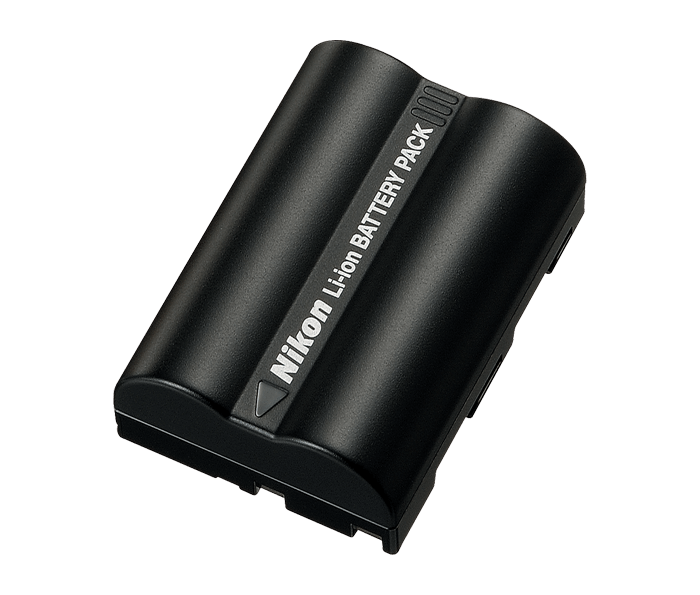
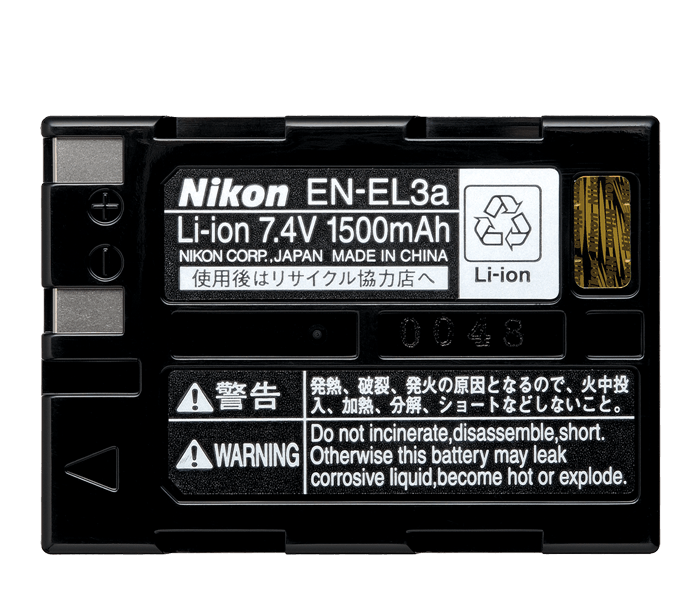
Supplied EN-EL3a. Manual claims approximately 500 shots in Nikon's single-frame test with AF-S DX 18–70mm f/3.5–4.5G IF-ED and full flash on alternate exposures; this is not labelled CIPA. Separate continuous test claims approximately 2500 shots. EN-EL3 or three CR2 cells with optional MS-D70 holder also supported
Charging
MH-18a external charger; optional EH-5 AC adapter
Dimensions
Approximately 140 × 111 × 78 mm
Weight detail
Approximately 600 g excluding battery, memory card, body cap and monitor cover
Video
Video detail
No movie recording or live view
Pros and cons
Pros
+Shutter speeds up to 1/8000 second and flash sync at 1/500
+Body autofocus motor supports compatible screw-drive lenses
+Electronic cable-release port and optional infrared remote