Nikon NIKKOR Z DX 16–50mm f/2.8 VR vs Nikon NIKKOR Z MC 105mm f/2.8 VR S
Better figure, where one is clearly better
| NikonNIKKOR Z DX 16–50mm f/2.8 VR | NikonNIKKOR Z MC 105mm f/2.8 VR S | |
|---|---|---|
| Overview | ||
| Released | October 2025 | June 2021 |
| Optics | ||
| Lens type | Zoom | Prime |
| Focal length | 16–50 mm | 105 mm |
| Maximum aperture | f/2.8 | f/2.8 |
| Minimum aperture | f/22 | f/32 |
| Macro lens | – | Yes |
| Optical construction | 12 elements in 11 groups; internal focusing | 16 elements in 11 groups; internal focusing |
| Special elements | One ED and two aspherical elements | Three ED elements and one aspherical element |
| Coatings | – | Nano Crystal and ARNEO coatings; fluorine-coated front element |
| Aperture detail | f/2.8–22 throughout the zoom range | f/2.8–32 at infinity; effective f/4.5–51 at the closest focus distance of 0.29 m. Main aperture figures refer to infinity |
| Diaphragm | Nine rounded blades | Nine rounded blades |
| Angle of view | DX 83°–31°30′; 24–75 mm equivalent angle of view in FX format | FX 23°10′; DX 15°20′ |
| Mount and compatibility | ||
| Mounts | Nikon Z mount | Nikon Z mount |
| Image circle | APS-C | Full frame |
| Compatibility | Native Nikon Z mount; designed for DX/APS-C format | Native Nikon Z mount; FX/full-frame image circle, also usable on DX cameras |
| Focus and stabilisation | ||
| Autofocus | Yes | Yes |
| Minimum focus distance | 0.15 m | 0.29 m |
| Maximum magnification | 0.24× | 1× |
| Optical stabilisation | Yes | Yes |
| Autofocus detail | Stepping motor; automatic or manual focusing | Multi-focus stepping-motor system; automatic or manual focusing |
| Focus distance detail | Minimum distances from focal plane are 0.15 m at 16 mm, 0.18 m at 24 mm, 0.21 m at 35 mm and 0.25 m at 50 mm | Minimum 0.29 m from focal plane; limiter selects full range or 0.29–0.5 m. Manual focus throw is adjustable; focus direction reversal requires a compatible Nikon Z body released in October 2020 or later |
| Magnification detail | Maximum 0.24× at 50 mm; no separate AF/MF figure published | Maximum 1×, reproducing subjects at life size |
| Stabilisation detail | Lens-shift VR using voice-coil motors. UK maker states up to 4.5 stops under CIPA standards with a DX camera, Normal VR mode and maximum telephoto setting. Canada announcement gives 5 stops under CIPA2024 yaw/pitch testing with Z50II at telephoto in Normal mode; these claims use different stated test conditions | Lens-shift VR using voice-coil motors; 4.5-stop CIPA claim with an FX camera in Normal mode. Stabilisation becomes less effective at macro distances, as both reviews note; the USA release's generic footnote refers to maximum telephoto although this is a prime |
| Video features | Suppressed focus breathing and quiet focusing. Nikon Canada specifies Z50II Hi-Res Zoom for Full HD 30p/25p/24p only; Wide-area AF (L), no displayed focus point and electronic VR off | Quiet autofocus, smooth aperture control and reduced focus breathing |
| Design | ||
| Dust and moisture resistant | Yes | Yes |
| Filter diameter | 67 mm | 62 mm |
| Maximum diameter | 74.5 mm | 85 mm |
| Length | 88 mm | 140 mm |
| Weight | 330 g (better) | 630 g |
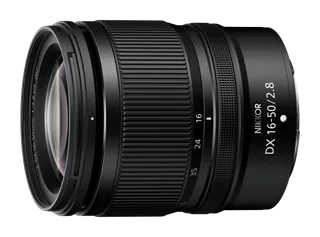
| Controls | Customisable control ring for focus, aperture, exposure compensation or ISO; physical zoom ring; no AF/manual switch, as confirmed by both reviews | Separate manual focus and customisable control rings, L-Fn button, information panel with DISP button, AF/manual switch and focus limiter; Digital Camera World confirms distance, depth-of-field and aperture display |
| Zoom design | Barrel extends while zooming, as confirmed by both reviews; internal focusing does not change length. Focal-length markings 16, 24, 35 and 50 mm | Internal focusing keeps lens length unchanged |
| Filter detail | 67 mm screw-in filters, 0.75 mm pitch | 62 mm screw-in filters, 0.75 mm pitch |
| Weather resistance | Designed for dust and drip resistance; resistance is not guaranteed under every condition | Sealing around mount and moving parts for dust and drip resistance, not guaranteed in all conditions; fluorine front coating repels water, dirt and dust |
| Dimensions detail | Approximately 74.5 mm maximum diameter × 88 mm from mount flange | Approximately 85 mm maximum diameter × 140 mm from mount flange |
| Weight detail | Approximately 330 g | Approximately 630 g |
| Lens hood | HB-118 included | HB-99 included |
| In the box | LC-67B front cap, LF-N1 rear cap and HB-118 hood | LC-62B front cap, LF-N1 rear cap, HB-99 hood and CL-C2 case |
| Release detail | Nikon Canada states late October 2025 availability; earliest exact retail day and first UK day unconfirmed, so month precision retained | Nikon USA states late-June 2021 availability; earliest exact retail day and first UK day unconfirmed, so month precision retained |

More comparisons
- Nikon NIKKOR Z 70–200mm f/2.8 VR S II vs Nikon NIKKOR Z DX 16–50mm f/2.8 VR
- Nikon NIKKOR Z 70–200mm f/2.8 VR S II vs Nikon NIKKOR Z MC 105mm f/2.8 VR S
- Nikon NIKKOR Z 24–105mm f/4–7.1 vs Nikon NIKKOR Z DX 16–50mm f/2.8 VR
- Nikon NIKKOR Z 24–105mm f/4–7.1 vs Nikon NIKKOR Z MC 105mm f/2.8 VR S
- Nikon AF-S DX NIKKOR 18-140mm f/3.5-5.6G ED VR vs Nikon NIKKOR Z DX 16–50mm f/2.8 VR
- Nikon NIKKOR Z DX 16–50mm f/2.8 VR vs Nikon NIKKOR Z DX 16-50mm f/3.5-6.3 VR
- Nikon NIKKOR Z DX 12-28mm f/3.5-5.6 PZ VR vs Nikon NIKKOR Z DX 16–50mm f/2.8 VR
- Nikon NIKKOR Z DX MC 35mm f/1.7 vs Nikon NIKKOR Z MC 105mm f/2.8 VR S
- Nikon NIKKOR Z 17-28mm f/2.8 vs Nikon NIKKOR Z DX 16–50mm f/2.8 VR
- Nikon NIKKOR Z DX 16–50mm f/2.8 VR vs Nikon NIKKOR Z DX MC 35mm f/1.7
- Nikon NIKKOR Z 24-70mm f/2.8 S II vs Nikon NIKKOR Z DX 16–50mm f/2.8 VR
- Nikon NIKKOR Z 28-135mm f/4 PZ vs Nikon NIKKOR Z DX 16–50mm f/2.8 VR
- Nikon NIKKOR Z 35mm f/1.2 S vs Nikon NIKKOR Z DX 16–50mm f/2.8 VR
- Nikon NIKKOR Z 50mm f/1.4 vs Nikon NIKKOR Z DX 16–50mm f/2.8 VR
- Nikon NIKKOR Z 35mm f/1.4 vs Nikon NIKKOR Z DX 16–50mm f/2.8 VR
- Nikon NIKKOR Z 28-400mm f/4-8 VR vs Nikon NIKKOR Z DX 16–50mm f/2.8 VR