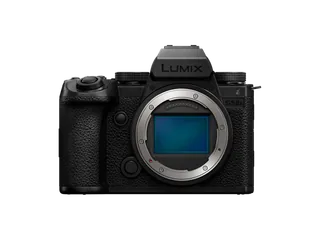
Nikon Z f vs Panasonic LUMIX S5IIX
Better figure, where one is clearly better
| NikonZ f | PanasonicLUMIX S5IIX | |
|---|---|---|
| Overview | ||
| Released | October 2023 | May 2023 |
| Image and sensor | ||
| Camera type | Mirrorless | Mirrorless |
| Sensor format | Full frame | Full frame |
| Sensor type | Back-illuminated CMOS | CMOS |
| Sensor dimensions | 35.9 × 23.9 mm | 35.6 × 23.8 mm |
| Effective resolution | 24.5 MP | 24.2 MP |
| Largest image | 6048 × 4032 | 6000 × 4000 |
| RAW recording | Yes | Yes |
| Standard ISO range | 100–64000 | 100–51200 |
| Sensor detail | 25.28 million total pixels; sensor cleaning and image-dust-off data for NX Studio. Pixel-shift frames require software combination and a static camera/subject; no composite resolution is substituted for the single-frame main figure. | Maker Japan specifies 24.2 million effective pixels, 35.6 × 23.8 mm CMOS; native 3:2 stills 6000×4000. High-resolution composites up to 12000×8000 are separate from native output; BSI or stacked construction is not inferred |
| Image formats | 14-bit NEF RAW with lossless or high-efficiency compression; JPEG and HEIF; RAW plus JPEG or HEIF. Firmware 3.00 adds adjustable Film Grain for stills/video with movie restrictions. | JPEG, RAW and RAW+JPEG; high-resolution composite RAW generated in-camera |
| ISO detail | Standard still-image ISO 100–64000, expandable to equivalent ISO 50–204800; HLG starts at ISO 400. Movie ISO 100–51200 with format-dependent expansion; physical dial and command-dial ranges differ. | Standard ISO 100–51200; expanded 50/102400/204800. Dual Native ISO 100/640 in standard stills, 640/4000 for V-Log and 400/2500 for HLG; profile-dependent ranges apply |
| Image processor | EXPEED 7 | – |
| Lens and shooting | ||
| Lens mount | Nikon Z mount | L-Mount |
| Stabilisation | Sensor shift | Lens and sensor shift |
| Maximum continuous burst | 30 fps | 30 fps |
| Lens detail | NIKKOR Z lenses; NIKKOR F lenses require an adapter and retain model-dependent restrictions. Manual-focus subject detection and focus confirmation available with compatible setups. | – |
| Autofocus | Hybrid phase/contrast detection; 273 single-point or 299 auto-area positions in FX stills; subject detection and 3D tracking. Nikon's −10 EV sensitivity uses AF-S, ISO 100, f/1.2 and 20°C. | Phase Hybrid AF combines phase and contrast detection; 779 points (maker US). Current Japan recognition includes people, animals, cars, motorcycles, trains and aircraft; launch-era reviews described fewer subjects, so later firmware recognition is not treated as a launch feature. Continuous autofocus during zooming requires compatible updated lens firmware |
| Shutter | Mechanical, electronic front-curtain and electronic; 1/8000 to 30 seconds using command dial, with Bulb/Time and manual extension to 900 seconds. Physical dial covers 1/8000 to 4 seconds plus special settings. Flash sync 1/200 and Auto FP support; threaded shutter button accepts a cable release. | Mechanical 60–1/8000 second, Bulb approximately 30 minutes; electronic first curtain 60–1/2000 with the same Bulb maximum; electronic 60–1/8000 with Bulb approximately 60 seconds |
| Burst detail | Ordinary high approximately 7.8 fps and extended high up to 14 fps, subject to format restrictions. C15/C30 high-speed capture reaches 30 fps with pre-release capture for JPEG normal; it is not a 30 fps RAW mode. | Full-resolution electronic SH30 at 30 fps AFS/AFC/MF; SH30 PRE added in version 2.0. Current SH buffer 200 RAW/RAW+JPEG/JPEG frames. Mechanical/electronic-first-curtain 9 fps AFS/MF or 7 fps AFC; normal electronic 9/8 respectively. Normal RAW/RAW+JPEG buffer at least 200 and JPEG at least 300 frames under maker media/test conditions |
| Stabilisation detail | Five-axis sensor shift; Nikon claims 8 stops under CIPA with NIKKOR Z 24–120mm f/4 S at the telephoto end in NORMAL mode. Focus Point VR has compatible-lens and AF-area restrictions; electronic video VR available. | Five-axis sensor-shift B.I.S. with compatible-lens Dual I.S.2; maker US Dual I.S.2 claim 6.5 stops under CIPA yaw/pitch conditions with S-E70200 at 200 mm and updated lens firmware. Active I.S. optimises video correction; electronic video modes have separate restrictions |
| Flash | No built-in flash; ISO 518 accessory shoe and compatible external i-TTL Speedlights | No built-in flash; external flash sync up to 1/250 second, with reduced guide number and maker restrictions at the fastest sync setting |
| Exposure controls | Auto and P/S/A/M; physical compensation dial ±3 EV, command control ±5 EV in C setting; dedicated black-and-white switch | – |
| Video | ||
| Highest video resolution | 3840 × 2160 at 60 fps | 5952 × 3968 at 29.97 fps |
| Video detail | UHD 3840 × 2160 up to 60p in cropped DX mode; full-frame UHD up to 30p oversampled from 6K. Full HD up to 120p. H.265 8/10-bit and H.264, N-Log, HLG, waveform and timecode; current maker table lists Hi-Res Zoom. Maximum recording time 125 minutes, subject to temperature, power and media conditions; no internal RAW video listed. | Internal 5952×3968 3:2 open-gate 6K at 29.97p, 4:2:0 10-bit HEVC Long GOP 200 Mbps; C4K/4K 59.94p uses an APS-C crop. ALL-Intra and ProRes 422/HQ options include 5776×3056 up to 29.97p with supported USB SSD/media restrictions. RAW is separate HDMI output to compatible Atomos/Blackmagic recorders, including 5888×3312 12-bit up to 29.97p or APS-C 4128×2176 up to 59.94p; not internal RAW. Built-in fan; maker unlimited-recording claims require 0–40 °C, and Thermal Management STANDARD can stop high-resolution recording after 30 minutes. Battery/media can also limit duration |
| Audio | Built-in stereo microphones; PCM 48 kHz/24-bit for MOV or AAC 48 kHz/16-bit for MP4; external microphone input and headphone monitoring | Built-in stereo microphone; 48 kHz/24-bit recording and compatible external/XLR high-resolution 96 kHz/24-bit options under maker mode restrictions |
| Screen and viewfinder | ||
| Viewfinder | Electronic | Electronic |
| Screen size | 3.2″ | 3″ |
| Screen dots | 2,100,000 | 1,840,000 |
| Touchscreen | Yes | Yes |
| Tilting screen | Yes | Yes |
| Display detail | Vari-angle TFT with approximately 100% coverage and 170° viewing angle; Touch Fn supports settings and focus-point adjustment while using the viewfinder; dots count subpixels | Three-inch 3:2 capacitive touchscreen, approximately 1.84 million dots; free-angle articulation. Amateur Photographer and Tom's Guide report connected HDMI/USB cables can impede its movement, despite the maker launch claim of no interference |
| Viewfinder detail | 0.5-inch Quad-VGA OLED, approximately 3.69 million dots, 100% coverage, 0.8× magnification and 21 mm eyepoint | Current Japan table 0.5-inch 4:3 OLED, approximately 3.68 million dots, 100% coverage and 0.78× magnification with 50 mm lens/infinity/−1 dioptre/3:2 ratio. US launch release's 0.76× description differs and is not silently substituted |
| Connections and design | ||
| Wi-Fi | Yes | Yes |
| Bluetooth | Yes | Yes |
| Battery life (maker's claim) | 430 photographs | 370 photographs |
| Body weight | 630 g (better) | 657 g |
| Release detail | Nikon US states first availability in mid-October 2023; main retains month precision. The later silver exterior is the same camera hardware, and Nikon explicitly states firmware 3.00 supports both original and silver editions. | Maker US confirms May 2023 availability; UK launch announcement states Spring 2023. Tom's Guide's June 2023 date is not used as the global first-sale month; no exact UK retail day inferred. UK body launch price £2299 |
| Recording media | Primary UHS-II SD/SDHC/SDXC slot and secondary UHS-I microSD/microSDHC/microSDXC slot; overflow, backup and separate format recording | Two SD/SDHC/SDXC slots, both UHS-II including V90; supported formats can record to USB SSD |
| Ports | USB-C SuperSpeed USB, Micro HDMI Type D, 3.5 mm microphone and headphone sockets | USB-C SuperSpeed USB 10 Gbps, full-size HDMI Type A, 2.5 mm remote and 3.5 mm microphone/headphone sockets; wired LAN streaming requires an optional USB-LAN adapter |
| Wireless connections | Wi-Fi IEEE 802.11a/b/g/n/ac and Bluetooth 5.0; SnapBridge. Nikon Imaging Cloud and automatic firmware updates supported by current firmware. | Wi-Fi 2.4 GHz 802.11b/g/n and 5 GHz 802.11a/n/ac; Bluetooth Low Energy 5.0. Wired/wireless IP streaming and USB tethering; regional 5 GHz restrictions apply |
| Battery life detail | EN-EL15c; CIPA approximately 430 monitor shots with power saving enabled or 380 without; EVF 410 with power saving or 360 without. Tested with NIKKOR Z 40mm f/2. Movie battery-life claim approximately 90 minutes; EN-EL15b/15a compatibility gives shorter endurance. | DMW-BLK22, 7.2 V 2200 mAh; current Japan table approximately 370 LCD/EVF shots with S-R2060 and Panasonic SDXC, or 1250 under specified one-second power-save EVF conditions. Tom's Guide's quoted 330 shots is not substituted for the current maker table |
| Charging | USB charging and power delivery with compatible equipment; optional EH-8P/EH-7P; EN-EL15c/15b rechargeable in camera. Nikon UK states no charger included. | Japan table approximately 220 minutes in-camera with bundled AC adapter or 170 with DMW-BTC15 adapter; optional DMW-BTC15 charger approximately 175 minutes |
| Dimensions | Approximately 144 × 103 × 49 mm | Approximately 134.3 × 102.3 × 90.1 mm, excluding protrusions |
| Weight detail | Approximately 630 g body only or 710 g with battery/card, excluding body cap and shoe cover; TechRadar's body-only narrative uses the battery/card figure, so main follows Nikon. | Maker Australia and Germany specify 657 g body only; Japan 740 g with battery and one SD card. Lens excluded |
| Materials | Magnesium-alloy front and top covers, brass control dials and embossed artificial leather; dust- and drip-resistant construction | Magnesium-alloy die-cast front and rear frames; dust/splash-resistant construction, not waterproof; matte black body and dark markings |
| Colours | Original black and later silver finishes with maker-specific exterior colour options; cosmetic variants remain one hardware product. Photograph shows the current silver/black finish. | – |
| In the box | EN-EL15c battery, UC-E25 USB cable, BF-N1 body cap, AN-DC27 strap, BS-1 shoe cover and DK-33 eyepiece | Maker Japan lists body cap, hot-shoe cover, battery-grip connector cover, shoulder strap, battery, USB AC adapter and USB A–C cable; regional contents may vary |

More comparisons
- Nikon Z f vs Nikon Z5IIC
- Nikon Z f vs Nikon ZR
- Fujifilm X-E5 vs Nikon Z f
- Panasonic LUMIX S1II vs Panasonic LUMIX S5IIX
- Panasonic LUMIX S1IIE vs Panasonic LUMIX S5IIX
- Nikon Z f vs Nikon Z5II
- Panasonic LUMIX S1RII vs Panasonic LUMIX S5IIX
- Nikon Z f vs Nikon Z50II
- Panasonic LUMIX S5IIX vs Panasonic LUMIX S5D
- Nikon Z f vs Nikon Z6III
- Panasonic LUMIX S5IIX vs Panasonic LUMIX S9
- Nikon Z f vs Nikon Z fc
- Fujifilm X-T5 vs Nikon Z f
- Nikon Z f vs Sony Alpha 7C II
- Nikon Df vs Nikon Z f
- Canon EOS R8 vs Nikon Z f