Nintendo DSi XL vs Sony PlayStation Vita
Better figure, where one is clearly better
| NintendoDSi XL | SonyPlayStation Vita | |
|---|---|---|
| Overview | ||
| Released | November 2009 | December 2011 |
| Performance | ||
| Type | Handheld | Handheld |
| CPU | – | ARM Cortex-A9, 4 cores |
| GPU | – | PowerVR SGX543MP4+ |
| Memory | – | 640 MB |
| Disc drive | No | No |
| CPU | – | ARM Cortex-A9 core (4 core) |
| GPU | – | SGX543MP4+ |
| Memory detail | – | 512 MB main memory and 128 MB VRAM (Sony's PCH-1000 specifications) |
| Storage detail | – | No built-in storage on the PCH-1000; games on PlayStation Vita cards or downloaded |
| Storage expansion | SD and SDHC cards up to 32 GB; miniSD and microSD cards require an adapter (Nintendo UK) | PS Vita memory card slot (Sony's own format) |
| Display and video | ||
| Built-in screen | 4.2″ LCD, 256 × 192 | 5″ OLED, 960 × 544 |
| Built-in screen | Two 4.2-inch transmissive TFT colour LCDs, approximately 260,000 colours each; five brightness levels and a touch screen on the lower display | 5 inches (16:9), 960 × 544, approx. 16 million colours, OLED; capacitive multi-touch screen and rear multi-touch pad |
| Audio | Built-in speakers and microphone; stereo headphone output | Built-in stereo speakers and microphone; headset jack |
| Design and power | ||
| Battery life (maker's claim) | Up to 17 hours | Up to 5 hours |
| Weight | 314 g | 260 g (better) |
| Battery life detail | UTL-003 user-replaceable lithium-ion battery pack, 3.9 Wh (Nintendo's Japanese manual). Nintendo rates approximately 13–17 hours at lowest brightness, 11–14 at low, 9–11 at medium, 6–8 at high and 4–5 at highest; software and usage affect runtime. Full charge approximately 3 hours | 2210 mAh built-in battery; about 3–5 hours of games, 5 hours of video and 9 hours of music (Sony) |
| Power use | Approximately 2.8 W maximum while charging (Nintendo's Japanese manual) | – |
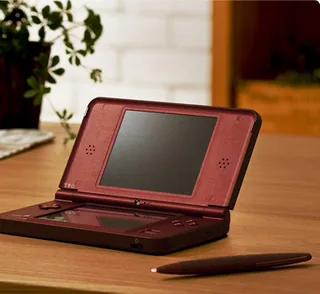
| Size | 161 × 91.4 × 21.2 mm when folded (width × depth × thickness); approximately 314 g includes battery and stylus | – |
| Colours | Dark brown, wine red and natural white at the Japanese launch; other regions and later releases differ | – |
| In the box | DSi LL, AC adapter, small stylus, large pen-style stylus, quick start guide and instruction manual (Japanese bundle); the large stylus is 129.3 mm long and the small stylus 96 mm | – |
| Connections | ||
| Ports | Nintendo DS card slot, SD card slot, AC adapter connector and stereo headphone/microphone connector | PS Vita card slot, memory card slot, multi-use port (USB, DC IN, audio), headset jack, accessory port; SIM card slot on the 3G/Wi-Fi model |
| Wi-Fi and Bluetooth | Wi-Fi IEEE 802.11b/g (DSSS/OFDM), 2.4 GHz; nominal range approximately 10–30 m depending on surroundings (Nintendo's Japanese manual) | Wi-Fi IEEE 802.11b/g/n (1x1), Bluetooth 2.1+EDR; 3G and GPS on the 3G/Wi-Fi model |
| Controller | Built-in D-pad, A/B/X/Y, L/R, Start and Select buttons, stylus and touch screen; inner and outer fixed-focus CMOS cameras, approximately 0.3 megapixels each (Nintendo Japan) | Built-in D-pad, two analogue sticks, four face buttons, two shoulder buttons; six-axis motion sensing and three-axis electronic compass; front and rear cameras (up to 640 × 480) |
| Backward compatibility | Nintendo DS and DSi games and installed DSiWare; no Game Boy Advance games or DS accessories requiring the GBA slot. DSi Shop purchases and free downloads ended on 31 March 2017 (Nintendo UK); launch reviews describe the service before closure | Supported downloadable PSP games and PS one Classics (PlayStation) |
More comparisons
- Sony PlayStation 5 Pro vs Sony PlayStation Vita
- Sony PlayStation Portal vs Sony PlayStation Vita
- Sony PlayStation 5 Slim vs Sony PlayStation Vita
- Sony PlayStation 5 vs Sony PlayStation Vita
- Nintendo DSi XL vs Nintendo Switch Lite
- Nintendo DSi XL vs Nintendo New 2DS XL
- Nintendo New 2DS XL vs Sony PlayStation Vita
- Sony PlayStation 4 Pro vs Sony PlayStation Vita
- Sony PlayStation 4 Slim vs Sony PlayStation Vita
- Sony PlayStation 4 (CUH-1200) vs Sony PlayStation Vita
- Nintendo DSi XL vs Nintendo New 3DS XL
- Nintendo New 3DS vs Sony PlayStation Vita
- Sony PlayStation 4 vs Sony PlayStation Vita
- Nintendo 2DS vs Sony PlayStation Vita
- Sony PlayStation Vita vs Sony PlayStation Vita Slim (PCH-2000)
- Nintendo 3DS XL vs Sony PlayStation Vita