Nokia E62 vs Sony Ericsson P990i
Better figure, where one is clearly better
| NokiaE62 | Sony EricssonP990i | |
|---|---|---|
| Overview | ||
| Released | September 2006 | August 2006 |
| Display | ||
| Screen size | – | 2.76″ |
| Resolution | 320 × 240 | 320 × 240 |
| Sharpness | – | 145 pixels per inch |
| Panel | LCD | LCD |
| Display type | Landscape active-matrix TFT, 16 million colours, 320 × 240 pixels and 56.9 × 42.7 mm active area in the exact owner guide; not a touchscreen. Production reviews call it 2.8 inches, while GSMArena lists 2.9; no headline diagonal inferred. | TFT touchscreen with 262,144 colours (PhoneArena) |
| Display features | – | Stylus touchscreen with full 240 × 320 resolution; 240 × 240 visible with the flip closed (OSnews) |
| Cameras | ||
| Main camera | None | 2 MP (better) |
| Ultra wide camera | None | None |
| Telephoto camera | None | None |
| Optical zoom | None | None |
| Main camera | No camera; camera-free business device | 2 MP autofocus camera with photo light, digital zoom and lens cover |
| Front camera | – | Separate video-call camera |
| Battery and charging | ||
| Battery | 1,500 mAh | – |
| Wireless charging | None | None |
| Battery life detail | Removable BP-5L 1500 mAh; exact guide's battery chapter calls it Li-Polymer, while its accessory list says Li-Ion. Maker claims up to 5.5 hours GSM talk and 14 days idle; launch release says approximately five hours. Review tests use different conditions, not video playback. | – |
| Wired charging | Separate battery charger connector; AC-4 travel charger and DC-4 mobile charger in the exact guide. No charging wattage inferred. | – |
| Design | ||
| Type | Standard | Standard |
| Weight | 144 g (better) | 155 g |
| Thickness | 16.2 mm (better) | 26 mm |
| Height × width | 116.5 × 69.9 mm | 114 × 57 mm |
| Stylus | – | Yes |
| Size unfolded | – | Maker P1 comparison lists 21 mm body and 26 mm with flip; P990i user guide instead specifies 25 mm overall thickness |
| Weight detail | 144 g with battery and 116.5 × 69.9 × 13.9–16.2 mm in the exact maker technical table; headline thickness uses its upper bound. Secondary database's rounded 117 × 69.7 × 14 mm is not substituted. | – |
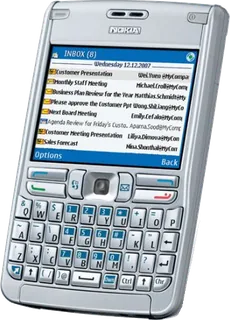
| Materials | Silver metal enclosure in PhoneArena's exact production review | – |
| Buttons | Backlit QWERTY keyboard, joystick, email/menu/call/end and soft keys, side volume and voice key, top power key; email indicator and light sensor | Removable numeric keypad flip, fixed QWERTY keyboard and Jog Dial |
| Speakers | Built-in loudspeaker and stereo audio playback in the exact guide; PhoneArena hears distortion at maximum loudspeaker volume | – |
| Software | ||
| Operating system | Symbian | Symbian |
| Software at launch | Symbian 9.1a with S60 Third Edition, release 3.0 in the exact guide | Symbian OS 9.1 with UIQ 3 |
| Software features | Maker launch and exact guide support creating/editing documents, spreadsheets and presentations, PDF viewing, HTML/WAP browsing, email, instant messaging, VPN and synchronisation. Guide/launch carrier services may no longer operate; not a promise of present network support. | – |
| Release detail | Announced by Nokia/Cingular on 12 September 2006 with US retail planned for 29 September; contemporaneous actual-sale coverage confirms Cingular shipping that day. Month precision retained because an earlier worldwide first-sale day is unresolved. Separate regional E61-related hardware, not an inferred successor. | – |
| Performance | ||
| Memory | – | 64 MB |
| Storage | – | 60 MB |
| CPU | 32-bit RISC ARM9 in the exact maker guide; no clock speed or chip identity inferred | – |
| Memory | Greater than 80 MB total user memory in the exact guide; Computerworld reports 80 MB and PhoneArena 75 MB. Installed RAM and an exact internal capacity are not established, so omitted from configurations. | – |
| Storage type | Hot-swappable miniSD beneath the rear cover; exact maker accessory list supports 3.0 V cards from 64 MB to 2 GB. Not microSD, RS-MMC or full-size SD. | Up to 60 MB internal user memory without 3D games; 64 MB Memory Stick PRO Duo supplied; supports cards up to 8 GB in the maker user guide; the original sale release stated up to 4 GB |
| Connectivity | ||
| Mobile network | Quad-band EGSM 850/900/1800/1900; EGPRS/GPRS/HSCSD/CSD in the exact owner guide. No UMTS, HSDPA or other 3G radio. | GSM 900/1800/1900 and UMTS 2100; no EDGE support (OSnews) |
| Wi-Fi | No Wi-Fi, confirmed by both production reviews; not the E61's WLAN hardware | Wi-Fi 802.11b wireless network connectivity |
| Bluetooth | Bluetooth 2.0, up to six simultaneous connections in the guide; headset/hands-free, serial/dial-up, file/object transfer, remote SIM and imaging profiles. No A2DP inferred. | Bluetooth 2.0 with A2DP stereo audio (OSnews) |
| USB | Mini-USB, described as USB 2.0 in the exact guide; separate headset and charger connectors, plus infrared. No Hi-Speed transfer rate or headset-jack diameter inferred. | USB 2.0 low speed (1.5 Mbit/s) and full speed (12 Mbit/s) through Fast Port; IrDA-SIR and IrOBEX infrared |
| Positioning | Exact guide lists optional LD-1W wireless GPS module; PhoneArena tests an external Bluetooth receiver. No built-in GPS inferred. | – |

More comparisons
- Sony Ericsson P990i vs Sony Xperia 1 VIII
- Nokia E62 vs Nokia E72
- Nokia E52 vs Nokia E62
- Nokia E55 vs Nokia E62
- Nokia E62 vs Nokia E63
- Nokia E62 vs Nokia E66
- Nokia E62 vs Nokia E71
- Nokia E62 vs Nokia E65
- Nokia E61i vs Sony Ericsson P990i
- Nokia N95 vs Sony Ericsson P990i
- Nokia E51 vs Nokia E62
- Nokia E50 vs Nokia E62
- Nokia E60 vs Nokia E62
- Nokia E62 vs Nokia N73
- Nokia E50 vs Sony Ericsson P990i
- Nokia E60 vs Sony Ericsson P990i