Samsung QLED Q90T (2020) vs Sony BRAVIA XF90
Better figure, where one is clearly better
| SamsungQLED Q90T (2020) | SonyBRAVIA XF90 | |
|---|---|---|
| Overview | ||
| Released | May 2020 | 2018 |
| Display | ||
| Panel | LED LCD | LED LCD |
| Panel detail | Quantum-dot LED-backlit LCD with Direct Full Array 16x local dimming. Samsung's UK tables do not publish native refresh or dimming-zone counts; they do confirm 4K 120 Hz Game Mode on HDMI 4 for each listed size. | Direct LED backlight with full-array local dimming and Triluminos colour. AVForums and Expert Reviews counted 48 dimming zones on their 55-inch review samples; Sony does not publish a series-wide count. X-Motion Clarity is picture processing, not a native refresh specification. |
| Resolution | 3840 × 2160 (4K) | 3840 × 2160 (4K) |
| HDR formats | HDR10, HDR10+, HLG | HDR10, HLG, Dolby Vision |
| HDR extras | Samsung's Quantum HDR 2000 is a product label, not a measured 2000-nit result. HDR10, HDR10+ and HLG are confirmed by the maker and exact-model reviews; Dolby Vision is unsupported. | Sony announced Dolby Vision support for XF90 and now lists the series as compatible; it arrived through a firmware update after launch. |
| Peak brightness | – | AVForums measured about 1,000 nits in its brightest HDR mode and 705 nits in Cinema Pro on its UK 55-inch review sample; these are test results, not maker series specifications. |
| Screen finish | Anti Reflection Screen in each UK maker table. | – |
| Colour range | Samsung's UK tables claim 100% colour volume with Quantum Dot; this is a maker claim, not a reviewer measurement for every size. | – |
| Picture processing | Quantum Processor 4K, AI Picture, Ultimate UHD Dimming, Contrast Enhancer and 4200 Picture Quality Index in the UK maker tables. PQI is not native refresh rate. | 4K X-Reality PRO, X-tended Dynamic Range PRO, Object-based HDR remaster, Super Bit Mapping 4K HDR and X-Motion Clarity. |
| Picture modes | Film Mode, Natural Mode and Contrast Enhancer in all three UK maker tables. What Hi-Fi? recommends adjusting the 55-inch picture for natural colour. | – |
| Motion handling | WIRED UK finds motion well controlled on its 55-inch unit; What Hi-Fi? finds an improvement over the prior model. Samsung's UK tables do not state native Hz, but explicitly confirm 4K 120 Hz Game Mode on HDMI 4 for every listed size. | Sony describes X-Motion Clarity but its exact UK size sheets do not publish a native refresh figure, so no Hz value is assigned to the series. |
| Viewing angle | Ultra Viewing Angle in all three UK maker tables; both independent 55-inch reviews find the picture remains usable well off-centre. | AVForums and Expert Reviews report the 55-inch LCD's contrast and colour degrade when viewed from the side. |
| Sizes | ||
| Sizes | 55, 65, 75″ | 49, 55, 65, 75″ |
| Largest size | 75″ | 75″ |
| Gaming | ||
| HDMI ports | 4 (1 HDMI 2.1 at 4K 120 Hz+) (better) | 4 (0 HDMI 2.1 at 4K 120 Hz+) |
| Variable refresh rate | FreeSync Premium | None |
| Auto low latency mode | Yes | – |
| HDMI detail | Four HDMI inputs, with 4K 120 Hz Game Mode specifically on HDMI 4 according to Samsung's UK size tables. Those tables confirm eARC; the remaining HDMI inputs are not claimed as 4K 120 Hz capable. What Hi-Fi? says the set lacked official HDMI 2.1 certification despite its supported gaming features. | Four HDMI inputs. AVForums reports only HDMI 2 and 3 accept the higher-bandwidth 4K 60 Hz signal modes. ARC is supported; no HDMI 2.1 bandwidth. |
| Input lag | What Hi-Fi? reports 11 ms on its exact UK 55-inch review unit; this reviewer measurement is not assigned to the other sizes. | Expert Reviews measured 25 ms at 4K and 42 ms at 1080p in Game mode on its 55-inch sample. |
| Game features | Auto Game Mode (ALLM), Game Motion Plus, Dynamic Black EQ and FreeSync Premium in all three UK maker tables. 4K 120 Hz is limited to HDMI 4. | Game mode; no HDMI VRR. |
| Smart TV and sound | ||
| Smart TV platform | Tizen | Android TV |
| Processor | Quantum Processor 4K | 4K HDR Processor X1 Extreme |
| Speakers | 60 W, 4.2.2 channels (better) | 20 W, 2.0 channels |
| eARC | Yes | – |
| Wi-Fi | Wi-Fi 5 | 802.11a/b/g/n/ac |
| Bluetooth | Bluetooth 4.2 | 4.1 |
| Speaker detail | Samsung's UK tables specify 60 W, 4.2.2 channels, a woofer and Object Tracking Sound for all three sizes. The 4.2.2 layout describes speaker placement, not Dolby Atmos decoding. | Two 10 W speakers with ClearAudio+ and S-Force Front Surround. |
| Audio features | Dolby Digital Plus, Dolby 5.1 decoder, Adaptive Sound+, Active Voice Amplifier and Q-Symphony in the UK maker tables. What Hi-Fi? confirms eARC can pass Atmos to external audio gear; the TV's speakers are not claimed to render Atmos. | – |
| Voice assistants | Bixby UK English, Alexa and listed Google Assistant compatibility in the maker tables; current service availability may differ. | – |
| Casting | Mobile-to-TV and TV-to-mobile mirroring, DLNA, Tap Mirroring, Wi-Fi Direct, Sound Mirroring and Multi-View in the UK maker tables. What Hi-Fi? also confirms AirPlay 2 on its 55-inch unit. | Chromecast built in, per Sony UK specifications. |
| TV tuners | Twin DVB-T2/C/S2 digital tuners, analogue tuner, CI+ 1.4, UK HbbTV 2.0.1 and MHEG 5, guide, PVR and time shift in the maker tables. | Sony UK lists DVB-T/T2 terrestrial, DVB-C cable and DVB-S/S2 satellite tuners. |
| USB | Two USB inputs in every UK maker size table. What Hi-Fi?'s 55-inch tech-spec box says three; WIRED UK and Samsung say two, so the main count follows the maker. | Three USB inputs, including support for media playback and USB HDD recording. |
| Ethernet | Ethernet LAN built in. | One LAN input. |
| Optical audio out | One optical digital audio output. | One optical digital audio output. |
| Design and power | ||
| Size | Without stand, width × height × depth: 55-inch 1227.6 × 705.6 × 34.8 mm; 65-inch 1446.5 × 828.3 × 34.8 mm; 75-inch 1670.6 × 957.8 × 35.2 mm. Configuration weights exclude stand. Each size is from its own UK maker table. | Without stand (W × H × D), Sony UK sheets: 49″ 1093 × 629 × 69 mm; 55″ 1228 × 706 × 69 mm; 65″ 1447 × 829 × 69 mm; 75″ 1674 × 958 × 73 mm. Configuration weights also exclude stands. |
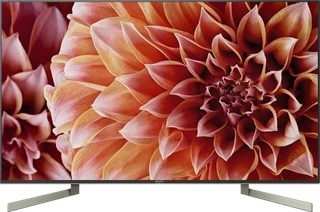
| Stand | Titan Black Bending Plate central stand. With-stand weights from separate UK maker tables: 55-inch 24.4 kg; 65-inch 33.6 kg; 75-inch 48.7 kg. Unlike the Q90R, inputs and power connect directly to the TV. | Wide-set feet; VESA is 200 × 200 mm for 49″, 300 × 300 mm for 55/65″ and 400 × 300 mm for 75″. |
| Power use | Maximum from separate UK maker tables: 55-inch 245 W; 65-inch 305 W; 75-inch 335 W. | – |
| Energy class | G in Samsung's current UK A–G maker tables for all three sizes; this scale differs from the old Q90R B label. | – |
| Colours | Titan Black front and stand in the UK maker tables. | – |
| In the box | Samsung's UK tables list TM2050C Smart Control and, for GB/IE, TM1240A standard remote, plus power cable, manual and e-manual. | Sony announced the series in January 2018; AVForums reported UK retailer availability in March 2018. |

More comparisons
- Sony BRAVIA 7 II vs Sony BRAVIA XF90
- Sony BRAVIA 9 II vs Sony BRAVIA XF90
- LG OLED evo C6 vs Samsung QLED Q90T (2020)
- Sony BRAVIA 3 II vs Sony BRAVIA XF90
- Sony BRAVIA 8 II vs Sony BRAVIA XF90
- Samsung Neo QLED QN90F vs Samsung QLED Q90T (2020)
- Sony BRAVIA 5 vs Sony BRAVIA XF90
- Sony BRAVIA 3 vs Sony BRAVIA XF90
- Hisense E8Q vs Samsung QLED Q90T (2020)
- Hisense E8Q vs Sony BRAVIA XF90
- Sony BRAVIA 9 vs Sony BRAVIA XF90
- Sony BRAVIA 8 vs Sony BRAVIA XF90
- Samsung Neo QLED QN90A vs Samsung QLED Q90T (2020)
- Samsung Neo QLED QN90A vs Sony BRAVIA XF90
- Samsung QLED Q90R (2019) vs Samsung QLED Q90T (2020)
- Samsung QLED Q90T (2020) vs Sony BRAVIA XE90