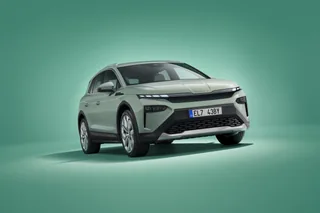
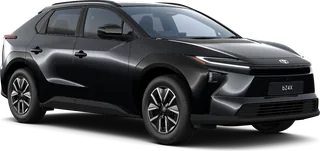
Škoda Elroq vs Toyota bZ4X (2025)
Better figure, where one is clearly better
| ŠkodaElroq | ToyotabZ4X (2025) | |
|---|---|---|
| Overview | ||
| Released | October 2024 | November 2025 |
| Performance | ||
| Powertrain | Electric | Electric |
| Power | 187–335 bhp | 165–338 bhp (better) |
| 0–62 mph | 5.4–8.5 s | 5.1–8.6 s (better) |
| Top speed | 99–112 mph (better) | 86–99 mph |
| Engine or motors | Rear motor, 190 PS (140 kW) or 286 PS (210 kW); vRS adds a front motor for 340 PS (250 kW); bhp converted from Škoda's PS figures | Permanent-magnet synchronous motors: FWD 165 bhp (167 DIN hp, 123 kW) with the 57.7 kWh battery or 221 bhp (224 DIN hp, 165 kW) with the 73.1 kWh battery; AWD front and rear motors, 338 bhp (343 DIN hp, 252 kW). Lithium-ion batteries of 57.7 kWh gross (54 kWh usable, 78 cells) or 73.1 kWh gross (69 kWh usable, 104 cells) |
| Torque | 350 Nm (60), 545 Nm (85), 545 Nm rear and 134 Nm front (vRS) | 268.6 Nm (front motor); 169.8 Nm (rear motor, AWD) |
| Gearbox | Single-speed automatic | Single-speed automatic |
| Drive | Rear-wheel drive; all-wheel drive on vRS | Front-wheel drive, or all-wheel drive with X-MODE and Grip Control (Excel) |
| Range and charging | ||
| Zero-emission range (WLTP) | 280–372 miles (better) | 274–352 miles |
| Battery | 58–79 kWh (better) | 54–69 kWh |
| Fastest charging | 105–165 kW (better) | 150 kW |
| Range detail | WLTP combined: up to 280 miles (60), 372 miles (85), 344 miles (vRS) on Škoda UK's site; the August 2026 brochure lists 274–279, 364–370 and 344 miles by trim | WLTP combined: 274 miles (57.7 kWh Icon); 352 miles (73.1 kWh Design, 18-inch wheels); 319 miles (Excel FWD, 20-inch wheels); 292 miles (Excel AWD) |
| Charging | Batteries 61/58 kWh, 84/79 kWh or 82/77 kWh (gross/net); DC 10–80% in about 26 minutes (60) or 29 minutes (85 and vRS); 7.2 kW home charging to 100% in about 10 hours (60) or 13 hours (85, vRS) | 150 kW DC, 10–80% in 28 minutes with battery pre-conditioning (consistent from −10 °C); 11 kW AC on Icon and Design (10–80% in 4.8 h), 22 kW AC on Excel (2.2 h) |
| Efficiency | WLTP combined: 3.7–4.1 miles/kWh (60 and 85), 3.6–3.8 (vRS) | WLTP combined: 4.47 miles/kWh (FWD, 18-inch wheels), 4.03 (FWD, 20-inch), 3.9 (AWD) |
| CO2 emissions | 0 g/km at the tailpipe | 0 g/km at the tailpipe |
| Practicality | ||
| Body | SUV | SUV |
| Seats | 5 | 5 |
| Boot | 470 litres (better) | 452 litres |
| Length | 4,488 mm | 4,690 mm |
| Width | 1,884 mm | 1,860 mm |
| Weight | From 1,957 kg | From 1,850 kg |
| Boot | 470 litres, 1,580 litres with the rear seats folded | 452 litres (VDA) including under the deck board |
| Towing | 1,000 kg braked (60), 1,800 kg (85 and vRS) | 750 kg braked (FWD); 1,500 kg braked (AWD) |
| Size | 4,488 mm long, 1,884 mm wide (2,148 mm with mirrors), 1,618–1,626 mm high; 2,765–2,772 mm wheelbase; kerb weight without driver from 1,957 kg (60) to 2,143 kg (vRS) | 4,690 mm long, 1,860 mm wide (excluding mirrors), 1,650 mm high; 2,850 mm wheelbase; 5.6 m turning radius (tyres); approach 17.4°, departure 25.6°; 500 mm wading depth; kerb weight 1,850–1,890 kg (57.7 kWh), 1,930–2,020 kg (73.1 kWh FWD), 2,025–2,080 kg (AWD, press specifications) |
| Tech and safety | ||
| Infotainment | – | 14-inch multimedia touchscreen with two wireless phone chargers; 7-inch digital driver's display; JBL audio in the Excel Premium Pack |
| Driver assistance | – | Toyota Safety Sense: Pre-Collision System, Intelligent Adaptive Cruise Control, Lane Trace Assist, Lane Departure Alert with steering assist, Road Sign Assist; Blind Spot Monitor on all versions; Panoramic View Monitor from Design; Lane Change Assist and digital rear-view mirror on Excel |
| Warranty | – | 3 years or 60,000 miles; battery 8 years or 100,000 miles, extendable to 10 years or 650,000 miles with an annual EV Care battery health check |