Sony Cyber-shot DSC-H400 vs Sony Cyber-shot DSC-H5
Better figure, where one is clearly better
| SonyCyber-shot DSC-H400 | SonyCyber-shot DSC-H5 | |
|---|---|---|
| Overview | ||
| Released | 2014 | May 2006 |
| Image and sensor | ||
| Camera type | Bridge | Bridge |
| Sensor format | 1/2.3-type | Other |
| Sensor type | Super HAD CCD | Super HAD CCD |
| Effective resolution | 20.1 MP | 7.2 MP |
| Largest image | 5152 × 3864 | 3072 × 2304 |
| RAW recording | No | No |
| Standard ISO range | 80–3200 | 80–1000 |
| Sensor detail | 1/2.3-type CCD with 20.4 million total photosites; optical format is not a physical dimension | 1/2.5-type Super HAD CCD; approximately 7.41 million total and 7.201 million effective photosites, rounded to 7.2 MP. Optical format does not establish physical sensor dimensions |
| Image formats | JPEG (DCF, Exif and MPF Baseline); Sweep Panorama stitches multiple exposures separately from sensor resolution | JPEG Fine or Standard, Exif 2.21, DCF and DPOF; no RAW recording |
| Image processor | – | Real Imaging Processor; Clear RAW NR is noise reduction, not a RAW recording mode |
| Lens and shooting | ||
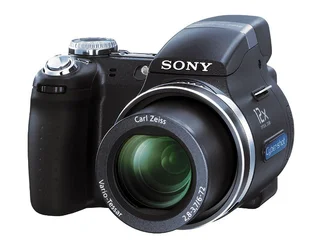
| Built-in lens | 24.5–1550 mm equivalent | 36–432 mm equivalent |
| Maximum aperture | f/3.4–6.5 | f/2.8–3.7 |
| Optical zoom | 63× | 12× |
| Stabilisation | Optical lens stabilisation | Optical lens stabilisation |
| Maximum continuous burst | 0.71 fps | – |
| Lens detail | Sony lens, actual 4.4–277 mm; 24.5–1550 mm equivalent for stills. Movie equivalents 32.1–2029 mm at 16:9 or 29.2–1849 mm at 4:3. 55 mm filter diameter; not a ZEISS lens | Carl Zeiss Vario-Tessar 12× optical zoom, physical 6–72 mm, 36–432 mm equivalent, f/2.8 wide to f/3.7 telephoto; 11 elements in 9 groups including one ED and one aspherical element. Supplied adapter supports 58 mm filters and optional conversion lenses; digital and Smart Zoom are crops |
| Autofocus | Multi-point, centre, spot, tracking and face-tracking autofocus; AF illuminator. Published minimum distance approximately 1 cm wide or 3.5 m telephoto | Single, Monitor or Continuous AF, multi-point, centre and movable spot areas, with AF illuminator and manual distance adjustment. Normal minimum approximately 50 cm wide or 90 cm telephoto; macro approximately 2 cm wide or 90 cm telephoto |
| Shutter | Intelligent Auto 2–1/2000 second, Program 1–1/2000, Manual 30–1/2000 | Auto 1/4–1/2000 second; Program Auto 1–1/2000 second; shutter-priority and Manual 30–1/1000 second. Fastest settings depend on aperture and mode |
| Burst detail | Approximately 0.71 fps at maximum still resolution, up to 100 frames | Exact maker manual and Japanese specifications give five full-resolution Fine JPEG photographs per burst, with approximately 0.9-second intervals; Standard JPEGs increase the limit. UK legacy web table lists seven/0.8 second, conflicting with the exact H5 manual column; manual retained. Separate Multi Burst puts sixteen small frames inside one image |
| Stabilisation detail | Optical SteadyShot; optical zoom available during movie recording | Optical Super SteadyShot with Shooting or Continuous operation; continuous correction uses more battery |
| Flash | Built-in pop-up flash; ISO Auto range approximately 0.4–8.8 m wide or 3.5–4.6 m telephoto. Advanced Flash increases sensitivity; no external flash connection | Built-in pop-up flash; approximately 0.3–9 m wide or 0.9–6.8 m telephoto at Auto ISO. Greater high-sensitivity range claims are conditional on ISO 1000 |
| Exposure controls | Intelligent Auto, Easy, Program, aperture priority, shutter priority, Manual, Sweep Panorama, scene selection and picture effects; ±2 EV in 1/3 EV steps; manual exposure offers F3.4 or F8.1 at maximum wide angle, F6.5 or F8.0 at maximum telephoto, rather than a continuous aperture range | Auto, Program, aperture-priority, shutter-priority and Manual, seven scene modes, multi-pattern/centre-weighted/spot metering and ±2 EV in 1/3 EV steps; jog dial adjusts exposure |
| Video | ||
| Highest video resolution | 1280 × 720 at 30 fps | 640 × 480 at 30 fps |
| Video detail | MP4 MPEG-4 AVC/H.264, 1280×720 at 30 progressive fps in Fine or Standard quality; VGA at 30 fps. No 1080p recording; Fine approximately 9 Mbps, Standard 6 Mbps, VGA 3 Mbps. General continuous recording limit approximately 29 minutes; 720p Fine approximately 15 minutes due to 2 GB file limit. HD movies require a memory card | MPEG-1 monaural video up to 640 × 480 at approximately 30 fps in VX Fine mode, requiring Memory Stick PRO Duo. VX Standard is approximately 17 fps; 160 × 112 Video Mail is approximately 8 fps. Optical zoom can change during recording |
| Audio | Built-in monaural microphone and speaker; exact Sony operating instructions distinguish these from incorrect stereo descriptions in some reviews | Built-in electret condenser microphone, monaural movie sound, speaker and monaural analogue A/V output |
| Screen and viewfinder | ||
| Viewfinder | Electronic | Electronic |
| Screen size | 3″ | 3″ |
| Screen dots | 460,800 | 230,400 |
| Touchscreen | No | No |
| Tilting screen | No | No |
| Display detail | Fixed 3-inch TFT LCD with 460800 colour-subpixel dots and five brightness settings | Fixed 3.0-type Clear Photo LCD Plus TFT, 230400 dots and 100% coverage; UK web table rounds to 230000. Separate 0.2-type electronic viewfinder has approximately 201000 dots equivalent in maker web specs, rounded to 200000 in the English manual |
| Viewfinder detail | 0.2-type electronic viewfinder with approximately 201600 equivalent dots, 100% coverage and dioptre adjustment; manual screen/viewfinder switching | – |
| Connections and design | ||
| Bluetooth | – | No |
| Wi-Fi | No | – |
| Battery life (maker's claim) | 300 photographs | 340 photographs |
| Body weight | 628 g | 406 g (better) |
| Release detail | Sony announced planned March 2014 US and April 2014 UK availability; April reviews describe the sold camera. Earliest worldwide actual first-sale month remains unresolved, so year precision retained | Sony US announcement on 25 February 2006 planned May availability; Japanese maker release specifies 19 May 2006 and Hong Kong launch planned end-May availability. May precision retained without claiming an exact worldwide first-sale day |
| Recording media | Approximately 55 MB internal memory; Memory Stick Duo/PRO Duo/PRO-HG Duo/XC-HG Duo, Memory Stick Micro, SD/SDHC/SDXC and microSD/microSDHC/microSDXC, using appropriate adapters | Approximately 30 MB internal memory under English maker manual; Japanese archive describes approximately 28 MB with 30 MB under its older measurement method. Memory Stick Duo/PRO Duo supported, with PRO Duo required for VGA Fine movies. US launch described 32 MB; exact manual retained |
| Ports | USB / A/V OUT jack for USB 2.0 and standard-definition analogue video/audio output; no HDMI | Mini-B Hi-Speed USB 2.0 and monaural analogue A/V output; PictBridge direct printing |
| Wireless connections | – | UK maker specifications explicitly list no Bluetooth |
| Battery life detail | NP-BX1 lithium-ion battery, nominal 3.6 V, 1240 mAh / 4.5 Wh. CIPA approximately 300 stills/150 minutes using LCD or 320 stills/160 minutes using viewfinder. Typical movie shooting approximately 60/75 minutes LCD/viewfinder; continuous movies approximately 120/135 minutes | Two supplied NH-AA-DB nickel-metal hydride AA cells; approximately 340 photographs/170 minutes with LCD or 370 photographs/185 minutes with finder under CIPA still-test conditions. Alkaline test gives only 50 LCD/60 finder photographs. Separate 190-minute LCD/230-minute finder movie claims use 160-size continuous recording, not VGA Fine |
| Charging | In-camera USB charging with supplied AC-UB10C adapter or a computer; camera switched off. Approximately 230 minutes for a full charge using supplied adapter; supplied adapter supports playback power but not shooting power. Shooting mains power requires separately sold AC-UD10 or region-dependent AC-UD11 | External BC-CS2A/CS2B Ni-MH charger; approximately six hours for fully depleted supplied cells at 25°C. LR6 alkaline and ZR6 Oxy Nickel primary AA cells or optional AC-LS5K adapter also supported |
| Dimensions | 129.6×95.0×122.3 mm width×height×depth (CIPA) | Approximately 113.2 × 83 × 94 mm width × height × depth excluding protrusions |
| Weight detail | Approximately 628 g body only; approximately 655 g with NP-BX1 battery and Memory Stick PRO Duo under CIPA conditions | Approximately 406 g body only. Maker 554 g figure includes two batteries, memory card, shoulder strap, adapter ring, lens hood, lens cap and straps; not bare camera-and-battery mass |
| Materials | Sony states the camera is not dust-proof, splash-proof or waterproof | – |
| Colours | Black | Black or silver |
| In the box | NP-BX1 battery, AC-UB10C adapter, dedicated USB cable, shoulder strap, lens cap and instructions; mains lead supplied outside USA, Canada and China | Camera, two rechargeable AA Ni-MH batteries, charger, power cord, battery case, USB and A/V cables, shoulder strap, lens cap, lens hood and adapter ring, instructions and software; regional fittings vary |

More comparisons
- Sony Cyber-shot DSC-H400 vs Sony Cyber-shot DSC-HX99
- Sony Cyber-shot DSC-H5 vs Sony Cyber-shot DSC-HX99
- Sony Cyber-shot DSC-H400 vs Sony Cyber-shot DSC-HX350
- Sony Cyber-shot DSC-H5 vs Sony Cyber-shot DSC-HX350
- Sony Cyber-shot DSC-H400 vs Sony Cyber-shot DSC-HX80
- Sony Cyber-shot DSC-H5 vs Sony Cyber-shot DSC-HX80
- Sony Cyber-shot DSC-H400 vs Sony Cyber-shot DSC-HX90V
- Sony Cyber-shot DSC-H5 vs Sony Cyber-shot DSC-HX90V
- Sony Cyber-shot DSC-H400 vs Sony Cyber-shot DSC-WX500
- Sony Cyber-shot DSC-H5 vs Sony Cyber-shot DSC-WX500
- Sony Cyber-shot DSC-H400 vs Sony Cyber-shot DSC-HX400V
- Sony Cyber-shot DSC-H400 vs Sony Cyber-shot DSC-HX60V
- Sony Cyber-shot DSC-H5 vs Sony Cyber-shot DSC-HX400V
- Sony Cyber-shot DSC-H5 vs Sony Cyber-shot DSC-HX60V
- Sony Cyber-shot DSC-H200 vs Sony Cyber-shot DSC-H400
- Sony Cyber-shot DSC-H400 vs Sony Cyber-shot DSC-HX300