Sony Cyber-shot DSC-HX99 vs Sony Cyber-shot DSC-V3
Better figure, where one is clearly better
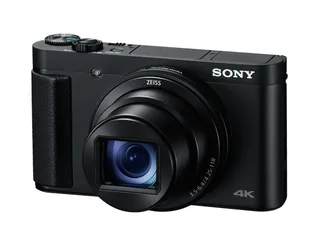
| SonyCyber-shot DSC-HX99 | SonyCyber-shot DSC-V3 | |
|---|---|---|
| Overview | ||
| Released | October 2018 | October 2004 |
| Image and sensor | ||
| Camera type | Compact | Compact |
| Sensor format | 1/2.3-type | 1/1.8-type |
| Sensor type | Back-illuminated Exmor R CMOS | Super HAD CCD |
| Effective resolution | 18.2 MP | 7.2 MP |
| Largest image | 4896 × 3672 | 3072 × 2304 |
| RAW recording | Yes | Yes |
| Standard ISO range | 80–3200 | 100–800 |
| Sensor detail | 1/2.3-type Exmor R CMOS; approximately 21.1 million total photosites. Optical format is not physical sensor dimensions | 1/1.8-type interlaced Super HAD CCD with primary-colour filter; approximately 7.41 million total and 7.201 million effective photosites. Optical format is not physical sensor dimensions |
| Image formats | Sony ARW 2.3 RAW, RAW+JPEG or JPEG Extra Fine/Fine/Standard; sRGB or Adobe RGB; 4:3, 3:2, 16:9 and square photographs plus Sweep Panorama | JPEG Fine/Standard, RAW plus JPEG, or uncompressed TIFF plus JPEG; maximum 3072 × 2304 or 3072 × 2048 in 3:2 |
| ISO detail | Ordinary ISO 80–3200; extended single-frame ISO 6400. Multi-shot Noise Reduction offers ISO 6400 and 12800 using combined exposures | – |
| Image processor | BIONZ X with front-end LSI | Real Imaging Processor |
| Lens and shooting | ||
| Built-in lens | 24–720 mm equivalent | 34–136 mm equivalent |
| Maximum aperture | f/3.5–6.4 | f/2.8–4 |
| Optical zoom | 28× | 4× |
| Stabilisation | Optical lens stabilisation | – |
| Maximum continuous burst | 10 fps | 1 fps |
| Lens detail | ZEISS Vario-Sonnar T*, actual 4.25–118 mm, 11 elements in 10 groups with five aspherical elements; five-blade iris. Maker specifies 28× optical zoom, while 24–720 mm equivalent values are those displayed by the camera and recorded in Exif | Carl Zeiss Vario-Sonnar, actual 7–28 mm, 34–136 mm equivalent; optional conversion lenses and adapter |
| Autofocus | 25-point contrast autofocus, AF-S, Direct Manual Focus and manual focus; AF-C available for movies only. Eye AF, Lock-on AF and flexible spot areas; minimum focus approximately 5 cm wide or 250 cm telephoto | Five-area Multipoint, Center or movable Flexible Spot AF; Single, Monitor and Continuous AF modes. Hologram AF laser-pattern assist; fourteen preset manual-focus distances from 0.1 m to infinity. Macro approximately 10 cm wide or 40 cm telephoto |
| Shutter | Mechanical shutter: Manual and shutter-priority 30–1/2000 second, aperture-priority 8–1/2000, Program 1–1/2000 and Intelligent Auto 1/4–1/2000 | Auto 1/8–1/2000 second, Program 1–1/2000, shutter-priority and Manual 30–1/1000; slow-shutter noise reduction |
| Burst detail | Full-resolution Speed Priority Continuous up to 10 fps, or ordinary Continuous approximately 3 fps. Up to 155 frames in Speed Priority with JPEG Fine; rate falls as buffer fills. Focus, exposure and white balance lock to first frame in either mode | Normal full-resolution Burst has approximately 1.0-second intervals, up to fifteen Fine or twenty-eight Standard JPEGs at 7M. Brief Speed Burst uses approximately 0.4-second intervals, up to eight full-resolution JPEGs; flash disabled. Reduced Multi Burst combines sixteen frames into one 1M image. No RAW/TIFF bursts |
| Stabilisation detail | Optical SteadyShot for stills; Intelligent Active movies combine optical and electronic correction | – |
| Flash | Built-in pop-up flash; ISO Auto range approximately 0.3–5.4 m wide or 2.5–3.0 m telephoto; no accessory shoe | Built-in rotating pop-up flash; hot shoe and ACC terminal for external flash. Manual recommends ISO Auto range 0.4–3.0 m wide or 0.4–2.5 m telephoto; red-eye reduction and slow sync |
| Exposure controls | P/A/S/M and two Memory Recall modes; ±3 EV in 1/3 EV steps; multi-pattern, centre-weighted, spot, entire-screen average and highlight metering | P/A/S/M, Auto and seven scene modes; multi-pattern, centre-weighted and spot metering; ±2 EV in 1/3 EV steps, AE lock and live histogram. NightShot records infrared photographs; NightFraming uses infrared framing followed by flash for natural-colour photographs |
| Video | ||
| Highest video resolution | 3840 × 2160 at 30 fps | 640 × 480 at 30 fps |
| Video detail | XAVC S 3840 × 2160 at 30p or 24p, 60/100 Mbps; PAL uses 25p. Full-pixel readout without pixel binning. Full HD up to 120p (100p PAL); 4K and 120p/100p HD sessions limited to approximately five minutes, with possible earlier thermal shutdown. Other modes approximately 29 minutes subject to temperature. UHS-I U3 microSDHC/XC required for 100 Mbps | MPEG Movie VX Fine, 640 × 480 at 30 effective fps, requires Memory Stick PRO or PRO Duo with adapter. Standard 640 × 480 at approximately 16.6 fps or 160 × 112 at approximately 8.3 fps; recording to available media capacity |
| Audio | Stereo recording: XAVC S Linear PCM or AVCHD Dolby Digital | MPEG1 mono sound, electret condenser microphone and built-in speaker |
| Screen and viewfinder | ||
| Viewfinder | Electronic | Optical |
| Screen size | 3″ | 2.5″ |
| Screen dots | 921,600 | 123,000 |
| Touchscreen | Yes | No |
| Tilting screen | Yes | No |
| Display detail | 3.0-type 4:3 TFT LCD, 921600 dots; tilts up 180 degrees. Touch focus, touch shutter and touchpad focus while using viewfinder; menus are not touch controlled | Fixed 2.5-type TFT LCD with 123000 dots; live histogram and adjustable brightness |
| Viewfinder detail | Retractable 0.2-type OLED, 638400 dots; 100% coverage (97% during 4K recording), 0.50× equivalent magnification, −4 to +3 dioptres | Optical zoom viewfinder without dioptre adjustment; DPReview measured approximately 84% coverage |
| Connections and design | ||
| Wi-Fi | Yes | – |
| Bluetooth | Yes | – |
| Battery life (maker's claim) | 370 photographs | 300 photographs |
| Body weight | 216 g (better) | 360 g |
| Release detail | Sony Switzerland states availability from late October 2018; Sony Hong Kong specifies 26 October locally. October precision retained because the international first-sale day is not established | Sony US announcement specifies availability in late October 2004; Sony Japan specifies 5 November. October month precision retained without assuming an international first-sale day |
| Recording media | microSD, microSDHC, microSDXC and Memory Stick Micro/Mark2; no full-size SD slot | Separate Memory Stick and CompactFlash Type I slots selected by rear switch; Memory Stick Duo/PRO Duo require adapter. Type II and Microdrive not supported |
| Ports | Micro HDMI and Multi/Micro USB with USB 2.0 | Mini-B USB 2.0 Hi-Speed with PictBridge, mono A/V minijack with NTSC/PAL output, DC input and 2.5 mm ACC accessory jack |
| Wireless connections | 2.4 GHz IEEE 802.11 b/g/n Wi-Fi, NFC Type 3 and Bluetooth for location information from a compatible smartphone; no built-in GPS or compass | – |
| Battery life detail | NP-BX1; CIPA claim approximately 370 photographs with LCD or 300 with viewfinder. LCD claim rises to 460 with monitor auto-off set to two seconds | NP-FR1 InfoLITHIUM, 4.4 Wh/1220 mAh; manual claims approximately 300 photographs/150 minutes with LCD on or 400/200 minutes off at 25°C, CIPA-based Fine JPEG, one shot every 30 seconds, alternating zoom ends, flash every second shot, power cycle every ten shots and Single AF |
| Charging | In-camera USB charging and USB external power using supplied AC adapter with battery inserted | NP-FR1 charges inside camera through supplied AC-LS5/LS5B adapter and DC input |
| Dimensions | 102 × 58.1 × 35.5 mm (width × height × depth), CIPA | 119.8 × 72.0 × 63.0 mm (width × height × depth), excluding maximum protrusions |
| Weight detail | Approximately 216 g body only, or 242 g including NP-BX1 and memory card | Approximately 360 g body only in Sony Japan announcement; manual gives 410 g including NP-FR1, Memory Stick and shoulder strap |
| Colours | Black | Black |
| In the box | NP-BX1, AC-UB10C adapter, micro USB cable, wrist strap and instructions in Japan; regional mains fittings vary | NP-FR1 and battery case, AC adapter/mains lead, USB and A/V cables, shoulder strap, two software CD-ROMs and instructions; supplied memory card varies by market |

More comparisons
- Sony Cyber-shot DSC-HX99 vs Sony Cyber-shot DSC-RX100 VII
- Sony Cyber-shot DSC-RX100 VII vs Sony Cyber-shot DSC-V3
- Sony Cyber-shot DSC-HX90V vs Sony Cyber-shot DSC-HX99
- Sony Cyber-shot DSC-HX80 vs Sony Cyber-shot DSC-HX99
- Sony Cyber-shot DSC-HX50V vs Sony Cyber-shot DSC-HX99
- Sony Cyber-shot DSC-HX99 vs Sony Cyber-shot DSC-WX500
- Sony Cyber-shot DSC-HX350 vs Sony Cyber-shot DSC-HX99
- Sony Cyber-shot DSC-HX400V vs Sony Cyber-shot DSC-HX99
- Sony Cyber-shot DSC-HX60V vs Sony Cyber-shot DSC-HX99
- Sony Cyber-shot DSC-H400 vs Sony Cyber-shot DSC-HX99
- Sony Cyber-shot DSC-HX99 vs Sony Cyber-shot DSC-W800
- Sony Cyber-shot DSC-HX99 vs Sony Cyber-shot DSC-W830
- Sony Cyber-shot DSC-HX99 vs Sony Cyber-shot DSC-WX350
- Sony Cyber-shot DSC-HX300 vs Sony Cyber-shot DSC-HX99
- Sony Cyber-shot DSC-H200 vs Sony Cyber-shot DSC-HX99
- Sony Cyber-shot DSC-HX99 vs Sony Cyber-shot DSC-WX200