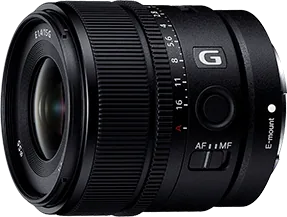
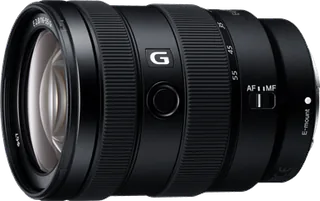
Sony E 15mm F1.4 G vs Sony E 16-55mm F2.8 G
Better figure, where one is clearly better
| SonyE 15mm F1.4 G | SonyE 16-55mm F2.8 G | |
|---|---|---|
| Overview | ||
| Released | June 2022 | September 2019 |
| Optics | ||
| Lens type | Prime | Zoom |
| Focal length | 15 mm | 16–55 mm |
| Maximum aperture | f/1.4 | f/2.8 |
| Minimum aperture | f/16 | f/22 |
| Optical construction | Thirteen elements in twelve groups | Seventeen elements in twelve groups |
| Special elements | Three aspherical elements, one ED glass element and one Super ED glass element | Two AA (advanced aspherical) elements, two further aspherical elements and three ED glass elements |
| Coatings | – | Nano AR Coating and fluorine-coated front element |
| Diaphragm | Seven rounded blades | Nine rounded blades |
| Angle of view | 87° APS-C | 83°–29° APS-C |
| Mount and compatibility | ||
| Mounts | Sony E | Sony E |
| Image circle | APS-C | APS-C |
| Image circle detail | APS-C coverage; 22.5 mm equivalent field of view | APS-C coverage; 24–82.5 mm equivalent field of view |
| Teleconverter support | Not compatible with SEL14TC or SEL20TC | Not compatible with SEL14TC or SEL20TC |
| Focus and stabilisation | ||
| Autofocus | Yes | Yes |
| Minimum focus distance | 0.17 m (manual focus) | 0.33 m |
| Maximum magnification | 0.15× (manual focus) | 0.2× |
| Optical stabilisation | No | No |
| Autofocus detail | Two linear motors and internal focusing; maker does not designate these motors XD | XD linear motor for autofocus |
| Focus distance detail | Minimum focus 0.20 m in AF or 0.17 m in MF; Linear Response MF | 0.33 m minimum focus; Linear Response MF |
| Magnification detail | Maximum magnification 0.12× in AF or 0.15× in MF | 0.20× maximum magnification |
| Stabilisation detail | No optical stabilisation; compatible bodies provide stabilisation | No optical stabilisation; compatible bodies provide stabilisation |
| Video features | Reduced focus breathing; breathing compensation requires a compatible camera, changes field of view and image quality slightly, and may not fully compensate breathing | – |
| Design | ||
| Dust and moisture resistant | Yes | Yes |
| Filter diameter | 55 mm | 67 mm |
| Maximum diameter | 66.6 mm | 73 mm |
| Length | 69.5 mm | 100 mm |
| Weight | 219 g (better) | 494 g |
| Controls | Aperture ring with click on/off switch, AF/MF switch, manual-focus ring and one customisable focus-hold button; no aperture-ring lock | Separate zoom and manual-focus rings, AF/MF switch and one customisable focus-hold button; no aperture ring |
| Zoom design | – | Barrel extends during zooming; Photography Blog measured approximately 35 mm additional extension from 16 to 55 mm |
| Filter detail | – | 67 mm front filter thread; front filter does not rotate during focusing (Photography Blog) |
| Weather resistance | Dust- and moisture-resistant design; not guaranteed completely dust- or moisture-proof | Dust- and moisture-resistant design; not guaranteed completely dust- or moisture-proof |
| Dimensions detail | 66.6 mm maximum diameter × 69.5 mm length; internal focusing | 73 mm maximum diameter × 100 mm length |
| Weight detail | Approximately 219 g lens; separate hood and caps excluded | Approximately 494 g lens; separate hood and caps excluded |
| Lens hood | ALC-SH171 petal bayonet hood | ALC-SH161 petal bayonet hood |
| In the box | ALC-SH171 hood, ALC-F55S front cap and ALC-R1EM rear cap; no case listed | ALC-SH161 hood, ALC-F67S front cap, ALC-R1EM rear cap and soft case |
| Release detail | Sony Hong Kong specified mid-June 2022 availability. Independent full reviews were authored by Photography Blog Mark Goldstein, testing ZV-E10, and Digital Camera World Matthew Richards, whose sample images identify Alpha 7R III. Their wide-open sharpness results differ. Sony specifies one ED plus one Super ED element, superseding Photography Blog’s two ED claim. This is a G lens, not the G Master designation used in parts of that review; its unconfirmed fluorine coating is omitted | Sony Hong Kong specified end of September 2019 availability. Photography Blog Mark Goldstein tested Alpha 6600. Digital Camera World Chris George and Matthew Richards identify Alpha 6600 sample images and Alpha 6400 lab testing. Their long-end corner assessments differ; Digital Camera World explicitly removed forced distortion correction for raw lab testing. Reviews’ historical stabilised-body lists are not used as a current compatibility restriction |
More comparisons
- Sony E 15mm F1.4 G vs Sony FE 16mm F1.8 G
- Sony E 16-55mm F2.8 G vs Sony E PZ 16-50mm F3.5-5.6 OSS II
- Sony E 10-18mm F4 OSS vs Sony E 15mm F1.4 G
- Sony E 15mm F1.4 G vs Sony E 16mm F2.8
- Sony E 15mm F1.4 G vs Sony E 35mm F1.8 OSS
- Sony E 11mm F1.8 vs Sony E 15mm F1.4 G
- Sony E 11mm F1.8 vs Sony E 16-55mm F2.8 G
- Sony E 15mm F1.4 G vs Sony E PZ 10-20mm F4 G
- Sony E 16-55mm F2.8 G vs Sony E PZ 10-20mm F4 G
- Sony E 15mm F1.4 G vs Sony FE 14mm F1.8 GM
- Sony DT 16–50mm F2.8 SSM vs Sony E 16-55mm F2.8 G
- Sony E 16-55mm F2.8 G vs Sony Vario-Tessar T* E 16-70mm F4 ZA OSS
- Sony E 16-55mm F2.8 G vs Sony E 18-135mm F3.5-5.6 OSS
- Sony E 16-55mm F2.8 G vs Sony E PZ 18-110mm F4 G OSS