Photo 1 of 6
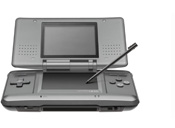
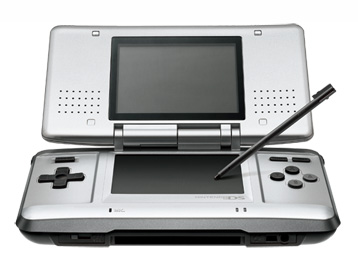
Nintendo DS · Nintendo official Nintendo DS product image, silver finish, open console with stylus; complete supplied canvas retained.
DS
Nintendo's original 2004 DS, a clamshell handheld with two 3-inch screens, the lower one a touch screen, for collectors and anyone comparing it with the Game Boy Advance, 3DS or PSP.
- Type
- Handheld
- Output
- –
- Memory
- 4 MB
- Storage
- –
- Weight
- 275 g
What reviewers say
Reviewers liked its inventive dual-screen, touch and microphone games, wireless multiplayer and Game Boy Advance compatibility, finding it fun and accessible. Both found it bulky and clunky, with graphics and media features behind Sony's PSP; Trusted Reviews missed an analogue stick, and CNET noted weaker third-party games.
From cnet.com and trustedreviews.com
Specifications
Report a wrong or missing specPerformance
- Type
- Handheld
- CPU
- ARM946E-S, 67 MHz, plus ARM7TDMI, 33 MHz
- GPU
- Nintendo 2D and 3D graphics engines
- Memory
- 4 MB
- Disc drive
- No
- CPU
- ARM946E-S at 67.028 MHz and ARM7TDMI at 33.514 MHz (Nintendo NITRO Programming Manual)
- GPU
- Two 2D graphics engines and a 3D engine with texture mapping, alpha blending and Gouraud shading; polygon-list memory holds up to 2,048 triangles (Nintendo NITRO Programming Manual)
- Memory detail
- 4 MB main memory, 656 KB video memory, 32 KB shared work RAM and 64 KB ARM7 work RAM (Nintendo NITRO Programming Manual)
- Storage detail
- Games on Nintendo DS game cards
- Storage expansion
- Game Boy Advance cartridge slot (Slot-2)
Display and video
- Built-in screen
- 3″ LCD, 256 × 192
- Built-in screen
- Two 3-inch TFT LCDs, 256 × 192 each, 4:3; resistive touch screen on the lower one
- Audio
- Stereo speakers with virtual surround; built-in microphone; headphone and microphone jack
Design and power
- Battery life (maker's claim)
- Up to 10 hours
- Weight
- 275 g
- Battery life detail
- User-replaceable lithium-ion battery; 6–10 hours of play after about a 4-hour charge (Nintendo)
Connections
- Wi-Fi and Bluetooth
- Wi-Fi IEEE 802.11b with WEP
- Controller
- Built-in D-pad, A/B/X/Y, Start, Select, L and R buttons; stylus
- Backward compatibility
- Game Boy Advance games (not Game Boy or Game Boy Color)
Pros and cons
Pros
- Two screens, with a resistive touch screen and stylus on the lower one
- Plays Game Boy Advance games in a second slot
- Built-in microphone and Wi-Fi (802.11b) for local and online play
Cons
- Two 256 × 192 screens
- Nintendo rates battery life at 6–10 hours, less than the later DS Lite
- Bulkier and dimmer than the DS Lite that replaced it
Closest rivals
Model | Type | Output | Memory | Storage | Weight | Released |
|---|---|---|---|---|---|---|
| Handheld | – | – | – | 80 g | Nov 2005 | |
| Handheld | – | – | – | 218 g | Mar 2006 | |
| Handheld | – | 36 MB | – | 280 g | Sept 2005 |
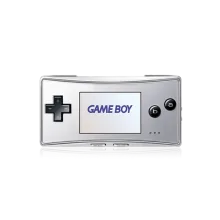
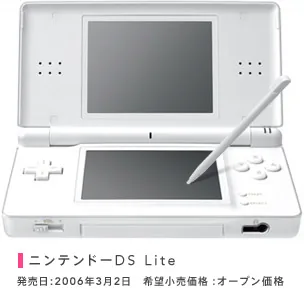
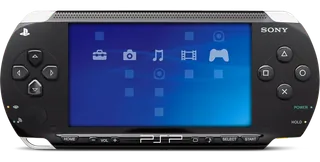
Newer model: DS Lite.
Sources
- nintendo.com/eu/media/downloads/support_1/nintendo_ds_19/NDS_Manual_UK_DE_FR.pdf
- nintendo.co.jp/ds/spec/index.html
- scribd.com/document/52151943/NDS-NITRO-Programming-Manual-V1-44
- nintendo.co.jp/corporate/en/history/index.html
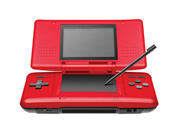
- Original Nintendo DS in Red, open front three-quarter view with matching stylus; Japanese product-page finish: Nintendo official Japanese product/colour or launch-release image; complete supplied canvas, background and catalogue captions retained.
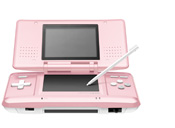
- Original Nintendo DS in Pink, open front three-quarter view with matching stylus; Japanese product-page finish: Nintendo official Japanese product/colour or launch-release image; complete supplied canvas, background and catalogue captions retained.
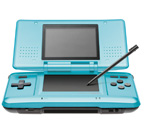
- Original Nintendo DS in Turquoise Blue, open front three-quarter view with matching stylus; Japanese product-page finish: Nintendo official Japanese product/colour or launch-release image; complete supplied canvas, background and catalogue captions retained.
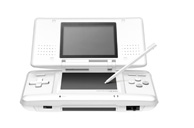
- Original Nintendo DS in Pure White, open front three-quarter view with matching stylus; Japanese product-page finish: Nintendo official Japanese product/colour or launch-release image; complete supplied canvas, background and catalogue captions retained.
- Original Nintendo DS in Graphite Black, open front three-quarter view with matching stylus; Japanese product-page finish: Nintendo official Japanese product/colour or launch-release image; complete supplied canvas, background and catalogue captions retained.